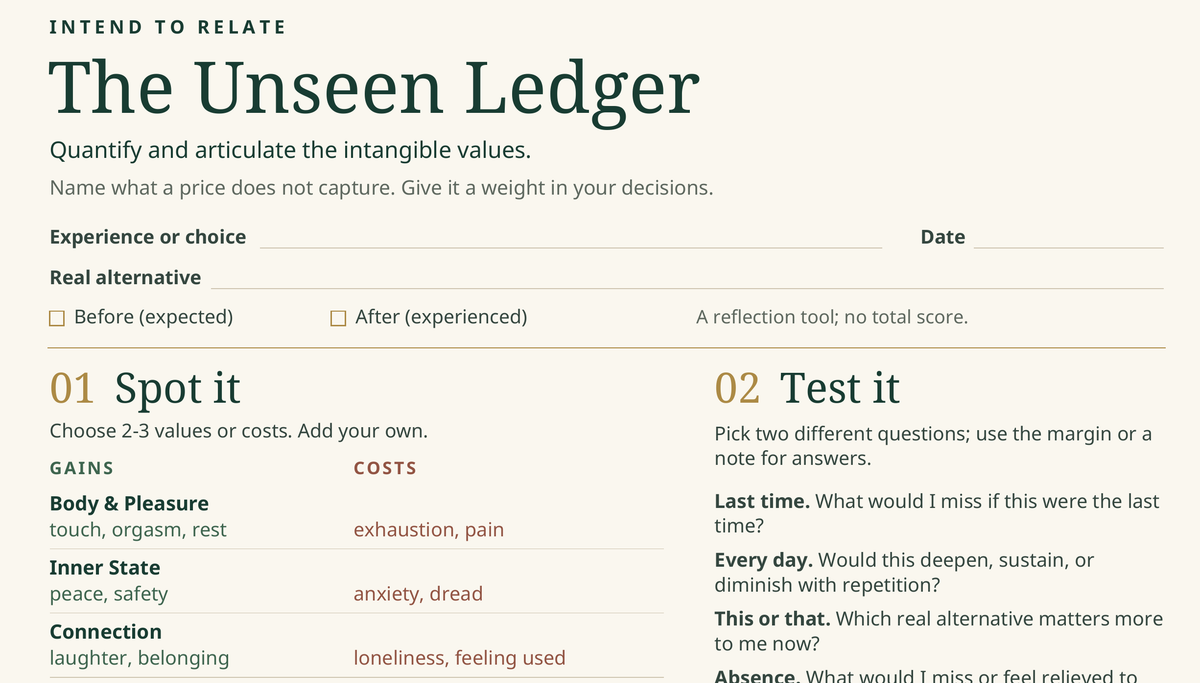
Quantify and articulate the intangible values
Intend to Relate | 17 November 2026 | Version 1.0
A companion to Volume One: To Him, Episode 1, and The Unseen Ledger.
Suppose you have a real choice between four hours with an old friend and an available job that would leave you $200 better off. You choose your friend.
Was it worth it?
“It was nice” gives us a start. But what was nice? You laughed harder than you had in months. You felt known. A conversation you had been avoiding finally became possible. Or perhaps you went out of habit, felt lonely in company, and came home wishing you had chosen differently.
The $200 is visible. Much of the rest needs language.
Episode 1 of To Him names a principle for this: Quantify and Articulate the Intangible Values. Name what an experience gives you and what it costs you. Give those things enough weight to influence your choices.
What intangible value means here
For this tool, intangible value means the significance, benefit, or cost of an experience, state, or relationship that a price does not adequately express.
A concert has a ticket price. What it means to hear that music with that person, at that moment in your life, is another question. A quiet evening can have value even when no money changes hands. So can a difficult conversation that preserves something you intend to honor.
Two related ideas help us be more precise. Economists use nonmarket valuation to consider benefits and costs without readily observed market prices. Philosophers ask whether something has intrinsic value: whether it matters for its own sake. These questions concern different aspects of value. Something may matter for what it makes possible, for itself, or for both. [1–3]
Peace may matter because you enjoy it and because it lets you think clearly. Reputation may matter because it opens doors and because it expresses a life you are proud to have lived. The Ledger leaves room to say why a particular value matters to you.
Where the principle sits
Intend to Relate approaches relational life through the natural, business, and divine worlds. In this exercise, we bring all three into view.
The natural world directs attention to the body, its pleasures, needs, capacities, and limits. The business world directs attention to exchange, agreements, coordination, and practical costs. The divine world directs attention to meaning, dignity, love, ideals, and what a relationship might become.
This principle speaks from the divine perspective: an intention to see and honor value that can disappear from an account built only around what is easy to price. The phrase divine capital belongs to that vocabulary. It gives us a way to speak about friendship, beauty, purpose, and other forms of significance. Each still requires its own description.
The invitation is available whether your understanding of the divine is religious or concerns what you regard as meaningful, good, beautiful, and worthy of care. [4]
Give it a weight
The principle asks us to do three things.
Articulate it. Be specific. “We laughed until I could hardly breathe” tells you something. So does “I spent the evening monitoring every word because I expected an argument.”
Quantify it. In this exercise, begin with a weight or comparison you can honestly defend. “More important to me than another evening of work.” “Worth doing once a month.” “A cost I am unwilling to repeat.” A ranking tells you what matters more without pretending to establish exactly how much more.
Count both directions. Pleasure, connection, and meaning belong in the account. So do dread, exhaustion, lost freedom, and time suffered. An experience can contain several of these at once.
The point is to make your judgment clearer. You can write “mixed” or “uncertain.” You can identify something you are unwilling to trade. You do not have to make every value interchangeable or calculate a total.
Compare the alternatives you actually have
Episode 1 introduces the base economic value of an hour as a cognitive tool. If a paid opportunity really is available, its earnings may give you a useful reference point. Your ordinary hourly rate does not establish that every evening away from work represents lost income. The limitations of using wages to value time are recognized in nonmarket valuation too. [2]
The useful question is: What am I actually giving up, and what makes this choice worth that trade to me?
Sometimes the alternative is paid work. Sometimes it is sleep, a promise, another friendship, or a quiet evening you badly want. Count the actual alternative, including what it would ask of you.
Then separate what you expected from what you experienced. Choosing the evening does not prove that it delivered the value you hoped for. A disappointing result does not, by itself, show that your original decision was unreasonable. Recording both gives you something to learn from.
A tool you can use
The Unseen Ledger turns the principle into three moves: Spot it. Test it. Weigh it. Begin with one experience, choice, or recurring arrangement. Name the real alternative. Mark whether you are considering it beforehand or reviewing it afterward.
1. Spot it
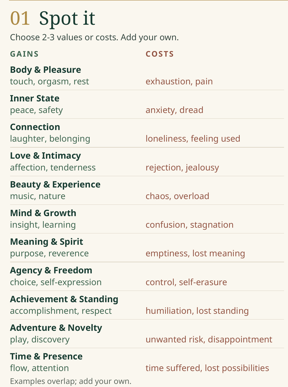
Choose two or three values or costs that seem present. The Ledger offers eleven domains as prompts: Body and Pleasure; Inner State; Connection; Love and Intimacy; Beauty and Experience; Mind and Growth; Meaning and Spirit; Agency and Freedom; Achievement and Standing; Adventure and Novelty; and Time and Presence.
These categories overlap. A shared meal can involve pleasure, affection, beauty, and belonging. Add your own language when it fits better. The prompts draw partly on William Frankena’s list of intrinsic goods, as discussed in the Stanford Encyclopedia of Philosophy; the arrangement and exercise are ours. [1]
2 .Test it
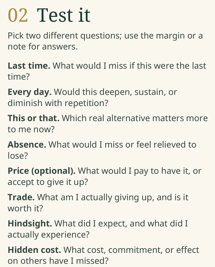
Choose two different questions. A second angle may reveal something your first answer missed.
· Last time: What would I miss if this were the last time?
· Every day: Would this deepen, sustain, or diminish with repetition?
· This or that: Which real alternative matters more to me now?
· Absence: What would I miss or feel relieved to lose?
· Price, optional: What would I pay to have it, or accept to give it up?
· Trade: What am I actually giving up, and is it worth it?
· Hindsight: What did I expect, and what did I actually experience?
· Hidden cost: What cost, commitment, or effect on others have I missed?
The Price question borrows from willingness-to-pay and willingness-to-accept approaches in economics. Use it when it clarifies something. What you could pay depends partly on your resources; an affordable amount cannot tell the whole story of how much you care. A nonmonetary comparison may serve you better. [2, 5]
The Every day question also deserves care. Familiarity may reduce excitement while increasing the value of reliability, trust, or a practice you want to sustain. Quietly dependable things belong in the account.
3. Weigh it
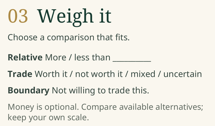
Choose the form that fits: more or less valuable than a named alternative; worth the trade or not worth it; mixed or uncertain; or a boundary you intend to keep.
Then write:
[Value or cost] matters [how much or compared with what], because [specific reason].
Finish with:
Next time I will choose, change, or discuss [one thing].
That last line gives the reflection somewhere to go. You might repeat a good choice, change its conditions, ask a question, honor a commitment, or stop doing something whose cost you had been refusing to name.
One evening in the Ledger
Return to the man choosing live music with an old friend over the available $200 job. Suppose the evening also costs him $40 in tickets and travel.
Spot it: friendship, music, laughter, and presence. Also money spent, foregone earnings, and a late night.
Last time: “I would miss the chance to be with him like this. We rarely get an evening together.”
Every day: “The cost and late nights would become too much. Occasionally, this is something I want to protect.”
Weigh it: “This evening of friendship and music mattered more to me than the available job and the $40 I spent, because we reconnected in a way I had been missing.”
Next time: “I will make room for another evening together and choose a time that leaves me less exhausted.”
Now suppose the music was poor and the friend distracted. The account may change. He can name the disappointment and ask whether a quieter setting would have served the friendship better.
He should also ask what else happened. Perhaps his friend was struggling, and being present mattered even though the evening was difficult. An unpleasant experience can still serve a commitment you freely intend to honor. The Ledger asks you to examine the whole choice.
Using it together
If two people use the Ledger, each can complete an account before comparing them. One may have valued the conversation; the other may have felt rushed. Those differences give you something specific to discuss.
Your assessment is yours. A shared choice requires the other person’s answer.
The hours or money you invested do not establish what the other person experienced or agreed to. Use the account to express what matters, make a request, and hear the response.
This connects with the project’s Relational Intelligence and Intentionality Feedback Loop: experience becomes understanding, understanding gains language, and that language informs choices you can revisit. The Values to Rules Worksheet can help carry an insight forward into a standard, request, or personal rule.
For now, choose one ordinary experience. Pick two questions. Write one honest line about its value and one about what you will do with that understanding.
What is one intangible value you want to recognize while it is still present?
Philosophical and educational commentary, not individualized legal, medical, or mental-health advice.
Be free, and be good to each other — intentionally.
Sources and further reading
1. Michael J. Zimmerman and Ben Bradley, “Intrinsic vs. Extrinsic Value,” Stanford Encyclopedia of Philosophy, revised June 2, 2025. Includes a discussion of William K. Frankena, Ethics, second edition (1973), pp. 87–88. The Ledger adapts the prompts through that discussion, rather than reproducing Frankena’s taxonomy.
2. Suzanne Bonner, Social Cost Benefit Analysis and Economic Evaluation, Chapter 12, “Non-Market Valuation Methods” (2022). Informs the discussion of absent market prices, monetary questions, and limits of wage-based comparisons.
3. Veronique Florec, Morteza Chalak, and Atakelty Hailu, “Integrating intangible values in economic analyses of flood mitigation”, Australian Journal of Emergency Management 32(4) (2017), 30–36. An example of considering intangible impacts in an economic analysis.
4. Intend to Relate, To Him, Episode 1 and American Samurai Posture, Version 1.0. The project sources for the principle, the three-world orientation, and divine capital.
5. National Research Council, Valuing Ecosystem Services: Toward Better Environmental Decision-Making, Chapter 2 (2005), particularly pp. 49–51. Explains how income constrains willingness to pay.
The Unseen Ledger is an Intend to Relate reflection tool. These sources inform its vocabulary and questions; they do not validate it as a psychological measure.
A free download of the Unseen Ledger PDF is below for members who are logged in. Membership is free and simply requires an email to sign up.