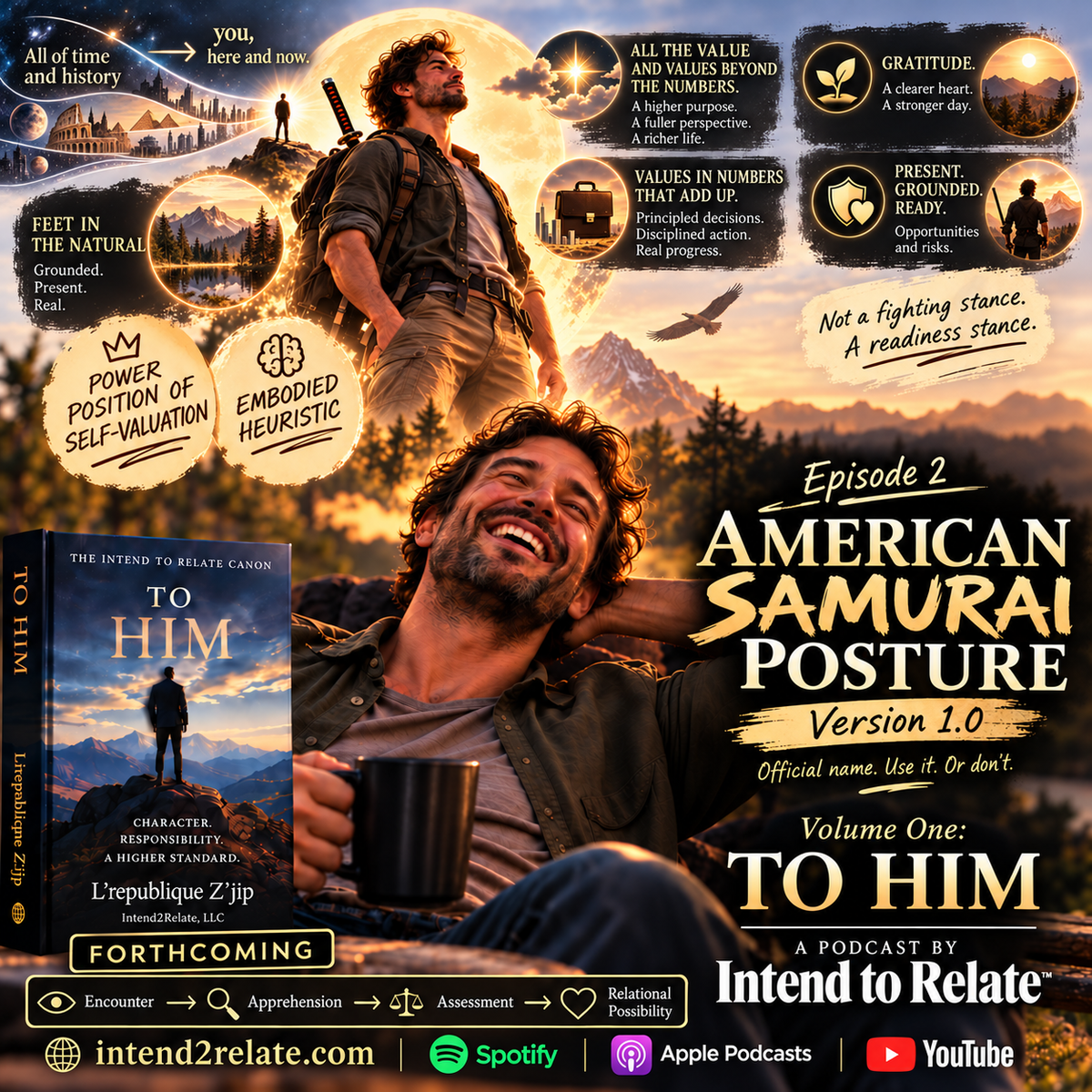
Volume One: To Him — Episode 2 | A podcast by Intend to Relate - What does the Power Position of Self-Valuation feel like when you leave the house?
Watch / Listen: Spotify / Youtube / Apple
In Episode One, “Heuristics of Confidence and the Default Rule of Assessment,” we began with somewhere to stand. Your time, attention, health, peace, pleasure, and participation have value. Recognizing that gives you a position from which to encounter other people, assess possibilities, and decide where your life goes next.
Episode Two asks us to carry that position into the body.
The name is American Samurai Posture, Version 1.0. The title comes with a grin and an invitation: take the tool, rename it, modify it, or throw it away. Its purpose is to make several parts of the framework available together—as posture, perception, orientation, and readiness.
From concept to embodiment
An embodied heuristic gives a cognitive position a felt expression. We begin with the image of someone standing comfortably, balanced and able to move. There is room to respond to what actually happens.
The episode draws on the image of a fighting stance because it makes readiness easy to picture. That readiness extends to defending yourself, declining an invitation, receiving something beautiful, becoming curious, loving someone, or walking away and continuing to have a perfectly good day.
The earlier heuristic of confidence also returns. Within that image, the immense history that preceded your existence becomes a sense of momentum behind you. You are here now, with some opportunity to decide where the movement goes next.
The invitation is to feel that position: grounded, upright, and present.
The three worlds in one posture
The episode brings the framework’s three worlds into a single bodily image:
The three worlds in one posture
The episode brings the framework’s three worlds into a single bodily image:
World | Place in the posture | What we keep in view |
|---|---|---|
Natural | Feet on the ground | Body, desire, power, danger, scarcity, mortality, and physical limits. |
Business or transactional | Body upright | Time, money, agreements, schedules, obligations, costs, and consequences. |
Divine | Heart, mind, and eyes oriented upward | Meaning, dignity, love, integrity, beauty, friendship, joy, and purpose. |
All three belong in the assessment.
We stand in nature, with its capacities and limitations. We face the practical circumstances of our lives honestly. We remain oriented toward what makes participation meaningful.
The divine world can be understood religiously if that is your framework. Here, it also names an orientation toward what is good, beautiful, meaningful, and difficult to price.
Integration matters because any one perspective can crowd out the others. Desire can obscure consequences. The pursuit of income can make valuable time appear wasted. An appeal to love or meaning can leave practical obligations unattended. The posture asks us to keep all three worlds available at once.
Seeing value before it disappears
From that position, look around.
The world contains friendship, opportunity, conversation, pleasure, beauty, silence, work, love, and people worth knowing. It also contains costs, risks, loss, and possibilities we may fail to recognize.
The base economic value of our time remains one useful reference point. At $50 an hour, four hours might represent $200 in foregone earnings if paid work was an available alternative.
Now imagine spending those four hours with a close friend. You laugh, reconnect, and feel alive. In the episode’s hypothetical, that friend dies the next day.
What were those hours worth?
The example brings us back to intangible value and what the framework calls divine capital. Quantification can help us notice what matters, while the experience’s significance exceeds the number we assign to it.
As the episode puts it:
The quantification is not the truth. It is a tool for making something visible that people often fail to see until it disappears.
The posture includes an intention to perceive value while we still have an opportunity to participate in it.
The same questions in a different register
Then another person enters the scene.
We move from encounter, through apprehension and assessment, toward possible connection. Attraction, hope, fear, memory, and imagination may already be shaping what we think we see.
The Default Rule of Assessment gives us a familiar structure:
Who the fuck are you?
What the fuck do you want?
What’s in it for me?
Its expression changes with the encounter.
In a threatening situation, the questions may take a protective form. In courtship, “Who are you?” can become curiosity about someone’s values, patterns, sense of humor, and becoming. “What do you want?” can become a conversation about the life they imagine and the relationships they hope to build.
“What’s in it for me?” asks what participation might mean in this actual encounter: its possibilities, costs, risks, and fit with what you value.
The structure remains available as its expression becomes more natural. We can ask better questions without mechanically reciting the same sentences to everyone.
And assessment can end with a decision to continue on our way.
Assessment does not obligate connection. It clarifies possibility.
Ready to connect
By the end of the episode, the pieces come together: self-valuation, confidence, the three worlds, scarcity, intangible value, and the assessment of an encounter.
You can stand in your own life, recognize a reason to say no, and remain available to a reason to say yes. You can notice someone worth knowing and become curious.
The episode also turns our attention inward. The wolf and the snake appear both outside and within; the loss of value can involve our own participation. That inquiry remains part of the work ahead.
For now, the practice is simple. The next time you leave the house, notice your feet, balance, breath, shoulders, and eyes. Feel the ground. Notice the value, risk, and opportunity around you. Bring the three worlds into the picture. If someone enters the scene, let assessment help clarify what may be possible.
My dudes, this one is for you. Everybody is welcome.
Key Ideas
- Give the framework a bodily expression. An embodied heuristic makes a cognitive orientation available as posture, attention, and readiness.
- Keep several responses available. Readiness includes defense, refusal, receptivity, curiosity, connection, and the freedom to leave.
- Integrate the three worlds. Ground yourself in nature, face practical obligations upright, and remain oriented toward meaning.
- Use the number to notice value. An economic reference point can sharpen an assessment while leaving room for what cannot be adequately priced.
- Let the encounter shape the expression. The assessment questions retain their structure across danger, friendship, business, courtship, and love.
- Allow connection to remain a possibility. An assessment can clarify a promising relationship, a poor fit, or a reason to keep walking.
- Keep the tool open to revision. Version 1.0 is an invitation to use, adapt, and examine the posture in your own experience.
Full Transcript
Prepared from the episode’s automatically generated transcript and lightly edited for punctuation, readability, and apparent transcription errors. Speaker labels have been removed; paragraph breaks, section headings, and navigation timestamps have been added.
00:00 — American Samurai Posture
Intend to Relate, Volume 1: To Him. Episode 2: American Samurai Posture, Version 1.0.
Welcome back to Volume 1: To Him, a podcast by Intend to Relate.
Alright, gentlemen, if you did not listen to Episode 1, this one builds directly on it. You can still listen to this without the first episode. I'm not going to arrest you.
But we're taking several of the concepts from Episode 1 and trying to integrate them now into something more embodied. And we have decided to give that embodiment an official name: American Samurai Posture, Version 1.0.
That is the official name. You have to use it or you can't use it. Those are the rules.
Obviously, I'm kidding. Take it, rename it, modify it, throw it away. That is the entire point of this framework.
These are tools, but I am going to call it American Samurai Posture, Version 1.0, because it makes me laugh. I remember it and it describes what I'm trying to show you surprisingly well.
So, let's build it from concept to embodiment.
In Episode 1, we introduced several pieces of the framework: the power position of self-valuation, heuristics of confidence, the base economic value as a cognitive tool, the idea that we should quantify and articulate the intangible values, scarcity, and the default rule of assessment.
Who the fuck are you? What the fuck do you want? What's in it for me?
That was a lot of cognition, a lot of concepts, a lot of language.
Now, I want to show you how I imagine some of those things working together in a body. Because I do not want this framework living only in your head as a collection of sentences. I want it to become increasingly available to you as posture, as orientation, as readiness, as perception, as something you can feel.
That's what I mean here by an embodied heuristic.
A heuristic of confidence gives you somewhere to stand cognitively. An embodied heuristic begins to teach your body what that standing feels like.
01:58 — Embodied Readiness
Why a fighting stance?
A little context for why this image makes sense to me. Over the years, I've spent time with yoga, Zen practice, martial training, neuroscience research, and other matters involving different ways with attention, posture, perception, nervous system state, and action.
And one thing those domains have in common is that thinking is not merely sentences happening inside your skull. Your body matters, your breath matters, your balance matters, your stance matters, your attention matters, your readiness matters.
So imagine: you know there may be a fight. Do you want to be standing with your feet perfectly lined up, your weight awkwardly distributed, leaning backward, surprised by everything? Probably not.
You want a stance that is relaxed but ready. One foot slightly forward, weight distributed intelligently, mobile, balanced, not tense, not looking for trouble, but able to move, able to defend, able to strike if absolutely necessary, able to leave.
That is important because the power position of self-valuation is not a fighting stance. It is a readiness stance: ready to defend, ready to decline, ready to move, ready to receive, ready to assess, ready to love, ready to walk away, ready to just keep walking down the road and have a perfectly good day.
That is American Samurai Posture, Version 1.0: the power position in the body.
In Episode 1, we said that a man moving intentionally through the world needs somewhere to stand: a vantage point, a power position of self-valuation.
We also offered a heuristic of confidence. All of time, all of history, all of prehistory, biology, evolution, ancestry, chance, divine intelligence, if that's how you understand it—all of that comes forward, and now you are here.
I said that within the heuristic, I experienced momentum in that.
Not merely, “Oh, I exist.” I mean, there is an immense movement behind me, and somehow I am downstream from it.
03:57 — Three Worlds Embodied
So now take that cognitive image and put it into the body. You have your stance. You are upright. You are relaxed. You are ready. And behind you is all that momentum.
You are not manufacturing your existence from scratch this morning. You arrived carrying billions of years of prior motion.
Now you are here and you can decide where some of that motion goes next.
That is part of the embodiment.
The three worlds in the body
Now I want to layer another part of the framework into the posture.
We talk about three worlds: the natural world, the business or transactional world, and the divine world.
Here is one way to embody them.
Feet in the natural world
Start at the ground: your feet, nature, scarcity, body, sex, danger, hunger, mortality, physics.
You cannot negotiate gravity. You cannot lawyer your way out of needing sleep forever. You cannot affirm your way into unlimited time.
Nature is limitation. Nature is also power.
Your feet are grounded there. You are an animal—a sophisticated one, but still an animal—and that is fine.
So we do not deny the natural world. We stand in it.
Body upright in the business world
Move upward. Now we are in the world of exchange. Time, money, schedules, obligations, agreements, trade-offs, costs, consequences.
This is where the numbers have to add up. Bills get paid, time gets allocated, promises matter. People show up or they do not.
You make $50 an hour, fine. $500, fine. Zero right now, fine. Debt, fine.
That is information.
We do not lie about it. We do not hide from it. We do not confuse it with our existential worth.
But we respect reality.
Our body stands upright in the business world, not hunched beneath it, not pretending it is not there. Upright.
Heart, mind, and eyes toward the divine
Then move higher.
Heart, mind, eyes. Meaning, dignity, love, integrity, gratitude, truth, beauty, friendship, joy, purpose. All the things that become absurd if you try to reduce them completely to a spreadsheet.
That is where we look toward the divine world, not necessarily religion. You can make it religious if that is your framework.
But here I mean the orientation toward that which is higher, meaningful, good, beautiful, honest, and difficult to price.
So now look at the posture.
Feet grounded in nature, body upright in reality, heart and mind oriented toward the divine.
That is American Samurai Posture, Version 1.0.
06:23 — Value and Integration
I actually want you to feel that. Not memorize it—feel it.
Surrounded by value
Now look around.
You are not merely standing in scarcity. You are standing in a world of value.
There is value everywhere, seen and unseen, tangible and intangible.
Money, health, people, friendship, sex, love, time, knowledge, opportunity, beauty, silence, peace, work, adventure, a conversation, a stranger, a job lead, a beautiful woman, a person you almost walked past, a friend you have not called in six months.
All of these may contain value. They may also contain costs, risk, loss, disappointment, trauma, missed opportunity. That is why valuation matters.
If you operate only from the natural world, you can make decisions with your dick and call it destiny. That creates problems.
If you operate only from the business world, you can decide that every hour not monetized is wasted. That creates different problems.
And if you operate only from the divine world, pretending bills, risk, biology, timing, and logistics do not exist, that creates problems too.
We are trying to integrate all three: grounded, realistic, oriented upward.
The base economic unit is not the point
This is where the dollar-per-hour tool comes back in.
If you make $50 an hour, that gives you a base economic unit. Four hours might equal $200 of opportunity cost. Fine, that is a cognitive tool.
But now imagine those four hours were spent with one of your best friends. You laugh, you reconnect, you feel alive, and the next day that friend dies.
How much were those four hours worth?
Now we are getting closer to what I mean by intangible value or divine capital.
Not because we can actually put the correct price on it. We cannot.
The quantification is not the truth. It is a tool for making something visible that people often fail to see until it disappears.
That is the broader posture. See value, see scarcity, see cost, see meaning, see possibility.
08:25 — Assessment Rule Applied
From encounter to apprehension
Now somebody enters the scene. This is where Episode 1's default rule of assessment comes back.
We have described the sequence as encounter, then apprehension, then assessment, then perhaps relational possibility.
You encounter a person. Now your nervous system, your mind, your prior experience, and your imagination all begin apprehending something.
Who is this? What is happening? What might this mean?
This is where projection can start. Fantasy can start, fear can start, hope can start, attraction can start.
That does not mean any of those things are wrong. It means assessment has begun.
The default rule changes register
So now: “Who the fuck are you?” “What the fuck do you want?” “What’s in it for me?”
We intentionally made that rule crude because it is easy to remember.
And because at the ground level, if some motherfucker walks up on you aggressively from eight feet away, “Who the fuck are you?” may actually be the relevant register.
But now imagine you see a woman you know.
“Who the fuck are you?”
Well, you already know who she is to some extent.
Now the question becomes: Who are you beyond what I already know?
What do you value? What are you building? What are your patterns? What makes you laugh? What do you believe? What are you trying to become?
Same question, different register.
Then: “What the fuck do you want?”
Again, maybe that sounds aggressive in one context.
But in another: “What do you value in relationships?” “What kind of life are you imagining?”
“Are you down to take this kink test and attachment style quiz with me?”
Or: “I noticed you said you wanted one thing, but then you did something completely opposite.”
Same rule, different expression.
And then: “What’s in it for me?”
Maybe I see a flake or a danger. Maybe I see the mother of my children. Maybe I see nothing beyond just another person.
That is okay.
Assessment does not obligate connection. It clarifies possibility.
The rule is invariant. The expression changes.
So I want to make a distinction here.
The default rule is invariant. Its expression changes with the encounter.
Danger has one register, curiosity another, courtship another, friendship another, business another, love another.
The cognitive structure remains.
Who are you? What do you want? What is here for me?
And as you become more practiced, you should not have to mechanically repeat those sentences every 30 seconds.
The point is for the structure to become increasingly natural, embodied, available, ready to fight and love.
10:56 — Integrated Posture
Now put everything together.
You are standing upright, grounded in nature, aware of scarcity, operating honestly in the business world, oriented toward meaning in the divine world.
You feel the momentum of everything that came before you. You understand that you are surrounded by value, risk, loss, and opportunity.
You do not need another person to affirm your worth before you can stand there. You do not need to puff yourself up. You do not need to dominate anyone.
You are simply there. Present.
And if life requires you to defend yourself, you are ready. If life requires you to say no, you are ready.
If life gives you something beautiful, you are ready to receive it.
If you see somebody worth knowing, you are ready to become curious.
If opportunity for connection appears, you are not so defended that you cannot recognize it.
That is the posture.
Ready to fight and ready to connect as may be right for you. Preferably much more of the second.
The wolf and the snake inside
There is another reason we need this embodiment.
We talk a lot in this framework about the wolf and the snake. And we already know that we are dealing with them both outside and within.
Without getting ahead of the material and process here, the wolf and the snake can take value in ways other than outright theft or fraud and in conspiracy with ourselves.
That is why perception matters.
The hardest values to see may be the most important ones.
We are just getting started thinking about value.
The practice
So here is the practice for this episode.
The next time you leave the house, just notice your body.
Feet, balance, breath, shoulders, eyes.
Feel the ground. Remember what came before you.
Notice what is around you.
Notice value. Notice risk. Notice opportunity.
Feel the position of being ready.
Then imagine the three worlds.
Feet in the natural, body upright in the business, heart and mind toward the divine.
And if another person enters the scene: Who are you? What do you want? What's in it for me?
Not as aggression. As presence, as discernment, as assessment, as readiness for relational possibility.
That is your practice. American Samurai Posture, Version 1.0.
This is Volume 1: To Him, a podcast by Intend to Relate.
Until next time, be free and be good to each other, intentionally.
Related Concepts
The Power Position of Self-Valuation; embodied heuristics; the natural, business, and divine worlds; scarcity; intangible value and divine capital; encounter, apprehension, and assessment; relational possibility; the wolf and the snake outside and within.
For the foundations of this episode, read Episode One: Heuristics of Confidence and the Default Rule of Assessment.
Join the Conversation
Which of the three worlds is easiest for you to lose sight of when you encounter someone—and how might bringing it back change your assessment?
About To Him
To Him is the podcast accompanying the development of the forthcoming first volume of the Intend to Relate canon. It speaks directly to men and welcomes everyone interested in the inquiry. Explore Volume One: To Him.
Intend to Relate develops a philosophy and toolkit for approaching relationships intentionally: understanding ourselves, articulating aims, encountering other people’s intentions, and giving participation a more deliberate form.
Become a free member, sign up for updates, and get Relationship Agreements and Conflicting Understandings: A Primer from the member Library. Two complete stories with short analysis. No paid subscription required.
Content note: Explicit language and frank discussion of adult relationships. Philosophical and educational commentary, not individualized legal, medical, or mental-health advice. Relationship agreements do not replace ongoing consent.
Published by Intend2Relate, LLC.
Intention today. Awareness tomorrow. Freedom forever.
Be free, and be good to each other - intentionally.