The Intend to Relate Podcast | Season One, Episode Twelve
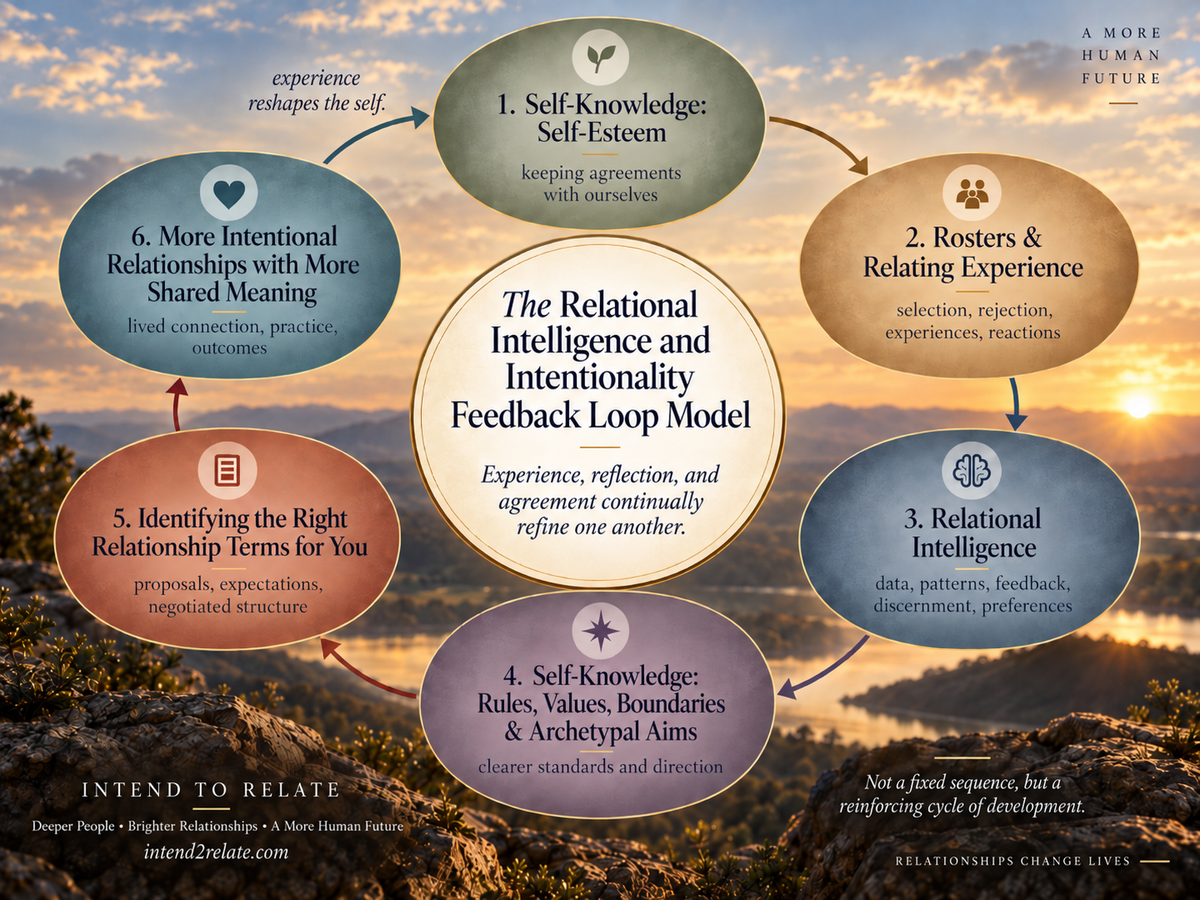
The Relational Intelligence and Intentionality Feedback Loop Model
Learn Yourself. Express Yourself. Build Together. Learn Again.
The relationship you build with yourself travels into the relationships you build with others.
Season One, Episode Twelve brings together the Relational Intelligence and Intentionality Feedback Loop Model, the tools that help put it to work, and an example involving Daniel and Maya: two people who like each other but have not agreed on Friday.
The movement is from experience to understanding, from understanding to language, from language to shared choices, and from living those choices back into self-knowledge. You do not have to finish yourself before you begin.
The Six-Part Feedback Loop
1. Self-Knowledge: Self-Esteem
It begins with your own word. Choose commitments you honestly mean to keep. Practice keeping them. When you fall short, acknowledge it, repair what you can, and revise deliberately.
That can give you reasons to trust yourself. Not because your worth depends on perfection, but because your word begins to mean something to you. Relating can become less about proving your worth and more about discovering what fits.
2. Rosters and Relating Experience
Explore, play, select, decline, and be declined. Your roster helps direct your attention toward the relationships you actually seek in the season you are living.
The aim is not a supposedly perfect person for every purpose. Move toward your MVP for a particular aim, remembering that the other person still gets to choose. When an aim is fulfilled, the work may shift from selection to sustaining what you have chosen.
3. Relational Intelligence
Every encounter offers material: feelings, reactions, preferences, patterns, and feedback. Experience alone is not wisdom. Repeating a pattern is not the same as learning from it.
Ask what happened, what you felt, what you assumed, and what remains to be understood. Develop discernment without making deception your method. The ethical direction remains powerful authenticity and radical honesty.
4. Self-Knowledge: Rules, Values, Boundaries, and Archetypal Aims
Turn raw relational data into articulated statements. What do you value? What do you want and need? What rules are you willing to live by? Where are your boundaries? What kind of relationship are you actually seeking?
Perhaps you discover: "I enjoy spontaneity, but I need dependable plans." Or: "I want a lover, but I am not seeking a spouse." Or: "I can offer affection and consistency, but not constant availability."
Now your self-knowledge has language.
5. Identifying the Right Relationship Terms for You
That language becomes something you can work with: terms to offer, requests to make, and proposals to accept, revise, or decline. The other person has the same freedom.
Your intention is not yet a shared agreement. An invitation is not an entitlement. Speak it, discuss it, and write it when that helps. What matters is that both people understand what they are choosing.
6. More Intentional Relationships with More Shared Meaning
Then live what you have chosen. Honor commitments, hold boundaries, ask questions, and address changes. Negotiate rather than silently suffering, fighting to impose your wishes, or fleeing every difficult conversation.
Negotiation does not mean surrendering your boundaries. An intentional ending may be right when a relationship is harmful or no longer fits.
An ending can break the heart without breaking the agreement.
Living with integrity can give you further reasons to trust yourself. Experience returns to self-knowledge and self-esteem, and the loop begins again. Not because you failed to finish yourself, but because living keeps teaching you.
How the Tools Work Together
We are not simply handing you a relationship agreement to fill in. The agreements grow out of self-knowledge, self-esteem, discernment, selection, and expression.
My Future Self-Agreement gives you a place to work with what you know and discover what remains unclear: your values, wants, needs, boundaries, and the person you are becoming.
The Roster Model connects the individual, the archetypal aim, the roster, and the season. The Phenomenology of Relating helps you distinguish an encounter from your interpretation, possibility from availability, and your intention from a shared agreement.
The Values to Rules Worksheet gives understanding usable language. What do you value? What standard follows? What will you communicate? What would trigger action, and what will you do? A value can become an offer, a request, and a personal rule without becoming an accusation or an agreement that the other person has never made.
An Assention conversation tool can support discovery. An Assention relationship agreement can give shared choices and aspirations a form to revisit. What can you honestly offer? What would you like to request? What are you prepared to accept? What should remain free? Mutual assent, not one person's certainty, makes the choice shared.
The Relationship Journal supports the conversation between agreements: a continuing, co-authored place for dreams, appreciation, questions, concerns, and proposed changes. An entry can begin a conversation; it does not automatically amend an agreement.
The Ending Addendum brings completion into the conversation before a crisis. How can you part with clarity and honor, rather than treating permanence as the only meaningful outcome?
The larger purpose is greater relational intelligence and freedom while remaining a good person. Serpent wisdom, never serpent methods.
Daniel and Maya: They Had Not Agreed on Friday
Maya says, "Maybe Friday?" Daniel replies, "Sounds good." He keeps the evening open. She thinks they are discussing a possibility.
On Friday afternoon, Maya says she cannot make it. Daniel is disappointed. His first thought is: "I guess I'm not a priority."
But he pauses and looks at their messages. They had said maybe. Neither had confirmed a time.
His disappointment is real. It does not turn a possibility into a promise.
From disappointment to a clear request
Daniel wants an ongoing romantic connection with time deliberately made for each other. He also values his work, friendships, and existing commitments. He enjoys spontaneity; he does not enjoy leaving his life on hold.
The question is not simply whether Maya likes him. It is whether their aims and availability fit, and whether he wants to keep investing. Maya gets to ask those questions too.
He uses the Values to Rules Worksheet:
I value dependable time together.
I can offer an evening most weeks.
Would you like to choose one in advance?
Until we confirm, I'll make my own plans.
A value, an offer, a request, and a personal rule. Not an accusation. Not yet a shared agreement.
From a proposal to a shared choice
Daniel does not recite the worksheet. He uses it to get clear, then speaks in his own words. He likes spending time with Maya and would like them to choose some time deliberately. Would that work for her?
Maya would like that too, but her work schedule comes out on Thursday. She cannot promise every Friday evening. Could they check by Friday noon and choose a time for the following week, while keeping spontaneous invitations welcome?
Daniel listens. Dependability does not have to mean the same evening every week. Spontaneity does not have to mean permanent availability.
They put their understanding into a short message. For three weeks, they will check schedules by Friday noon, confirm a day and time when one works, or say when nothing fits. If a confirmed plan needs to change, they will give notice as soon as they know. Unconfirmed time remains their own. Spontaneous invitations are welcome, with no expectation of acceptance. Then they will review.
Both confirm that this is what they are agreeing to. They have agreed how to make plans, not silently promised exclusivity, permanence, or an entire future.
They did not negotiate the attraction. They negotiated how to make room for it.
Living it teaches them more
They enjoy the time they have made for each other. Then an unexpected work shift disrupts a confirmed evening. Maya tells Daniel promptly and suggests Sunday. Daniel already has a commitment, so they agree on Tuesday at seven instead.
He does not abandon an existing promise to prove his interest. She does not pretend her schedule never changes. They address the disappointment and choose another time together.
At their three-week review, Daniel writes in their Relationship Journal:
I don't need the same night every week. I need us to be clear about what we've actually chosen.
Maya writes:
I enjoy planning time together when there's room to discuss changes honestly.
Those are reflections, not automatic amendments. They discuss them and both choose to continue the arrangement.
Daniel has learned more about what he needs. Maya has learned more about what she can offer. Both have better grounds for deciding whether to deepen the relationship, and further reasons to trust themselves because of how they participated.
A clear no would also have been useful. The aim was clarity, not agreement at any cost.
Learn Again
An experience became understanding. Understanding became language. Language became an invitation. Two people chose what to build. Living it taught them more.
Know yourself. Express honestly. Choose together. Live what you choose. Learn again.
Do you intend to relate?
Show Notes & Chapters
Chapter start times follow the supplied episode chapter file; titles have been expanded for navigation.
00:00 The Relational Intelligence and Intentionality Loop
04:25 Putting the Intend2Relate Tools to Work
08:33 Daniel and Maya: When Maybe Is Not a Promise
10:02 Negotiating a Shared Agreement
11:30 Living, Reviewing, and Learning from the Agreement
Full Transcript
Transcript note: Prepared from the supplied automatic transcript, with speaker labels removed and paragraph breaks and timestamped headings added. Three tool/publication references at 06:44, 06:47, and 08:28 have been normalized from 'Ascension' to the project's spelling, 'Assention.' The ambiguous 'ascension' at 04:13 remains unchanged. These are editorial spelling normalizations, not audio-verified corrections; all other supplied wording is preserved.
00:00 | An Invitation to the Listener
You're listening to The Intend2Relate Podcast, published by Intend2Relate LLC. Intend2Relate is interested in expanding human freedom and creativity in relationships.
We would like to enter into a non-exclusive podcast listener relationship involving a short-term limited power exchange dynamic, where you consent to considering some ideas as we present them, while retaining your judgment and critical thinking. We do not seek a deed to your mind in this relationship.
We ask for your assent to go on a journey with us into some ideas and tools regarding relationships. If you assent, let's intend to relate.
00:38 | The Loop Begins with Your Own Word
The relationship you build with yourself travels into the relationships you build with others. So before asking who you want beside you, ask, do you intend to relate? At Intend2Relate, we call this the relational intelligence and intentionality feedback loop model.
It begins with your own word. Choose commitments you honestly mean to keep. Practice keeping them. When you fall short, acknowledge it, repair what you can, and revise deliberately.
You are learning who you are and giving yourself reasons to trust yourself. That can strengthen self-knowledge and self-esteem. Not because your worth depends on perfection, but because your word begins to mean something to you.
From there, relating can become less about proving your worth, and more about discovering what fits.
01:24 | Rosters and Relating Experience
You can enjoy your rosters and the relating experience. Explore, play, select, decline, be declined. Your roster helps you direct your attention toward the relationships you actually seek in the season you are living.
01:39 | Experience, Reflection, and Discernment
Every encounter offers material, feelings, reactions, preferences, patterns, and feedback. But experience alone is not wisdom. Repeating a pattern is not the same as learning from it.
Ask what happened, what you felt, what you assumed, and what you still need to understand. That work can develop emotional intelligence and the broader intelligence of relating.
Be discerning without becoming deceptive. Be wise to manipulation without making manipulation your method. Choose powerful authenticity and radical honesty.
02:12 | Giving Self-Knowledge Language
Then comes the crucial movement. Turn raw relational data into articulated statements.
What do I value? What do I want and need? What rules am I willing to live by? Where are my boundaries? What are my authentic archetypal aims? What kind of relationship am I actually seeking?
Perhaps you discover, I enjoy spontaneity, but I need dependable plans. Or I want a lover, but I am not seeking a spouse. Or I can offer affection and consistency, but not constant availability.
02:41 | Terms, Requests, and Shared Choices
Now your self-knowledge has language, and language gives you something to work with. Terms you can offer, requests you can make, and proposals you can accept, revise, or decline.
The other person gets to do the same. Your intention is not yet a shared agreement. An invitation is not an entitlement. You are discovering whether your choices can meet.
Speak it, discuss it, write it when that helps. What matters is that both of you understand what you are choosing.
With self-esteem and relational intelligence, you can practice saying what you want, asking for it, and hearing an honest answer. That opens the possibility of more intentional relationships with greater shared meaning.
03:22 | Living What You Have Chosen
Then live what you have chosen. Honor your commitments, hold your boundaries, ask questions, address changes, negotiate rather than silently suffering, fighting to impose your wishes or fleeing every difficult conversation.
Negotiation does not mean surrendering your boundaries. And when a relationship is harmful or no longer fits, an intentional ending may be the right choice.
An ending can break the heart without breaking the agreement.
03:51 | Returning to Self-Knowledge and Self-Esteem
Living with that integrity can give you further reasons to trust yourself. You learn more about your capacities, your limits, your desires, and the person you are becoming.
The experience returns to self-knowledge and self-esteem. The loop begins again, not because you failed to finish yourself, but because living keeps teaching you.
This is a framework to use, not a system you must follow. Learn yourself, express yourself, build together, learn again, ascension, and self-esteem.
04:25 | Putting the Tools to Work: My Future Self-Agreement
In the previous video, we introduced the relational intelligence and intentionality feedback loop model. Now, how does Intend2Relate help you put it to work?
We are not simply handing you a relationship agreement to fill in. Our agreements grow out of self-knowledge, self-esteem, discernment, selection, and expression. Our tools help you connect those capacities.
Start with my future self-agreement. It gives you a place to work with what you already know and discover what remains unclear, your values, wants, needs, boundaries, and the person you are becoming.
Pay attention, experiment, reflect, keep your word to yourself or acknowledge when you have not. Our approach builds upon self-knowledge and self-esteem and invites you to grow both. You do not need to finish yourself before you begin.
05:14 | The Roster Model and the Phenomenology of Relating
The roster model puts that developing knowledge into practice by connecting the individual, the archetypal aim, the roster, and the season. What relationships do you actually want? Whom do you value for those aims? Where will you invest your time, attention, and care?
Enjoy the relating experience. Explore, play, select, decline, deepen, re-evaluate, disinvest. Self-esteem helps you make those choices without treating every rejection as a verdict on your worth.
Move toward your MVP for a particular aim, not a supposedly perfect person for every purpose. That person still gets to choose too.
When an aim is fulfilled, the work may shift from selection to sustaining what you have chosen.
The phenomenology of relating helps you understand what happens along the way.
An encounter is not the same as your interpretation of it. Possibility is not availability. Your intention is not our agreement.
These distinctions give you questions to ask before turning an assumption into a conclusion.
06:14 | Values to Rules, Conversation Tools, and Assentions
Then the values to rules worksheet helps you give your understanding usable language.
What do you value? What standard follows? What will you communicate? What would trigger action? And what will you do?
For example, I value dependable plans. I can offer one evening a week. Would you like to choose a day in advance? Until we confirm, I will make my own plans.
A value, an offer, a request, and a personal rule, not an accusation, not yet a shared agreement.
An Assention conversation tool can support discovery. An Assention relationship agreement can give your shared choices and aspirations a form you can revisit.
What can you honestly offer? What would you like to request? What are you prepared to accept? What should remain free?
The other person gets to answer too. You can consider a counterproposal or accept a no. Mutual assent, not one person's certainty, makes the choice shared.
07:10 | The Relationship Journal and the Ending Addendum
The Relationship Journal supports the conversation between agreements. It is a continuing co-authored place for dreams, appreciation, questions, concerns, and proposed changes. Both people have a voice and considered reflection has a place to live.
An entry can begin a conversation. It does not automatically amend an agreement.
The ending addendum brings completion into the conversation before a crisis. It asks how you can part with clarity and honor rather than treating permanence as the only meaningful outcome.
07:43 | Integrity, Freedom, and the Continuing Loop
All of this serves a larger purpose, greater relational intelligence and greater freedom while remaining a good person. You can pursue your interests, evaluate relationships, negotiate openly, and protect your boundaries without deceiving or coercing anyone.
Serpent wisdom, never serpent methods, radical honesty, powerful authenticity.
Then live what you have chosen. Honor your commitments, hold your boundaries. Address changes, negotiate, revise, or complete.
Practicing that integrity can strengthen self-trust and self-esteem. Experience returns to self-knowledge and the loop continues.
That is how the tools belong together, not a system you must obey, a framework you can use. Know yourself, choose deliberately, express honestly, build together.
Assention, forthcoming from Intend2Relate, more to come. Stay tuned.
08:33 | Daniel and Maya: When Maybe Is Not a Promise
They liked each other. They just hadn't agreed on Friday.
Meet Daniel and Maya. They enjoy each other's company. There is attraction, easy laughter, and a reason to meet again.
Maya says, maybe Friday? Daniel replies, sounds good. He keeps the evening open. She thinks they are discussing a possibility.
On Friday afternoon, she says she cannot make it. Daniel is disappointed. His first thought is, I guess I'm not a priority.
But he pauses. What happened? What did he assume? What does he actually want?
He looks at their messages. They had said maybe. Neither had confirmed a time.
His disappointment is real. It does not turn a possibility into a promise.
09:14 | From Self-Knowledge to a Personal Rule
Daniel already knows something about himself. He wants an ongoing romantic connection with time deliberately made for each other. He also values his work, friendships, and existing commitments.
He enjoys spontaneity. He does not enjoy leaving his life on hold.
The question is not simply whether Maya likes him. It is whether their aims and availability fit, and whether he wants to keep investing in this connection. Maya gets to ask those questions too.
He uses the values to rules worksheet to give his understanding language.
I value dependable time together. I can offer an evening most weeks. Would you like to choose one in advance? Until we confirm, I'll make my own plans.
A value, an offer, a request, a personal rule. Not an accusation, not yet a shared agreement.
10:02 | Negotiating a Shared Agreement
He doesn't recite the worksheet. He uses it to get clear about what he means, then speaks in his own words.
I like spending time with you. I realized I was holding Friday open when we hadn't made a plan. I'd like us to choose some time deliberately. Would that work for you?
Maya answers, I'd like that too. But my work schedule comes out on Thursday. I can't promise every Friday evening. Could we check by Friday noon and choose a time for the following week? I'd still like spontaneous invitations to be welcome.
Daniel listens. Dependability does not have to mean the same evening every week. Spontaneity does not have to mean permanent availability.
Yes, he says, let's try that. If no evening fits, let's say so rather than leave each other guessing.
Together, they put their understanding into a short message.
For three weeks, they will check schedules by Friday noon. They will confirm a day and time when one works, or say when nothing fits.
If a confirmed plan needs to change, they will give notice as soon as they know.
Unconfirmed time remains their own. Spontaneous invitations are welcome, with no expectation of acceptance.
Then they will review the arrangement.
Maya confirms, yes, that's what I'm agreeing to. Daniel replies, me too.
They have agreed how to make plans. They have not silently promised exclusivity, permanence, or an entire future.
They did not negotiate the attraction. They negotiated how to make room for it.
11:30 | Living the Agreement
Then comes the part no worksheet can do for them. They live it.
One evening is dinner. Another is a walk by the water that lasts longer than either expected. They're enjoying the time they've made for each other.
Then an unexpected work shift disrupts a confirmed evening.
Maya tells Daniel promptly, My shift changed. I'm sorry, I can't make tonight. Would Sunday work?
Daniel already has a commitment.
I was looking forward to tonight. Sunday won't work for me. How about Tuesday?
Tuesday at 7? 7. Looking forward to it.
He does not abandon an existing promise to prove his interest. She does not pretend her schedule never changes. They address the disappointment and choose another time together.
12:15 | Review, Self-Trust, and Learning Again
At their three-week review, they each add a short entry to their relationship journal.
Daniel writes, I don't need the same night every week. I need us to be clear about what we've actually chosen.
Maya writes, I enjoy planning time together when there's room to discuss changes honestly.
Those entries are reflections, not automatic amendments. They discuss them and both choose to continue the arrangement.
Daniel has learned more about what he needs. Maya has learned more about what she can offer. Both have better grounds for deciding whether to deepen the relationship.
And Daniel has further reasons to trust himself. He expressed what he wanted, listened to an answer, and kept his other commitments.
Maya has further reasons to trust herself too. She stated her availability honestly, asked for the flexibility she needed, and communicated promptly when her schedule changed.
That is the return to self-knowledge and self-esteem. Not simply being chosen, but acting in ways you can respect and learning from what you live.
A clear no would also have been useful. The aim was clarity, not agreement at any cost.
An experience became understanding. Understanding became language. Language became an invitation. Two people chose what to build. Living it taught them more.
Know yourself, express honestly, choose together, live what you choose. Learn again. Do you intend to relate?
13:41 | Closing the Listener Relationship
You've been listening to the Intend2Relate Podcast, published by Intend2Relate, LLC.
Our short-term podcast listener relationship is now complete.
You retain your judgment, your critical thinking, and your freedom to accept, reject, revise, or carry forward any idea we have explored together.
We do not ask you to surrender your mind to us.
We hope only that something here has helped you see yourself, another person, or a relationship with greater clarity and possibility.
Thank you for going on this journey with us.
Until next time, be free and be good to each other intentionally.
Related Concepts
Self-knowledge and self-esteem; rosters, archetypal aims, and seasons; relational intelligence; the Phenomenology of Relating; values, rules, and boundaries; offers and requests; mutual assent; Assentions; the Relationship Journal; intentional endings; powerful authenticity.
Join the Conversation
What has a recent relating experience taught you, and what clear request, offer, or personal rule could grow from that understanding?
About Intend to Relate
Intend to Relate is interested in expanding human freedom and creativity in relationships. These ideas and tools are offered for consideration while you retain your judgment, critical thinking, and freedom to accept, reject, revise, or carry forward what you find here.
Published by Intend2Relate, LLC.
Be free and be good to each other - intentionally.
Member discussion: