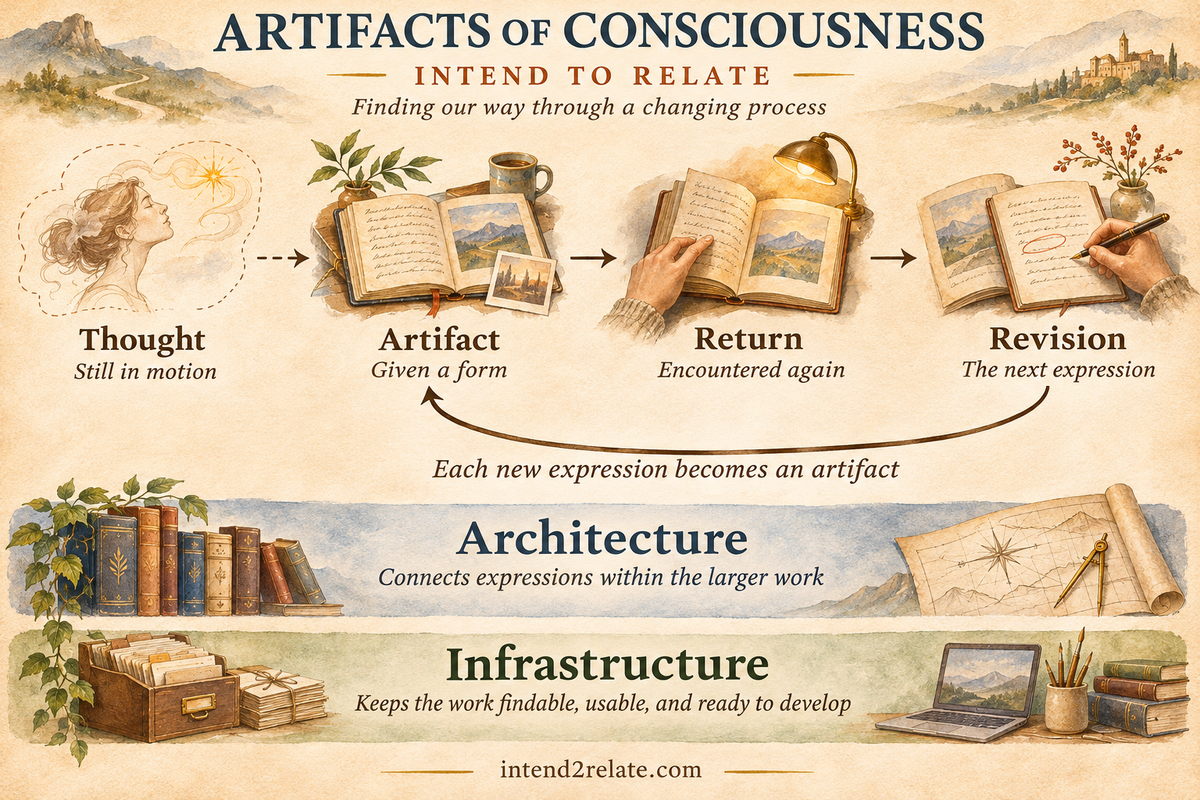
How Intend to Relate takes shape and finds its way through change. Version 1.0.
There was an architecture and an infrastructure plan, as well as fragments of thought and other artifacts of consciousness. There were objectives we wanted the work to advance. There were tracks to lay for things that would come later.
Then the decision to proceed with an unplanned Season 1 of Volume 8: to America interrupted the sequence.
Among the fragments was this thought: Artifacts of consciousness help us find our way as we move through dynamic processes.
The note was already doing what it described. It gave us something to return to. A thought that had been hard to hold together now had a place outside the immediate movement of thought.
That makes it a good place to begin with three ideas that run through Intend to Relate: architecture, infrastructure, and artifacts of consciousness. Architecture is how the work is arranged. Infrastructure is what lets it keep being expressed.
Artifacts are how we find our way while both are changing.
The plan and the interruption
Intend to Relate began with purposes that needed a lot of groundwork before they could take a useful public form: expanding freedom and creativity in relationships, helping people say what they intend, and developing ways to pursue those intentions with respect for other people’s agency. The purposes grow from there.
Those purposes have practical demands. A difficult distinction needs language, examples, and a chance to try it out. An agreement needs questions worth asking. A framework needs room for disagreement and revision. So we laid tracks: a structure for the canon, concepts and maps, instruments, stories, and the means to develop and publish them. Some of that work is useful right away. Some of it only builds capacity for what comes later.
Volume 8, To America, was part of that long-term plan – however, a Season One on the issue of racism was not whatsoever. The circumstances and what unfolded is discussed separately at length already.
The interruption produced a correction. Looking back at the season, we could see that its opening language aimed contempt at people when we meant to challenge their claims. We come back to that below, because it turned out to be the clearest example of what this article is about.
There was a real cost. Time and attention moved away from other planned work, and the sequence we had in mind changed. What remains open is narrower than it first felt: where the planned work picks up again, and how the detour connects to it.
That leads to a practical question: What helps an intentional undertaking keep its direction when its route changes?
This question is revelatory as to much of Intend to Relate’s purpose as a project.
Architecture: the shape of the work
Architecture is how the parts of an undertaking relate: what belongs where, how one element bears on another, and what their arrangement makes possible.
For Intend to Relate, the canon is one expression of it. Its nine planned volumes each take a different address: To Him, To Her, To Them, To the Wolf, To the Snake, To the Sheep, To the Dove, To America, and To God. Each gives the inquiry its own position from which to look at relationships, conduct, vulnerability, public life, and spiritual questions.
The wolf, snake, sheep, and dove draw on Matthew 10:16: like sheep among wolves, told to be wise as serpents and innocent as doves. Our adaptation compresses that into a working rule, serpent wisdom, never serpent methods, as well as other literary purposes just beginning to appear in our public work.
How the source and our use of it relate is itself part of the architecture.
The Three Worlds (natural, business, and divine) and the other maps in the work do architectural jobs too. A map helps us see which question we are actually asking. It can also show that we have carried an assumption from one world into another without checking whether it belongs there.
The Primer, Assention, the canon, the companion podcasts, and the instruments take on more meaning through their connections. A story makes a problem concrete. A later discussion examines its assumptions. A form invites someone to state an intention the story helped them recognize.
The architecture we describe and the arrangement we live
The same idea applies inside a relationship. Purposes, roles, practices, boundaries, resources, and ways of changing form an arrangement whether anyone writes it down or not. Time and attention get allocated either way.
An agreement or charter can describe part of that arrangement. It cannot be the arrangement. A document might promise a weekly conversation. The lived arrangement includes whether the conversation happens, whether people can speak freely, and what they do with what they hear.
So the architectural question continues after the document is signed: where do the described and the lived arrangement meet, where do they diverge, and what do the people in it want to change?
That applies to Intend to Relate as well. The planned canon gives the work direction, and the developing work keeps revealing questions that deserve different treatment. Volume 8 is one example. The architecture needs enough continuity to stay intelligible and enough room to absorb what we learn.
Infrastructure: what makes further expression possible
We use “infrastructure” in two senses. They are connected, but they are not the same.
Production infrastructure
The first is concrete. It is the digital stack: websites and publishing platforms, software, recording and editing tools, and the systems where files are stored and found. It is also the accumulated work product: drafts, images, manuscripts, transcripts, forms, recordings, and research. And it includes the habits that keep those materials usable. An image needs to be findable. An old discussion needs enough context to make sense. A revised passage needs a visible link to the version it replaced.
This kind of infrastructure turns earlier effort into present capacity. Suppose a question first came up in a podcast and now deserves an article. The transcript is a starting point. A concept note supplies a distinction. An image carries part of the argument. A familiar publishing routine gets it in front of someone.
The gain is more than speed. Recovering an earlier formulation can save a distinction that would otherwise be lost. Rereading the original context can show that today’s summary is too simple. That is why the files matter, and why their value grows once they are organized well enough to use again. It is also why, earlier this month, I made catching up on overdue articles a priority: a body of work that isn’t written down has a real gap in its substance.
Publishing has a second lesson in it. As we said in To Them, building channels makes visible the difference between intending something toward other people and actually encountering what they intend in return. Preparing a place for an audience doesn’t assemble one.
Relational infrastructure
The second sense is the project’s public purpose. Our white paper calls it relational infrastructure for sovereign people. Law has increasingly freed people from imposed roles, but freedom from imposed roles doesn’t teach anyone how to relate. People end up formally free but relationally unmanaged, filling the gap with inherited scripts, platform incentives, and guesswork.
Relational infrastructure is what sits beneath many relationships at once: shared vocabulary, templates, explanations, and examples. A vocabulary helps someone name a question. A template gives a hard conversation somewhere to start. A collection of examples helps people imagine options they hadn’t considered.
The first sense builds the body of work. The second is what that body of work can become for other people.
Design matters here. A tool should help people use their own judgment and leave real room to question, revise, or decline what it proposes. A well-presented form has no authority to decide someone else’s intentions for them.
Artifacts of consciousness: how we find our way
An artifact of consciousness is an expression through which something about experience, attention, imagination, interpretation, or intention becomes available for another encounter. It might be a note, a draft, a picture, a recording, or a work of art. It might be ready to publish, or it might be four words that help its author recover a question the next morning.
Where the idea came from
The phrase has previously appeared in Season Two, Episode Five of the podcast, in a discussion of a couple’s tools, as well as some of our social media posts, which are in the process of being included in the journal.
A calendar makes room for the relationship. An agreement states its purpose. A journal remembers what happened and what was decided. Shared language fixes what important words mean between two people. Together, we said, the language, shared meanings, processes, and artifacts of consciousness become part of a bridge through which two people think together. Over time the relationship becomes something they think through, not just something they think about.
This article turns that idea back on the project itself. The tools a couple uses to think together are the same kind of tools an author uses to think across time.
What artifacts do
Artifacts help us see where our attention has been, what is still unresolved, and how our understanding is changing. A note holds a question before we know the answer. A draft exposes an ambiguity that stayed hidden while the idea lived only in our heads. An image holds a tension we are still learning to describe.
A fragment can become a point of orientation before we know where it belongs.
This matters in a project that moves across media. A story asks what an idea means in one situation. An essay asks how its claims fit together. An image asks what a visible relationship can convey. Translating between them forces the idea to get clearer.
Encountering an earlier self
An artifact can support an encounter with another person’s understanding. It can also support an encounter with an earlier version of our own.
Volume 8, Season 1 gives a sharp example. When we went back to the beginning, we noticed a word choice made at the start with a particular rhetorical intent but unrelated to the ultimate intent of that work and using a word that aimed at the people where a different word would have aimed at their claims.
The difference was one word, but it set an attacking posture before any reasoning began. If we ask people to separate persons from propositions, that discipline applies to our own criticism too, especially when we are sure the criticism is justified. This was addressed as a reflection on the season’s tone.
We can see it because the recording stayed the same while we changed. The object held still. The person returning to it brought later experience and different questions. That gap is where the correction came from.
Between people, a shared artifact gives a difference in understanding a place to show up. Two people can look at an agreement or a journal entry and ask whether it says what each of them meant. They may agree on the words and still differ on what follows from them. They may remember the same evening differently. The record gives them something to examine together without settling every question for them.
What artifacts are not
An artifact is always a partial expression. A journal holds what someone chose to record. An agreement holds what was put into that form. The people and experiences involved are larger than either.
An artifact can record assent. It cannot supply it. Consent stays with the people, who remain free to explain, question, revise, or withdraw.
Artifacts can also outlive their function. Season Two, Episode Six describes a couple drifting toward the void. The calendar still exists, and so does the agreement. The journal may be sitting on the table. But those artifacts are no longer organizing what the two people actually do. What they said and what they live have come apart, and the artifacts can’t close that gap on their own. A well-kept record of a relationship nobody is living any longer is a monument, not a map.
How the three overlap
Architecture, infrastructure, and artifacts name functions, not separate kinds of objects. One object can do all three.
|
Object |
As an
artifact |
Architecturally |
As
infrastructure |
|
A completed 7-Day Connection Pact |
Gives two people’s intention a form |
Describes part of the arrangement they mean to explore |
A reference they return to during the week |
|
A diagram of the canon |
Records how I understand the work at one moment |
Shows how the volumes relate |
Orients a newcomer, or me months later |
|
The glossary |
Fixes what a term meant at a given stage |
Organizes the concepts |
Makes later discussions faster and more precise |
|
A folder of drafts |
Records how the thinking developed |
Shows which pieces answer which |
Supplies material for the next piece |
The functions can also shift over time. An image may start as an experiment, later help explain an idea, and finally become a resource that sits beside a written argument. Its first significance can stay visible as it takes on new uses.
The secret architecture
Some instruments do more than they appear to. We have called this their secret architecture. The First Date and Dreaming Agreement looks like a plan for an evening, and it also makes expectations easier to discuss. The 7-Day Pact looks like a short trial, and it also screens and shields, especially for anxiously attached people, by surfacing early whether someone is willing to offer a small, defined period of clarity.
Those hidden functions deserve deliberate design. Responsible design asks what a form makes visible, what assumptions it encourages, and whether participants understand the invitation well enough to make their own choices.
Thinking with the body of work
The three come together in a simple loop. We give a thought a form, come back to it, and compare it with something else. An implication shows up. An example stops fitting. Two pieces turn out to ask the same question from different sides. The next expression takes in what the return made available.
A draft might hold a word whose meaning shifts halfway through the argument, and hearing it read aloud exposes the shift. A story might show that a proposed rule misses a situation the writer never pictured. A later conversation reopens an old question with more precision.
Artifacts make the return possible. Infrastructure makes the right material practical to recover. Architecture shows how one expression bears on another. Over time, the body of work becomes something I think through, the same way season two, episode five described a relationship.
Preserving the development as well as the result
Right now, much of the useful work is making existing material easier to recover and connect. As the corpus becomes more coherent, a reader should be able to enter it without reconstructing its whole history.
People will arrive by different doors. One comes through the Primer. Another finds an artistic piece, a practical form, or a single philosophical question. Each needs enough context to understand what they have found and where they might go next. That doesn’t require one path for everyone. It requires intelligible connections among the paths that exist.
This also gives the practical side of the project a proper test. For any proposed publication or instantiation of the ideas: what capacity would it actually give the person using it? That question keeps the policy purposes tied to the things being built.
An archive that outlasts its maker’s present self
We also want our work to make sense to someone who finds it years from now. That reader may want the most developed arguments, or an instrument to use, or an account of how the project changed and why.
We made a related point in Why Online Connection Feels So Intimate. The artifact stays available while its maker changes. A listener who finds an old recording meets an expression from a particular time, not the creator’s whole present self. That doesn’t remove responsibility for what was published. It does mean context, revision, and later work matter when drawing conclusions.
The same idea appears at the personal scale in our future-self material: leave evidence for the person you will become about what it actually felt like to be you today.
A useful archive works the same way for a project. An exploratory discussion can sit beside the later treatment that refines it. An artistic experiment can keep its place without every line counting as a settled position. An interrupted season can be understood in light of what interrupted it. The Volume 8 archive is the first deliberate test of this.
What a future reader learns from that record will depend on the questions they bring. Preserving it makes those questions possible. Whether the instruments actually help is still something to judge by their use.
What we carry forward
These three ideas meet other recurring questions in Intend to Relate: fulfillment, honorable endings, and what travels with us into the next beginning.
A relationship, a season, or a project can end while something meaningful stays available. An artifact can preserve an intention, a completed act, an understanding, or a question that deserves another look. Architecture shows how it relates to the larger work. Infrastructure makes the return possible.
The same holds when a project changes direction. We can keep the significance of what came before, make room for what comes next, and leave a record of why one path ended. Volume 8, Season One has that record now. What remains is to pick up the tracks that were already being laid and to connect the detour to them honestly.
For us, that is what these three ideas name. We organizing a body of thought, building the capacity to keep expressing it various forms and media, and keeping the objects that help us find our way through it. Other people may find something in those objects that helps their own thinking or relationships.
The rough sentences that started this article have already done their job. They gave us a place to return and a question to develop.
Join the Conversation
What have you kept (a note, an image, a draft, an agreement) that helped you find your way when you came back to it?
Become a free member for updates and access to Relationship Agreements and Conflicting Understandings: A Primer in the member Library and other members' only materials.
Be free, and be good to each other—intentionally.
Published by Intend2Relate, LLC.
Philosophical and educational discussion; not individualized professional advice.Content note: Frank discussion of adult relationships. Philosophical and educational commentary, not individualized legal, medical, or mental-health advice. Relationship agreements do not replace ongoing consent.