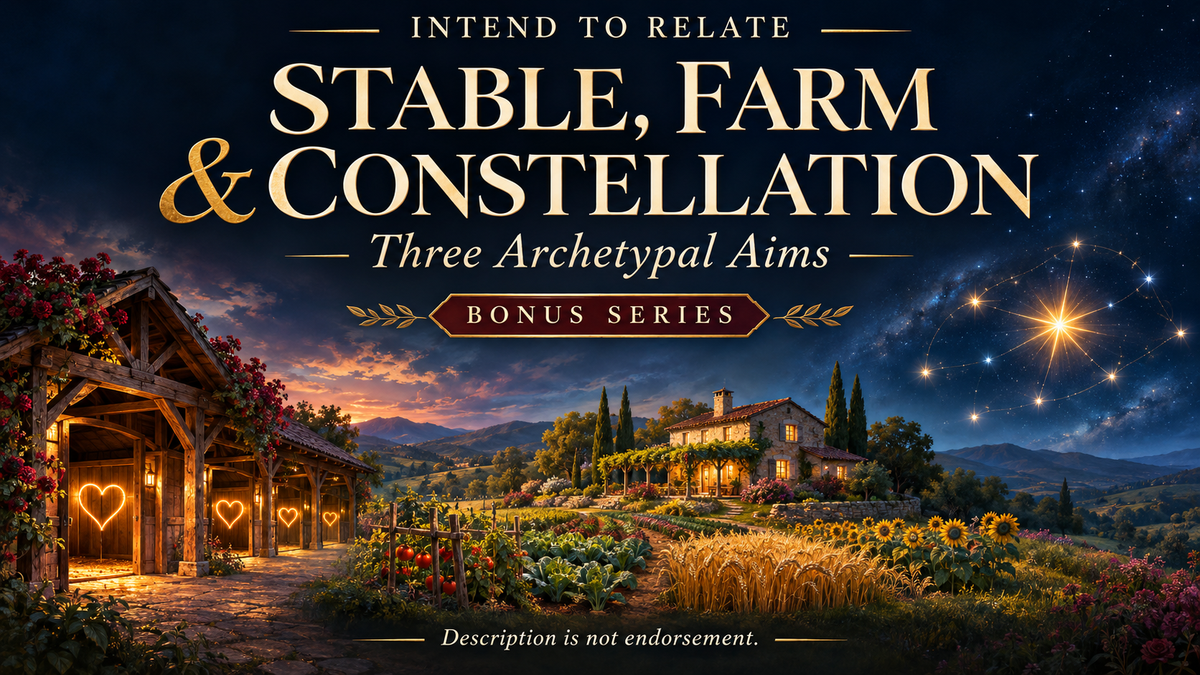
A stable. A farm. A constellation. Prior work, our form approach, and the purposes behind it.
In our recent videos, we used the images of a stable, a farm, and a constellation to begin examining relationship form: how people are connected, what purposes an arrangement serves, and what each participant understands their place within it to be. You can read about that and see the video here:
 Intend to Relate
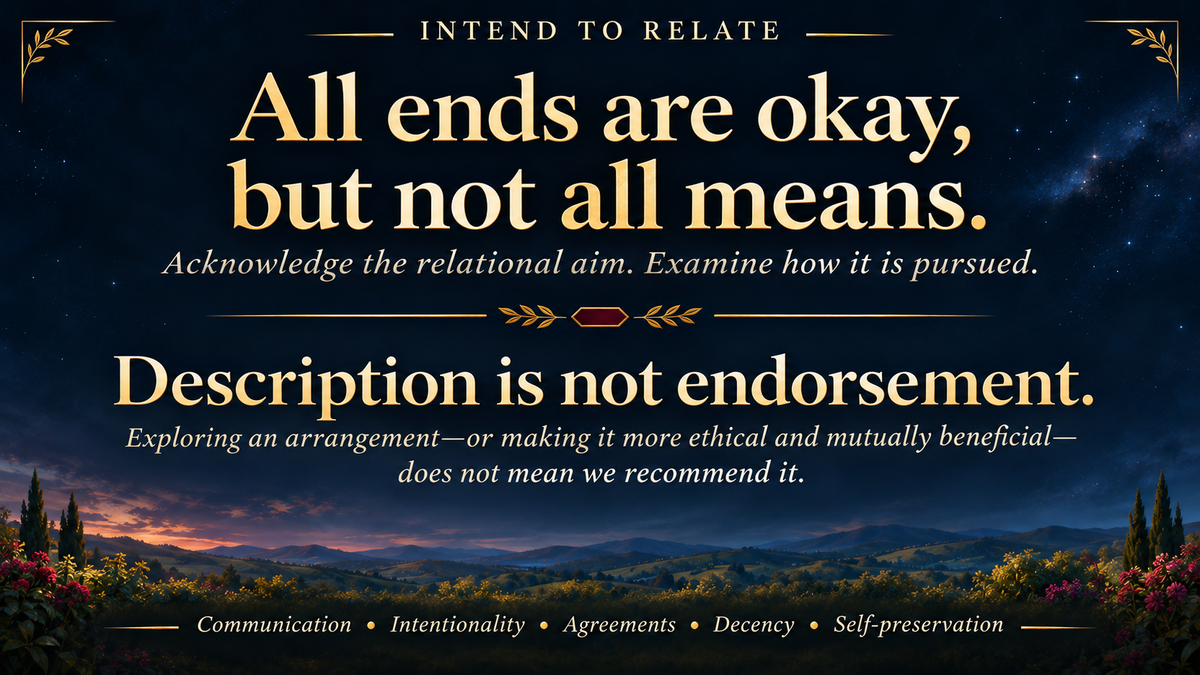
That exploration sits within a substantial body of existing work. People have already developed vocabularies, described arrangements, debated their ethics, and shared experience of trying to make them work. We are grateful for that foundation.
This short continuation of the series explains how we engage with that work—and what we are trying to contribute.
There is already a map
Franklin Veaux’s 2010 nonmonogamy diagram presents a crowded landscape of overlapping categories and examples. Alongside resources such as Alethya’s glossary of relationship frameworks, it gives readers language for recognizing and discussing a variety of arrangements.
That language matters. A person may discover a term for something they have experienced but could not previously describe. People may find that an arrangement they imagined was unusual has already been explored by others. Vocabulary can make inquiry possible, and it can make an otherwise difficult conversation easier to begin.
The glossary also addresses agreements, disclosure, ethics, and changing preferences. Those concerns are already part of the conversation we are entering. Our contribution does not require claiming to have discovered them.
Nor does referencing a resource require agreement with every definition or proposition it contains. We can acknowledge its usefulness, identify the particular ideas we are drawing on, and develop our own analysis.
Look at the statements around the diagram
Much of the diagram’s interest lies in the statements surrounding its categories. They describe what someone permits, expects, accepts, conceals, or assumes. Many amount to miniature descriptions of relationship terms.
Some suggest a negotiated understanding. Others reveal uncertainty about what was ever agreed. Some illustrate deception. The diagram places these practices within a broad descriptive landscape; their appearance on the same page does not make them ethically equivalent.
For our purposes, this leads to a basic question:
What understanding actually exists between the people in this arrangement?
A label may help begin the answer. It cannot complete it. Two people using the same label may understand it differently. An apparent agreement between two participants may also say very little about what a third person knows, wants, or has accepted.
Even where agreement exists, there is further work to do. What does it cover? How was it reached? Who bears its burdens? What happens when circumstances change?
Our architectural angle: form and stress points
We use an architectural perspective to examine how an arrangement is put together and what enables it to function. Form includes the connections between people, the distribution of authority, the purposes being pursued, and the expectations that organize participation.
Our stable, farm, and constellation images offer prompts for that examination. In this series, they direct attention toward romantic benefit, material benefit, and differentiated roles or benefits organized around a center. These are the particular forms we are exploring; they are not an exhaustive classification, and our use of “constellation” should not be assumed to encompass every use of that word elsewhere.
The metaphors describe organizing aims and patterns. They should not obscure the fact that the people involved have purposes of their own. Someone’s place in another person’s arrangement does not exhaust who they are.
An architectural examination therefore asks:
- Participation: Who is connected to whom, and what does each person believe that connection means?
- Authority: Who can make which decisions, and whose participation is needed when a decision affects others?
- Capacity: What time, attention, care, and resources does the arrangement require?
- Stress points: Where might competing expectations, unequal information, or changing needs create difficulty?
- Adaptation: How can the people involved revisit the arrangement as their circumstances develop?
This includes asking what helps the relationship succeed: what supports affection, enjoyment, trust, creativity, and mutual benefit. Preventing failure is part of the work. Creating conditions for a worthwhile shared experience is another.
A mediator’s concern: prepare for disagreement
We also approach relationships with a mediator’s concern for avoidable conflict. What could people clarify early, while they have goodwill and room to think? What process could help when their understandings diverge?
People need ways to express needs, disclose relevant information, ask questions, and assert their positions. They need to understand when they are discussing possibilities and when they are trying to reach a decision together.
Rules and boundaries are part of that work, but adding more restrictions is not automatically an improvement. A useful term should be understood by the people it concerns, connected to a purpose they can examine, and workable in the circumstances. A rule drafted by one person does not become a shared agreement simply because it has been announced.
The same care belongs in planning for change and endings. What happens if someone wants a different form of relationship? What commitments need to be addressed? How can people conclude an arrangement with clarity and dignity?
Our interest in honorable endings reflects that concern. Preparing for an ending can help reduce avoidable confusion and injury. It should never become a requirement that someone obtain another person’s permission to leave.
A protective purpose: help people understand their situation
Some of our work serves a more immediate purpose: helping someone recognize an arrangement they did not knowingly choose.
A person may think they are building one kind of relationship while their partner is privately organizing something quite different. They may be told that a troubling practice is simply what a particular relationship label means. They may be encouraged to accept ambiguity that consistently benefits someone else.
Our discussions of instrumentalism and “snake” tactics aim to give people ways to examine such situations. Practical discernment requires attention to conduct: what was represented, what was withheld, whose purposes are being served, and what happens when a person asks a direct question or says no.
Receiving benefits from a relationship is ordinary. The concern is being treated merely as an instrument—managed for someone else’s purposes while one’s own understanding and agency are disregarded.
Useful tools can help someone name a discrepancy, seek clarification, reconsider their participation, or leave. They should also help distinguish deliberate deception from a misunderstanding that people are willing to address honestly.
If one person in a thousand hears something here, recognizes what is happening, and avoids becoming a victim, that part of the work matters.
More love, with thought and intention
The constructive ambition belongs at the center of this project: more love, thoughtful experimentation, and relationships people can knowingly choose and help shape.
People may want different things. They may discover possibilities beyond the forms they first encountered. Exploring those possibilities intelligently means taking their purposes seriously while examining the means by which they pursue them.
We are still working through foundations and only beginning to touch polyamory from this form perspective. Revisiting basic questions helps establish how our concepts connect and how our tools are intended to be used. It is not a claim that the existing literature begins with us.
Our contribution is developing through a particular synthesis: form and purpose, communication and agreements, preparation for conflict and change, and practical protection against deception and exploitation.
The existing map gives us much to learn from. We want to help people examine the arrangements they encounter, participate with greater understanding, and create forms of relationship worth living within.
Sources and related exploration
Diagram discussed: Franklin Veaux, nonmonogamy diagram, version 2.5.1, ©2010. The diagram identifies www.xeromag.com as its source. It is displayed and discussed in the accompanying video.
Related reading: Alethya, “A Glossary of Relationship Frameworks.” Referenced for its vocabulary and discussion of relationship arrangements; citation does not imply endorsement of every statement on the page.
Explore the project and its tools at Intend to Relate, and find further articles and discussions on our Ghost publication.