Romance, resources, attention, affection. What is the person at the center seeking—and what do the other people understand about their place in the arrangement?
We are doing things out of our planned order again. This time, we are moving up a topic with considerable potential for both useful discussion and a little entertainment: the stable, the farm, and the constellation.
These three forms give us a way to examine one person’s involvement in multiple relationships by asking what that person is seeking, how the arrangement operates, and what the other people believe they are participating in.
That last part matters. Someone may be in the right place while thinking it is wrong—or in the wrong place while thinking it is right. The label alone will not tell us. We have to look at the aims, the representations, and the actual relationships.
This opening installment introduces the essences. The series that follows will explore practical do’s and don’ts, examples, and applications of the Intend to Relate framework. There will be room for humor, everyday stories, and perhaps a little celebrity news along the way.
The stable: romantic benefit
In our usage here, the stable is a poly individual with multiple non-monogamous romantic partners. Its organizing aim is romantic benefit: multiple romantic relationships in that individual’s life.
The important feature is the aim. These are people with whom the individual seeks romantic relationships, rather than an array assembled primarily to provide money, assistance, or other practical advantages.
That does not tell us everything about the arrangement. It does not establish how much time each relationship receives, whether the partners know one another, what commitments exist, or what anyone has agreed to. Those questions come next.
The metaphor also does not confer ownership. Each partner remains a person with an independent life, aims, and choices.
The farm: material benefit
The farm also involves one individual and multiple relationships, but its organizing aim is material benefit rather than romantic benefit. Think resources, assistance, or practical advantages cultivated through those relationships.
Romantic language or activity might appear in a particular example. That does not necessarily make romance the organizing aim. Part of the inquiry is whether the relationship being represented to another person matches the relationship being pursued.
Seeking material benefit does not, by itself, answer whether the arrangement is mutually acceptable. We still need to ask what the other person wants, what is offered in return, and what each understands. Someone may knowingly welcome an exchange that another person would decline.
A very different situation arises when participation depends on a false impression—for example, when one person provides ongoing assistance believing a romantic commitment is developing, while the other deliberately sustains that belief to keep the assistance coming.
The benefit sought and the method of obtaining it are separate questions.
The constellation: different people, different functions
The word constellation can be used broadly to map relationships. Here, we are examining a particular I2R form: a person at the center seeking to receive benefits from an array of people with different roles and functions.
One supplies attention. Another affection. Another practical help. The relationships need not all be romantic, and they need not serve the same purpose.
A simple example is a young adult maintaining an array of people who provide attention and affection while giving relatively little back. That is one illustration, not a definition of every constellation or a claim about young adults generally.
The distinguishing feature is the differentiated array: different people, different functions, benefits flowing toward the center. It resembles the farm in its orientation toward receiving through multiple relationships, but the benefits can extend beyond material support. It differs from the stable because the people need not all occupy the role of romantic partner.
Once again, drawing the pattern tells us less than we might think about its quality. Do the people involved understand their roles? Do they want those roles? Is what they receive worthwhile to them? Are they being encouraged to expect something the person at the center has no intention of offering?
Archetypal aims, with room for overlap
These are working distinctions within this series, not a claim that everyone uses these words in the same way. They are also archetypal aims, rather than three sealed boxes into which every relationship must fit.
A real arrangement may combine romance, material support, attention, and affection. The point of distinguishing the aims is to make the arrangement easier to examine: what is being sought, from whom, and under what understanding?
Looking from the center is only one perspective. The person providing attention, affection, or assistance also has an account of what is happening. They may be enjoying precisely the relationship on offer. They may be waiting for a relationship that has never been offered. Or they may have been led to believe an offer exists when it does not.
Those differences are where much of the practical work begins.
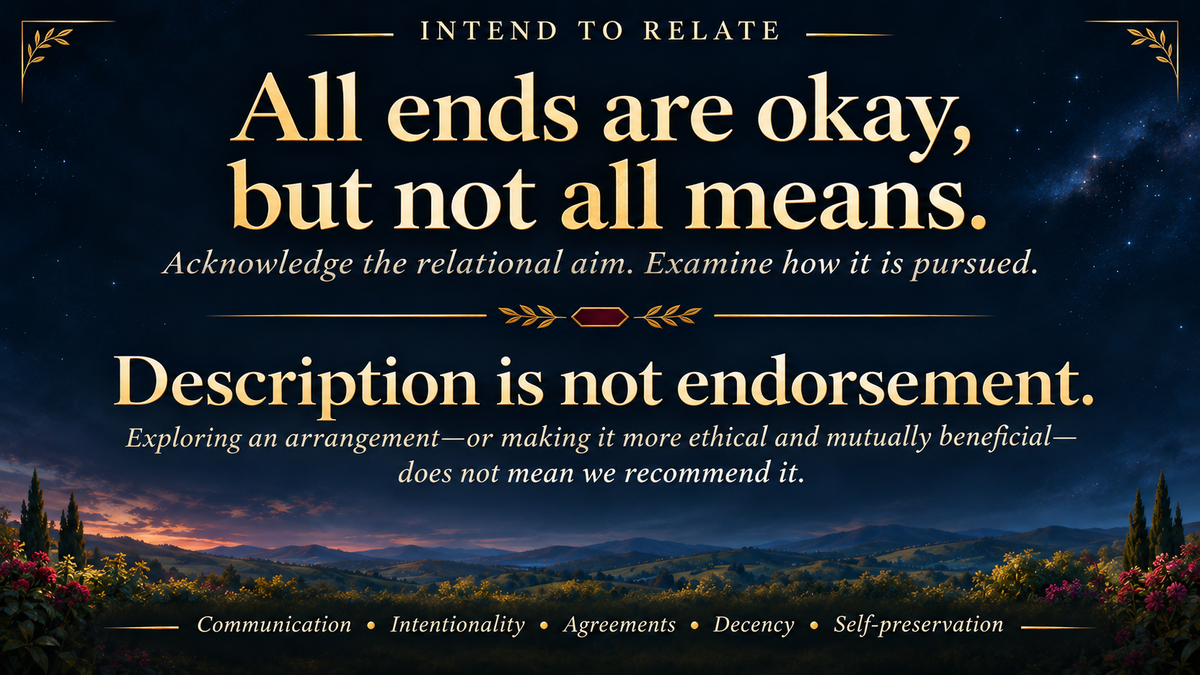
“All ends are okay, but not all means”
This is a principle we will return to throughout the series.
In this discussion, we begin by acknowledging the relational benefits someone actually wants: romance, material support, attention, affection. Naming an aim honestly gives us something concrete to examine.
Wanting something does not settle what you may do to obtain it. Nor does it create an obligation for a particular person to provide it.
What have you represented? What does the other person understand? What are you offering? Have they had a meaningful opportunity to decide whether the arrangement works for them?
Mutual benefit does not require everyone to want the same thing. It does require us to take seriously that there is more than one person deciding what is worthwhile. The person at the center cannot settle that question on everyone else’s behalf.
Description is not endorsement. Discussing these arrangements—or exploring how they could become more ethical and mutually beneficial—does not mean we recommend them.
We can examine a form, identify its problems, and consider better conduct within it without presenting that form as anyone’s ideal life.
Where the series goes next
The next installments will take up individual practical questions. The four communication duties—expression, disclosure, inquiry, and assertion—will be part of that work. What needs to be said? What needs to be revealed? What should someone ask? When must a person clearly state a position instead of hoping it will be inferred?
We will also explore the learning and intentionality loop: how what people learn about themselves and one another should inform what they intend and do next.
Then there is the rules issue. How do intentions become agreements and rules? Whose rules are they? Does a private preference become an expectation of someone else without ever being discussed? Does everyone understand the same arrangement?
These questions will be considered through the I2R framework and through ordinary decency and self-preservation—from the position of the person at the center and from the position of someone invited into the arrangement.
We intend to have some fun with the series. Stories and recognizable situations give us something to work with, and the metaphors have plenty of comic potential. The underlying questions remain useful even when the presentation is light.
Whatever the metaphor, the people involved have aims of their own.
Be free, and be good to each other—intentionally.
Explore the broader project at Intend to Relate, and find further writing and developments here on Ghost.