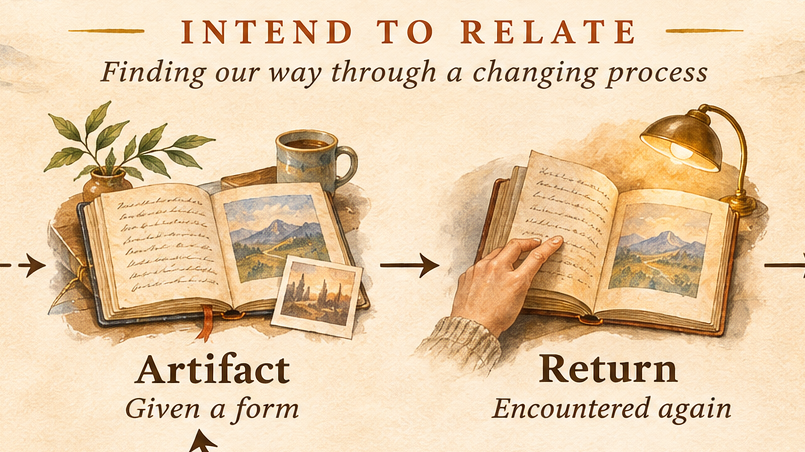
What would you want the person you will become to know about what it feels like to be you today?
In our recent discussion of Architecture, Infrastructure and Artifacts of Consciousness, we explored how notes, recordings, images, drafts, and other expressions preserve something we can return to as our understanding develops.
This short video brings that idea to a personal scale.
Watch the short on YouTube.
[Retain existing video embed]
Leaving evidence for someone you will become
We change over time. Our circumstances, relationships, priorities, beliefs, and understanding of our experiences may change with us.
But we cannot always recover what it actually felt like to be ourselves at an earlier moment.
Memory reconstructs. We interpret earlier experiences through what we have learned since. Sometimes we remember a conclusion more clearly than the uncertainty that preceded it.
An artifact of consciousness—a journal entry, voice recording, photograph, or even a few sentences—can preserve something of that earlier experience.
It gives our future selves an opportunity to encounter an expression of who we were, what we understood, and what we were experiencing at that time.
The artifact stays available while the person changes.
A conversation across time
Our My Future Self Agreement material approaches the relationship between present and future selves through intentionality: what we want to become, what we are undertaking today, and what consequences our future selves may inherit.
Leaving messages for our future selves offers a complementary practice.
We might record what we hope for, but also what we are worried about. What we are learning. What we appreciate. What feels difficult. What we cannot yet understand.
We need not give our future selves instructions or insist that our present understanding must remain correct.
Instead, we can leave something for them to encounter, examine, appreciate, question, or reconsider.
That is one way an artifact of consciousness can support a relationship across time.
Try it yourself
Take a moment to leave your future self a message. Write a paragraph, record a minute of audio, or make a short video.
Describe something about your life today that you might otherwise forget. Perhaps a feeling, a relationship, a difficulty, an aspiration, or something that made you smile.
Date it. Keep it somewhere you can find it.
You might even arrange to encounter it a year from now.
When you return, consider not only what changed, but what you recognize, what you understand differently, and what you are glad your earlier self preserved.
The message need not be profound. Its value may only become apparent later.
Transcript
YouTube auto-generated transcript, with paragraph breaks preserved for readability.
The same idea appears at the personal scale in our future self material.
Leave evidence for the person you will become about what it actually felt like to be you today.
A useful archive works the same way for a project.
An exploratory discussion can sit beside the later treatment that refines it.
An artistic experiment can keep its place without every line counting as a settled position.
Join the Conversation
Have you ever left a message for your future self—or discovered an old recording, photograph, or journal entry that helped you understand who you once were?
What did you learn from encountering it?
Become a free member for updates and access to Relationship Agreements and Conflicting Understandings: A Primer in the member Library and other members-only materials.
Be free, and be good to each other—intentionally.
Published by Intend2Relate, LLC.
Philosophical and educational commentary, not individualized legal, medical, or mental-health advice. Relationship agreements do not replace ongoing consent.