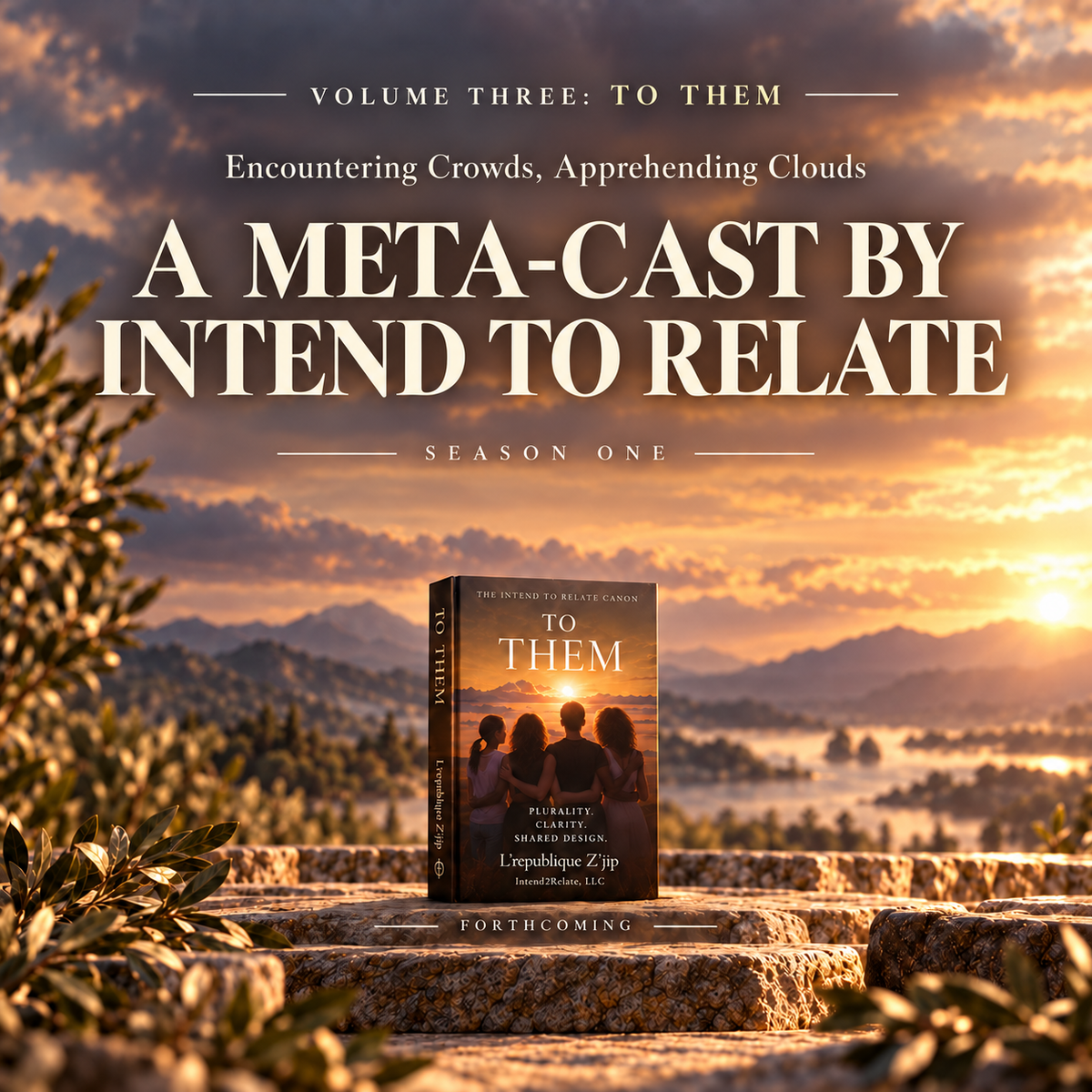
Volume Three · Season One: Encountering Crowds, Apprehending Clouds
A Meta-Cast by Intend to Relate - Episode One
Imagine a band playing to a crowd it cannot see. The music reaches the room, but the room cannot reach the musicians. Applause, laughter, movement, and voices never make their way back to the stage.
Someone may be delighted. Someone may be bored. A song may have become deeply meaningful to a listener. From the stage, none of that is available.
What part of the concert have they not yet learned how to make together?
The opening episode of To Them uses that imagined concert to examine the undertaking behind this additional podcast: building a body of work while participating in an environment where the people encountering it may remain largely unknown.
Watch or listen
To Them — Episode One
Original Version: Spotify · Apple · Youtube
Groundwork that someone can encounter
Intend to Relate began by giving its ideas enough form to be examined: language, instruments, examples, infrastructure, and a record of the work. That groundwork has a purpose whether someone encounters it immediately or much later.
An invitation to explore a framework changes once there is a framework available to explore. Preparing it is itself part of making the encounter possible.
Publishing also places the project within an environment it wants to understand. How does the material travel? What participation becomes possible? What can the people involved perceive about one another? The project can investigate those questions while taking part in the process.
What the stage can—and cannot—know
The episode makes a careful distinction between another person’s presence and the evidence of that presence available to us.
“I cannot register their presence is not the same statement as they are absent. I have not received an answer is not the same statement as nothing happened.”
The concert thought experiment removes the return path between crowd and band. When that path opens, a laugh, a call, or a rhythm from the room can enter the musicians’ next action. The performance changes what the crowd does next, and the evening may take a form neither could have produced alone.
The band and audience remain distinguishable. Their participation may nevertheless help create a particular, meaningful event. The episode offers that possibility as a place to explore the project’s developing idea of an entity.
Quiet itself tells us too little. An attentive silence can belong to an intensely shared performance. The uncertainty in the experiment comes from the musicians’ inability to encounter what the silence means. A listener’s meaningful experience may also remain real without becoming available from the stage.
Building the work and encountering its reception
A band can rehearse and record before the people who will appreciate its music have found it. Likewise, a framework can be developed and preserved before its eventual readers or collaborators arrive.
What happens around the work is another object of inquiry. What changes when an idea enters someone else’s experience? What might return that the author could not have produced alone?
Here, Intend to Relate applies its own feedback loop: intend, prepare, participate, examine what happened, and bring what becomes available into the next decision.
The episode separates four questions:
- Did we produce the work we intended?
- Did we make it available in a form someone could encounter?
- Did we create an understandable opportunity to respond?
- What could we learn from the response that became available?
Groundwork may succeed while reception remains uncertain. A response may reveal a misunderstanding, an unexpected application, or an invitation that needs to be made clearer. Each gives us something different to consider.
What this parallel track makes possible
To Them gives the project room to expose more of its developing process. A question can remain visibly unfinished. An instrument can be examined while it is being made. The circumstances of the work can become part of the conversation.
The invitation matters. Another episode can add to the body of work without making it easier for a person to answer. A more particular question may give someone a clearer way to enter.
Listening, trying an instrument, challenging an argument, contributing an example, and helping develop an idea are different forms of participation. Each can have its own purpose and limits. The episode’s playful audience assentions begin with those distinctions and with the individual’s freedom to choose.
Quiet listening remains a worthwhile form of participation in its own right.
From “them” to you
The episode leaves the fuller creator–audience relationship for further inquiry. One person may speak toward many people who encounter the work at different times, never meet one another, and bring very different purposes.
Does that create one relationship, many relationships, or an undertaking containing several kinds of participation? Under what circumstances might an audience become something more than a category of recipients?
Those questions remain open. The closing invitation becomes more particular: one individual with something to say, addressing another.
You do not need to represent an audience or master the framework. A thought, question, disagreement, or provocation can become an encounter of its own.
Show notes and chapters
Chapter titles and start times follow the supplied episode chapter file.
- 0:00:00 — Introduction
- 0:02:59 — Concert Feedback
- 0:06:57 — Engaging in an Encounter
- 0:08:31 — Intentional Inquiry
- 0:10:27 — Parallel Track Purpose
- 0:11:49 — Forms of Participation
- 0:12:57 — Audience Relationship
Full reading transcript
Prepared from the supplied automatic transcript with paragraphing and evident transcription errors corrected. “Audience ascensions” has been normalized to “audience assentions” in keeping with the project’s terminology. The speaker’s distinctions and exploratory voice are retained. This is an edited reading transcript, not an independently audio-verified verbatim record.
0:00:00 — Introduction
This is Volume Three: To Them (forthcoming), a Meta-Cast by Intend to Relate. The relationship itself deserves some attention. When I say that Intend to Relate is relating toward an audience, what exactly am I saying? Who is relating with whom? What has actually happened between us? What have we intended, offered, or imagined? We will give that inquiry its own episode. I do not want to answer it casually just so we can proceed as though we know. For today, I would like to examine something closer to the undertaking itself. Why open this additional podcast?
Why begin a parallel track into the third volume now? We began by doing what we understood needed to be done. Groundwork, initial architecture, infrastructure, planting seeds, establishing a stake in the space, giving the ideas enough form that someone could encounter them, developing the language, the instruments, the examples, and the record of what we were attempting, and establishing competence through the work itself. Not merely announcing that we had something to contribute, but putting something there that could be examined. That record might be encountered now. It might be reviewed later. We understood that.
The purpose of the groundwork did not depend on an immediate response. There was something we intended to build, and some of it needed to exist before another person could reasonably assess what we were talking about. An invitation to explore a framework becomes a different invitation once there is a framework available to explore. So we were making it available, but we were also entering an environment, podcasting, publishing, speaking toward people we did not yet know through arrangements we wanted to experience and understand. And because this project concerns relating, that participation was itself something worth examining.
We could develop ideas about a creator and an audience from outside the encounter. Or we could participate, observe what became available, and let the experience give us something to think with. We chose to do both. We were speaking toward an early audience. There was not much of a signal coming back that we could recognize as an encounter with them. Notice how carefully that needs to be stated. I have not said that nobody was there. I have not said that nobody cared. I have not said that the work meant nothing to anyone.
I am describing what was available from this side of the communication. The distinction matters. I cannot register their presence is not the same statement as they are absent. I have not received an answer is not the same statement as nothing happened. We were interested in that difference. Because if we are examining the organism and process environment of podcasting, we cannot look only at the material being produced. We also have to look at how it travels, what participation it makes possible, and what becomes perceptible to the people involved.
0:02:59 — Concert Feedback
Let me approach this through a band. Imagine a band playing to a crowd it cannot see. There is some arrangement between the stage and the room. The music reaches the crowd, but the crowd cannot make itself heard by the band. Its applause, movement, laughter, and voices do not come back through. This is not a crowd refusing to clap. For purposes of the experiment, the return path is missing. Perhaps someone is delighted, perhaps someone is bored, perhaps someone has just heard a song that matters to them in a way the musicians could not have anticipated.
From the stage, none of that is available. The band plays, the room receives, but the band cannot experience how it is being received. Now imagine that the separation is removed. Someone calls out, someone laughs at the introduction, a rhythm comes back from the room, the musicians respond to it, a phrase gets held a little longer. Something unexpected becomes part of the evening. In this imagined concert, the crowd's contribution is not merely an evaluation delivered after the performance, it enters the performance. And the performance changes what the crowd does next. That is where I become interested in something beyond the organization of the event.
There are the musicians, there is the band, there are the arrangements that put the band in this place at this time. And then there is this concert, this particular evening with these people and the things that happened between them. The audience did not write the songs, it did not become the band. We do not have to erase those distinctions to notice that the evening may have become something they helped make together. Perhaps that is another place to explore what we have been calling an entity, a particular, meaningful something taking form through the participation of people who remain distinguishable within it.
The earlier dimensions do not disappear. There is still organization, there are still people having experiences, but something recognizable may take form through what they participate in together. We will return to that. I'm not going to announce that we have discovered a new species because someone requested an encore, but I do want to notice the possibility. The organization made the performance possible. The participation may have made it this performance. Now put the separation back. The band is still there, the crowd is still there, the music still reaches people. What has been lost?
Not necessarily the entire concert, certainly not the fact that somebody may have had a meaningful experience. But something in the exchange has become unavailable. The musicians cannot let the response of the room enter their next action because they cannot encounter that response. They have to imagine more of the other side. Perhaps that changes the performance. Perhaps a possibility for mutual responsiveness never develops. Perhaps something that had begun to take form becomes a little less available to the participants. Something does not necessarily collapse, but something can thin. And we should be careful here, too.
Noise is not the same thing as connection. We can imagine an intensely shared performance in a quiet room. The silence might itself be something the participants understand together. The problem in our experiment is not simply that the room is quiet. It is that the band cannot tell what the quiet means. They cannot distinguish an attentive silence from an empty room or a deeply affected listener from someone who has already left. That uncertainty belongs in our inquiry. We should not fill it with whichever story happens to be most convenient. Nor should we make the musicians experience the final measure of everything that happened.
Something meaningful may have occurred for a listener without becoming available from the stage. The inquiry has to leave room for that, too.
0:06:57 — Engaging in an Encounter
Now bring this back to the work we are doing. There is a distinction between establishing a body of work and participating in an encounter around it. A band can develop its sound, rehearse and record an album before the people who will eventually appreciate it have found it. That work has its own purpose. The absence of immediate applause does not undo the recording. Similarly, we were establishing an architecture and a record. We intended for something substantial to be there, whether it was reviewed immediately or encountered later. But we were also interested in what might happen around that work.
What kind of participation might become possible? What changes when an idea leaves the circumstances in which it was made and enters someone else's experience? What can return from that encounter that the author could not have produced alone? Those are not substitutes for the original purpose. They are additional objects of inquiry. Part of that inquiry concerns the felt dimension of participation. What is it like to speak toward people whose presence you cannot register? What changes when a question comes back? What happens when someone notices something you did not notice, or takes an instrument somewhere you had not imagined it going?
The experience can teach us something about the process, but we need to distinguish the experience from the conclusions we draw about it. A signal returning is something to examine. A signal not returning is also something to examine. Neither arrives with a complete explanation attached.
0:08:31 — Intentional Inquiry
This is where we apply our own approach. We have an intention. We prepare something. We participate. Then we look at what happened, what became available, what remained unknown, what did the experience reveal about the arrangement? What should we try differently? We participate, and then we learn. That is the feedback loop we have already been developing in other settings. Here we are applying it to the project itself. And that requires us to separate several questions that could otherwise get mixed together. Did we produce the work we intended to produce? Did we make it available in a form someone could encounter?
Did we create an understandable opportunity for another person to respond? And what could we actually learn from whatever response became available? Those questions are related, but an answer to one does not automatically answer the others. We might accomplish the groundwork while still knowing very little about its reception. We might receive a response that reveals a misunderstanding rather than agreement. We might discover that what interested someone was not the part we expected. Or we might discover that our invitation was less clear than we thought. That is useful information. It does not require us to reinterpret the original undertaking as a mistake.
It gives us something to bring in to the next decision. And it also lets us examine whatever remained less explicit in our own expectations. When we said audience, what forms of participation had we imagined? Listening, considering, testing an instrument, challenging an argument, helping develop an idea. Had we distinguished those possibilities? Had we given each of them an appropriate invitation? That is one way to examine what lies beneath an announced aim without assigning ourselves a hidden motive in advance. We can investigate an expectation rather than invent a confession.
0:10:27 — Parallel Track Purpose
So this parallel track becomes an opportunity to try something more particular. The original podcast offers the developing framework, its stories and its instruments. Here we can expose more of the process by which a question becomes a tool or fails to become one. We can leave some thoughts visibly unfinished. We can examine the circumstances of the work while continuing to do it. And we can see whether that creates a different opportunity for participation. Another episode is not necessarily another opportunity for conversation. Another thousand words may make an undertaking more complete without making it easier for someone to answer.
So part of the experiment concerns the invitation itself. Have we offered a question another person can enter? Have we made it clear where something remains unsettled? Have we left room for a contribution that changes our understanding rather than merely confirms it? That is more specific than saying we would like engagement. We are asking what sort of encounter we are trying to make possible. Then we can see what actually happens. Perhaps someone answers, perhaps someone responds much later. Perhaps the experiment teaches us that the invitation needs another form. We do not have to determine the outcome before undertaking it, but we do need to remain attentive enough to learn.
0:11:49 — Forms of Participation
This also gives us somewhere to begin with our more playful audience assentions. Not by declaring that listening has enrolled someone in a collective undertaking, but by distinguishing what a person might choose to participate in. Listening is one possibility, trying an instrument is another, discussing a question, contributing an example, or helping develop an idea might be others. Different invitations can have different purposes and limits. We can become more intentional about those differences without making every encounter solemn. There may be room for a very dignified agreement about asking an inconvenient question. The playful part is imagining what those arrangements might look like.
The serious part is understanding what is being offered and leaving the other person room to decide. We are not promoting people out of ordinary listening, as though quietly enjoying something were an inferior form of life. We are exploring what else people might wish to do together, and whether giving those possibilities a little language and structure helps them become available.
0:12:57 — Audience Relationship
This is part of what we intend to explore in Volume 3 of our Canon and here on this podcast. We have spent time with one person facing another, attraction, intimacy, romantic possibilities, and the lives people might try to create together. We are not leaving that territory behind. But when we turn toward a hoped for audience, something changes. One person may be speaking toward many. Those people may encounter the work at different times. They may never encounter each other. They may have very different reasons for being there. The author may be relating toward an imagined whole while actual listeners are each having a particular experience.
Does that produce one relationship? Many relationships? An undertaking that contains several different kinds of participation? Under what circumstances does an audience become something more than a category of recipients? What might form between a creator and a crowd without either becoming the other? Those questions belong to the relationship episode we have set aside. For now, it is enough to notice that taking our tools beyond a familiar one-on-one setting does not simply give us a larger version of the same picture. It reveals distinctions we may not have needed to make so carefully before.
Between reaching and meeting, between participation and the experience of participation, between the people who are present and the presence available to a particular participant, between something organized in advance and something that takes form through what people actually do together. Those differences may eventually teach us something about the intimate relationships, too. But we should let the inquiry earn its conclusions. For today, we have a body of work taking shape, an environment we are participating in, and an opportunity to examine what that participation reveals. The groundwork continues. The experiment continues. And what we learn can affect what we prepare next.
So we return to them, the audience we intended toward, not necessarily absent, not necessarily known, perhaps already encountering something, while we are still learning what kind of encounter might become possible between us. And we leave this part with a question. When the music reaches the room, but the room cannot reach the musicians, what part of the concert have we not yet learned how to make together? Before we close, let me turn from them to you, not the audience as an imagined whole, not you as a representative of it, you, the individual listening.
We would like to hear from you. I am not asking for the usual buttons to be pressed. We welcome a thought, a question, a provocation, something you noticed, something you disagree with, something this brought into view that we have not yet considered. Leave a comment, speak to us in the YouTube community, or send us an email. You do not need to have mastered the framework. You do not need to speak for anyone else. One person with something to say, addressing another. Reach out, one on one, if you Intend to Relate.
Related concepts
Encounter and apprehension; presence and perceptibility; creator–audience relationships; entities and shared participation; intention and feedback; audience assentions; the distinction between building a record and participating in an encounter around it.
For the broader vocabulary, begin with Season One of the original Intend to Relate Podcast. To Them carries the inquiry into the developing third volume of the canon.
Join the conversation
When the music reaches the room, but the room cannot reach the musicians, what part of the concert have we not yet learned how to make together?
Bring a thought, a question, a provocation, or something this brought into view that we have not yet considered. Leave a comment here or join the conversation on the episode’s YouTube page.
You do not need to speak for anyone else. One person with something to say, addressing another. Reach out, one on one, if you intend to relate.
About Intend to Relate
Intend to Relate is a philosophical and educational project developing tools, language, and practices for more intentional relationships. Through books, podcasts, agreements, and creative exploration, it examines how sovereign individuals relate to themselves, one another, and the wider world.
Be free, and be good to each other—intentionally.
Member discussion: