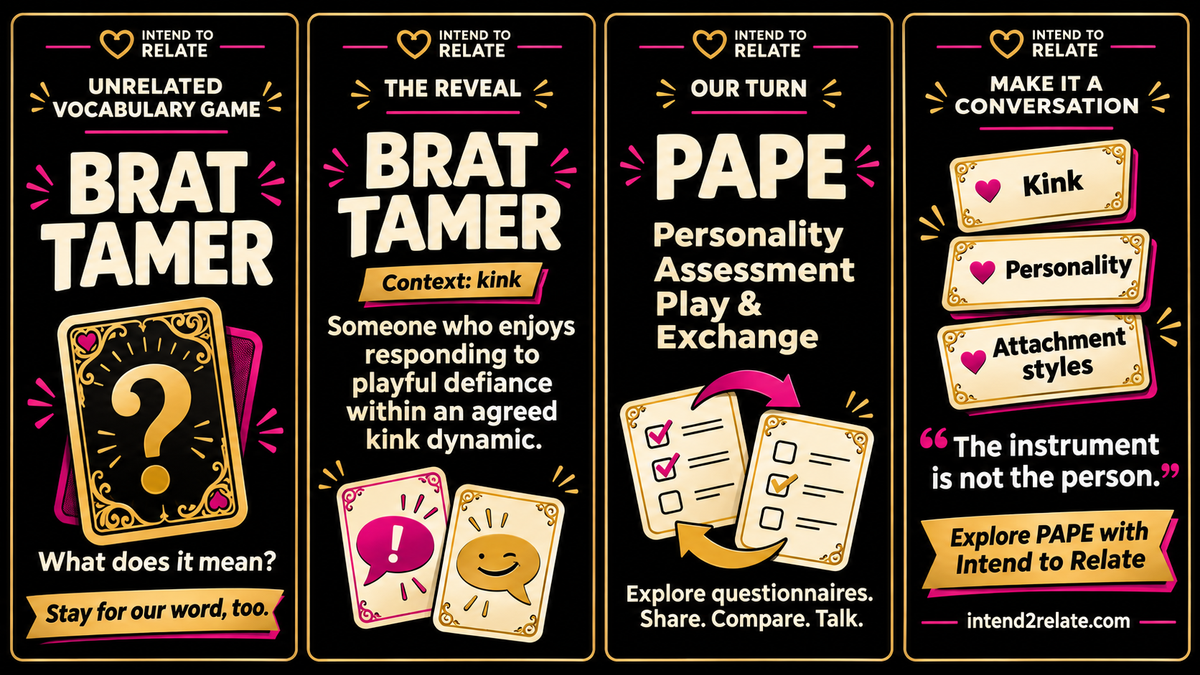
A little vocabulary, a little mischief, and an entirely disclosed attempt to introduce you to something we are working on.
We have a new game. Its media strategy is sufficiently elaborate that we can explain it in one sentence:
We are overtly hoping to grab your attention for enough seconds to get one or two seconds of attention on the information we are sharing with people.
There. The scheme has been disclosed.
Welcome to the Unrelated Vocabulary Game: a short, playful series in which we introduce a word or expression, give you a quick reveal, and then use the occasion to introduce a little vocabulary, concept, model, or proposed tool from Intend to Relate.
You might learn something. You might laugh. You might decide the first term was more interesting than the second. We accept that possibility.
Why start with “Brat Tamer”?
Because it is a much more entertaining opening card than “Please consider our proposed questionnaire exchange.”
Our first round starts with Brat Tamer, drawn from kink vocabulary. It is provocative, a little funny out of context, and likely to produce some combination of recognition, curiosity, and “wait, what?” That is part of why we chose it. We are not pretending the choice was random.
The format gives the opening term its own brief explanation. Then comes the disclosed turn: since you are here, we would also like to show you something from our work.
The humor includes the contrast. One card promises a rather different evening from a card announcing a personality questionnaire. Putting them next to each other amuses us.
This is a light social-media game. We are not presenting each opening word as a solemn thesis, a recommendation, or a comprehensive lesson. Nor does choosing a term mean we are assigning that identity to the audience. Sometimes a funny way into a conversation can simply be a funny way into a conversation.
The second reveal: PAPE
For the first round, our contribution is PAPE: Personality Assessment Play and Exchange.
The proposed tool starts with an accessible activity: people use questionnaires or similar prompts to explore something about themselves, then exchange and discuss what they find. The material might concern personality, attachment styles, kink interests, or other preferences relevant to the relationship they are considering.
There is room for play in that process. Compare answers. Be surprised. Laugh at a result that feels uncomfortably familiar—or spectacularly wrong. Ask what the other person means.
The useful exchange begins when a result becomes a conversation:
“Does that actually sound like you?”
“What would that look like between us?”
“Is that something you enjoy imagining, something you want to try, or something you expect?”
“What did the questionnaire miss?”
Those are illustrative questions, rather than a finished PAPE instrument. We are introducing a proposed approach, not announcing that the reel contains a complete assessment system.
And an answer on a questionnaire is not, by itself, an agreement between people. A label can give us something to discuss; the people involved still have to explain themselves and work out what, if anything, they want to do together.
How the game connects to the larger work
Intend to Relate moves between theory and application. We develop language for thinking about relationships, and we work on ways people might use that language in actual encounters, conversations, and agreements.
PAPE is an easy example of that movement. Begin with curiosity about a person. Give the curiosity a little structure. Exchange information. Ask follow-up questions. Consider what the answers mean for the relationship you might actually have.
In the framework’s vocabulary, that can create opportunities for expression, disclosure, inquiry, and assertion. In ordinary conversation, it may begin with: “I took this. Want to compare?”
The short video only needs to open that door. The fuller explanation, distinctions, and eventual work product can live elsewhere. We do not need to squeeze an entire framework into a vocabulary reveal.
And the word “unrelated” leaves us some room to play. The opening term and the I2R contribution might have an interesting connection. They might share a theme. Or the pairing may be mostly an excuse to introduce the second item. We are not promising that every juxtaposition establishes a profound theoretical relationship.
Yes, this is media strategy. Also, we are having fun.
We want a repeatable, low-maintenance format that lets us make small, enjoyable things while the more substantial writing, theory, applications, and tools continue off camera. A reusable set of cards gives us somewhere to put a new word and a new idea without turning every short into a major production.
The choice of opening words is part of that strategy. So are the humor, the reveal, and the frank admission that we would like a little of your attention. We can be intentional about how we introduce the work and still enjoy being silly.
Our interest is in what happens after someone notices: a question, a conversation, a visit to an article, or a decision to explore a tool. A few seconds can introduce something worth returning to. They do not have to carry the whole project.
If you came for “Brat Tamer” and stayed long enough to meet PAPE, the game has done what we hoped. Whether you go further is up to you.
For the broader work, explore Intend to Relate and the articles here on Ghost.
More words to come. Some of them may even appear to belong together.