The archive, the reporting resource, and the question hiding inside “we.”
There is a little teasing in the accompanying video. Volume Eight: To America, Season One has stopped to address a problem. And here we are, still talking about America, belonging, responsibility, and what people mean when they say “we.”
That distinction is deliberate. And a particular season can stop while the larger body of work continues. The questions it encountered belong to the broader Intend to Relate project, and they remain worth pursuing in their own right.
The reel moves through three connected developments: preserving the season in an archive, developing a practical reporting resource, and continuing our work on ontology and attribution. The delivery is informal and argumentative. The connections underneath it deserve a little more room.
A season can end without taking the work with it
Volume Eight, Season One remains stopped. There is no closing installment planned. Its short life, and the absence of a conventional closing, are part of the record.
The archive preserves what was made and gives it a place in the larger project. Readers and listeners can return to the arguments, examine their connections, and understand how this part of the work developed. A piece does not lose its value because the sequence it belonged to has ended.
For Intend to Relate, publication contributes to an enduring body of work. An episode may be encountered later, alongside an article or an example that makes its significance clearer. Keeping that work available matters independently of what happened around its original release.
[A link to the archive is provided in the member's only section].
Why the FBI page stays on screen
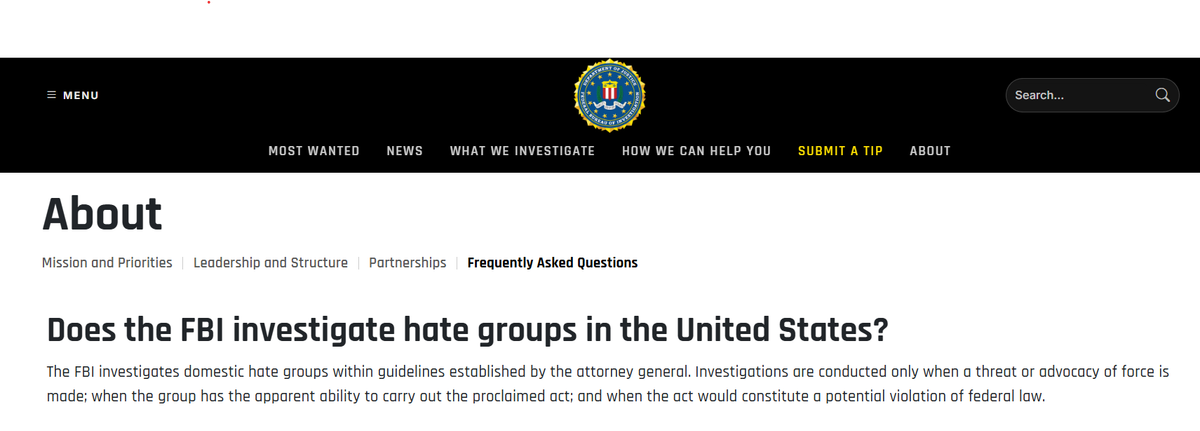
Across the top of the reel sits an FBI page asking whether the Bureau investigates hate groups in the United States. Its placement gives the video a second layer: while we discuss categories, belonging, and collective action, there is also a practical question about what to do when conduct raises a reportable concern.
The archive is also becoming a place from which readers can reach a reporting resource. That resource is in development. Its purpose is to help people find appropriate channels and present relevant information clearly.
The distinction between beliefs and conduct matters here. The FBI explains that hate itself is not a crime. The FAQ shown in the video describes conditions involving threats or advocacy of force, apparent capacity to carry out the act, and a potential violation of federal law. Those distinctions belong alongside the link; displaying the page does not establish that a particular person or group satisfies them.
For readers seeking the official information now, see the FBI FAQ shown in the reel, the FBI’s hate-crimes information, and the Justice Department’s reporting guidance. The latter explains reporting to state or local police and following up with the FBI, including through tips.fbi.gov.
This practical direction connects directly to the philosophical work: an account of what happened needs care about who acted, what they did, and what connects their actions to anyone else.
Who, exactly, is “we”?
Our ontology work begins with a deceptively small word.
When someone says “we,” what are they referring to? A demographic category? A nation? An organization? People pursuing a shared purpose? People who actually acted together?
These can be meaningful forms of grouping, but they do different work. Moving between them without explanation can make an argument seem stronger than it is.
The reel revisits the example “we built America.” A contemporary person identifies with a population and then speaks as though that relationship establishes personal authorship of its historical achievements. What, precisely, connects that person to those acts? Shared characteristics? Ancestry? Membership in a continuing political community? Something else?
The argumentative turn is to test the proposed rule against less flattering conduct. If demographic identification is sufficient to appropriate the credit for everything admirable done by a population, why would the same rule exclude its wrongdoing?
The video uses hypothetical numbers of murders and rapes to press that consistency question. Those figures function as an illustration, not a historical statistical claim. The point is to expose the selective attribution: claiming the achievements through a broad “we,” then narrowing that “we” when responsibility becomes uncomfortable.
A consistent account must explain both what the relationship supports and where it stops. Belonging, benefiting, inheriting, contributing, and personally doing something are different claims.
A shared American starting point
The reel also makes an affirmative claim: we can share a starting base of confidence as Americans, attributable to America. All of us.
That is a meaningful relationship to a continuing collective reality. It gives us something to examine and build from. It does not require each present-day American to pretend to have personally performed the acts of earlier generations.
In the broader Intend to Relate framework, this returns us to the relationship between the sovereign individual and the collectives to which that individual belongs. A collective can matter. Membership can matter. The question is what follows from the particular relationship being asserted.
From “we built it” to “who acted?”
The next movement in the reel points toward Who Acted? Ontology and Attribution, in the To Them work.
Imagine people wearing blue and marching for a cause. They share a visible characteristic and participate in a coordinated undertaking. Now suppose one marcher gets into a fight with someone outside the march. Change the example: several marchers join in. Change it again: organizers planned the attack and participants knowingly carried it out.
Each change alters the relationships among the people and the act. We need to describe those relationships before deciding whose action it was.
This is where ontology and attribution meet. Ontology asks what kind of group or entity we are talking about. Attribution asks whose act it is, and why. The answers require more than pointing at a crowd or counting matching shirts.
The reel’s “not exactly” is an invitation to that closer examination. Multiple participants do not automatically settle the responsibility of everyone present. Equally, treating coordinated conduct as a series of disconnected individuals can obscure what they actually did together. These examples develop the conceptual questions; particular legal responsibility requires its own analysis.
Moving forward separately
The archive preserves Volume Eight, Season One. The planned resource develops the practical reporting direction. The ontology work continues through its own explainers, articles, and discussions, including To Them. Broader studies of confidence, collective identity, and game theory also have a place beyond the stopped season.
Those paths connect because they belong to the same project. Continuing them does not require reopening Season One or delivering the closing installment it will not have.
At the heart of Relationship Agreements is the effort to understand what a relationship is, what its participants intend, and what follows from their participation. The same discipline matters when we speak about a couple, a crowd, a movement, or a country. Who is involved? What is shared? What has been undertaken? Whose actions and commitments are we describing?
The reel carries those questions with a little provocation. The work ahead gives them room.
Be free, and be good to each other—intentionally.