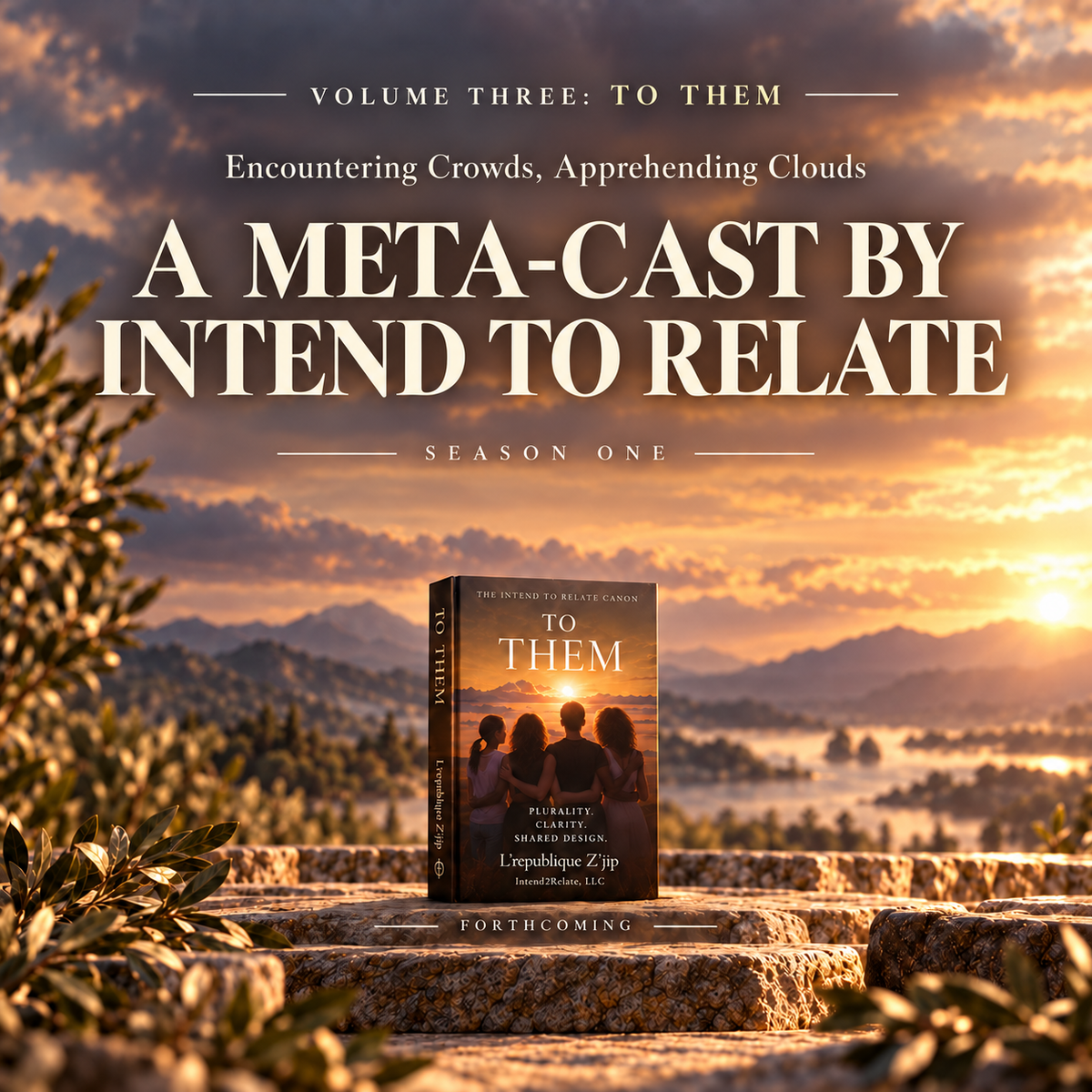
Volume Three · Season One: Encountering Crowds, Apprehending Clouds
A Meta-Cast by Intend to Relate - Episode Three
A brief project update becomes an inquiry into anticipated relationships, the work already being made, and what a dashboard cannot establish.
Episode guide · Full transcript
Watch or listen
To Them — Episode Three
Original Version: Spotify · Apple · Youtube
Imagine seeing someone and imagining her as your bride before you have introduced yourself. You may picture a household, a future, a life together. Something has happened in your experience. Nothing in that image establishes what she wants or whether she would even welcome a conversation.
The imagined bride and the person before you are different objects of attention. One is part of your anticipated life. The other has intentions you have not yet encountered.
“A brief update on the project — The New; The Unreal” uses that image to consider the launch of additional Intend to Relate podcasts. The spoken introduction identifies the update as Volume Three, Season One, Episode Three. Its subject is practical—the project’s developing channels—and also philosophical: what kind of relationship exists when we prepare for people we hope will arrive?
An imagined relationship can guide an approach
The opening analogy gives imagination a legitimate role. It can reveal an aim, motivate preparation, or help someone recognize a possibility they wish to explore. The problem arises when the imagined other begins supplying the actual person’s participation.
A hoped-for audience creates a similar condition. An author imagines people who might understand an argument, benefit from a tool, challenge an example, or contribute something the author has missed. Those possibilities can influence how the work is prepared.
The author may write more clearly for a particular reader, create a channel for a distinct inquiry, or leave an opening for a critic. All of that can happen before the reader, listener, or critic has appeared in a discernible encounter.
The preparation is real. The anticipated relationship remains uncertain. Keeping those two facts together allows the project to build toward people without pretending that their side of the undertaking has already been supplied.
Three relationships need to be distinguished
The episode separates the creator’s relationship with the work, the project’s operational relationships with service providers, and its intention toward prospective audiences. They are connected, but they do not have the same evidence or the same kind of participation.
| Relationship or orientation | What is already available | What it does not establish by itself |
|---|---|---|
| Creator and developing work | Drafting, revision, examination, tools, examples, and a record | That anyone else has encountered or understood the work |
| Project and corporate providers | Services, production systems, distribution, and reports | Another person’s meaning, intention, or assent |
| Project toward a hoped-for audience | An invitation and a particular intention | A reciprocal relationship with its anticipated members |
| A particular person answering | Something that person has intentionally expressed | Their entire perspective or an unlimited continuing relationship |
The last row describes a possible development of the third. It shows why the episode closes with a specific invitation to answer. A return expression changes what can be encountered without automatically resolving every question about the relationship.
The relationship with the work already exists
The artist is not waiting for an audience to begin relating. There are drafts to return to, ideas to examine, instruments to develop, and questions about whether the expression withstands scrutiny.
That activity has its own substance. A confusing passage can become clearer. A distinction can acquire a useful example. A weak argument can be revised. A completed artifact becomes available for examination now or later.
The update describes the work as architecture and groundwork, including a record through which competence can be assessed. That record matters because other people need something to encounter before they can reasonably evaluate an invitation to a body of ideas.
This gives creation a temporal openness. A work can be made before its eventual reader arrives. The creator’s present undertaking and a future listener’s encounter need not coincide for either to be real.
It also offers a way to assess progress without inventing reception. What has actually been produced? What is more intelligible or usable than before? What could someone examine today that was unavailable yesterday? These questions concern the work already within reach.
The project’s operational relationships are also real
Production and distribution depend on other entities. The project uses services, submits material, receives outputs, and encounters reports generated through technological systems. These are present relationships with purposes and processes of their own.
A dashboard belongs to that setting. It reports activity through the machinery of the provider. Such information can help us understand whether material is being distributed or what actions have been recorded.
The distinction becomes important when a report is treated as if it were a personal introduction. A count does not tell us what an individual understood, what they intended by the action, or what relationship they might want with the work.
The episode’s phrase “a dashboard is not an introduction” names this limit. It does not render the dashboard useless. It asks us to use it for questions its information can actually help answer.
A reported action and an expressed meaning
A person may be listening without replying. They may be developing a substantial relationship with a text or tool that remains invisible to its author. The absence of a response does not make those possibilities disappear.
Conversely, the creator cannot supply their contents. We do not know the quiet listener’s interpretation simply because we hope it is favorable or fear it is dismissive.
Technology can carry a human answer as well as a systems report. A question in a comment may provide a particular interpretation. A message may describe an application. The difference concerns what is being received, not whether a device sits between the participants.
A report of activity and an expression of understanding answer different questions. They can inform each other, but one cannot quietly substitute for the other.
Why separate the channels?
At the time of the update, the project reports launching three additional podcasts in line with the intended aims of its forthcoming volumes. The channels make those intentions more particular.
Different lines of inquiry can have different voices, emphases, and invitations. Preparing a place for each can make the body of work easier to develop and eventually encounter. The architecture gives the anticipated relationships a more definite form on the project’s side.
Yet the prospective audiences remain partly amorphous and hoped for. Naming a channel and defining its subject matter do not establish that a corresponding community has assembled. The project has differentiated its offers; the people who might answer retain their own purposes.
This is why the update belongs in To Them. The infrastructure itself makes visible the distinction between intending toward others and having encountered what they intend in return.
Feedback needs a question
The framework’s feedback loop continues through production and publication. The important task is to identify what produced the feedback and what it can support.
A distribution report can prompt a question about availability. A confused comment can prompt a question about an explanation. A person applying a tool can reveal a use the author had not considered. Those forms of information have different implications for the next decision.
Without that distinction, the project could mistake more circulation for better understanding, or an absence of comments for the failure of a body of work. It could also mistake its own clarity about an intention for another person’s agreement to it.
The practical discipline is to ask: what question does this information answer, and what question remains open? That keeps the next action connected to what was actually encountered.
Preparing without pretending
The title’s reference to the unreal is not a denial that actual people may be somewhere on the other side. The unestablished part is the relationship being imagined and the participation being anticipated.
A creator can prepare thoughtfully without asserting that those people already know, understand, or belong. A listener can answer without representing a collective audience. The first particular exchange can begin on a smaller and more truthful basis.
For reflection, name one relationship you are preparing for. What part of the preparation already exists? What do you know about the other person’s intentions? What have you supplied from hope? What invitation would allow their own answer to enter?
The update closes by moving from “them” to “you.” A thought, a question, or a provocation would give the project something a button press cannot supply. The invitation is to speak as yourself, with something of your own to offer.
Continue with Intend to Relate
Explore the framework at Intend2Relate.com, read further in the journal, and find the publications and audio. The original podcast develops the shared foundation; To Them examines the others we address, encounter, and imagine.
A question, disagreement, or account of trying an idea is welcome in the YouTube community. Speak as yourself, with something you have actually encountered. One on one, if you intend to relate.
Episode guide
Times are taken from the supplied transcript; a differently edited video may need different chapter points.
- 0:00 · The Analogy of the Imagined Bride
- 1:19 · The Author's Relationship with a Hypothetical Audience
- Existing Relationships in the Creation Process
- 2:54 · The Limitations of Metrics and Click Counts
- 3:35 · Distinguishing System Reports from Human Encounter
- 4:14 · Differentiating Channels and Building Groundwork
- 4:58 · Understanding Feedback Loops and Shared Intentions
Full episode transcript
Reading copy of the full supplied transcript. Paragraphs and section headings aid navigation; minor spelling and recognition corrections are recorded in the draft’s editorial notes. This copy has not been checked against the recording.
0:00 · The Analogy of the Imagined Bride
This is volume three, to them forthcoming. A meta-cast by Intend to Relate, season 1, episode 3. A brief update on the podcasting part of the intend to relate project and a distinction as to the varying intentions. We have now launched three additional podcasts. As planned, we are separating the channels in line with the intentions and aims of the volumes of our forthcoming extended canon. This metacast is the appropriate place to discuss that development.
And our position begins with an image from our phenomenology of relating. Imagine seeing a woman and imagining her as your bride before you have even introduced yourself. Perhaps you can already picture a life together. You have an image, an attraction, an intention. Something about that possibility has entered your experience, but the woman has not yet entered the relationship you have imagined. You have not encountered her intentions. You do not know what she might wish to create with you or whether she would like to continue the conversation after hello.
The imagined bride and the person before you are not interchangeable. That does not make imagination useless. It can help you recognize something you hope for. It can give direction to an approach, but it cannot provide the other person's participation.
1:19 · The Author's Relationship with a Hypothetical Audience
We think the new author's relationship with a hypothetical audience can occupy a similar position. The author imagines people who might understand the work, appreciate its questions, challenge its arguments, or find something useful within it. Those anticipated people can influence what the author prepares. But anticipating them is not the same as having encountered them. And describing an intended audience does not establish a shared relationship with its members. So what relationships actually exist at this stage?
Existing Relationships in the Creation Process
There is more than one. First, the artist has a direct relationship with the developing body of work itself. There are ideas to examine, drafts to return to, instruments to develop. There is the question of whether the work expresses what we intend and whether it withstands our own scrutiny. That relationship is already being lived through the activity of making the work. It is not waiting for an audience to become real. The work also establishes a record, something that can be encountered and evaluated now or later.
Its initial purpose includes building the architecture and demonstrating competence through what is actually produced. Second, intend to relate as a corporate undertaking has relationships with the other corporate entities through which its data processing, production and media distribution are handled. Those relationships are also present. We use services. We work through systems. We submit material and receive outputs, reports and information through technological machinery.
2:54 · The Limitations of Metrics and Click Counts
And this is where we need to be particularly careful about clicks and numbers. Is a click count an established relationship with an audience? At that level, what we are directly encountering is information supplied through the platform. The report is a continuation of our relationship with the corporate provider and its machinery. That information may be useful. It may help us examine how the distribution process is functioning. But the number is not the person.
It does not by itself tell us what someone understood, what they intended, or what kind of relationship they might wish to have with the work. A dashboard is not an introduction.
3:35 · Distinguishing System Reports from Human Encounter
Someone may indeed be listening. Someone may be developing their own relationship with the work. We are not declaring those possibilities absent merely because they have not become available to us. We are distinguishing them from what we have actually encountered. Nor are we saying that a human relationship cannot develop through technology. A question or a conversation can arrive through the same infrastructure. The distinction is between receiving a systems report of activity and encountering another person through what they express.
Until then, we should not quietly provide their side of the relationship ourselves.
4:14 · Differentiating Channels and Building Groundwork
That brings us back to the three new podcasts. The prospective audiences have been separated in our planning and in the channels we have prepared. Our intentions toward them have become more particular, but those audiences remain amorphous and hoped for. We have differentiated the subject matter and intentions. You can imagine along with us the architecture of a foundation and connecting infrastructure as the beginnings of the new supported and structures begin to form.
This is the groundwork we intended to do. Architecture infrastructure a substantive body of work and opportunities for people to encounter it. As we participate, we also learn about the environment through which the work travels.
4:58 · Understanding Feedback Loops and Shared Intentions
That is part of our feedback loop. But feedback needs to be understood in relation to what produced it. Information about distribution is not automatically information about understanding. Activity reported by a platform is not automatically a shared intention between people. So at this stage we distinguish the creator’s relationship with the work, the project's operational relationships with corporate providers and its intention toward prospective audiences. They are connected. They are not the same relationship.
There is more to discuss about audience relationality. What happens when someone answers, how a listener relates to a work, and whether something shared can develop among people who encounter it separately. Those questions belong here in To Them. For today, our position is this. We can prepare for them without pretending that we already know them. And before we close, let us turn from them to you, the individual listening. We would welcome a thought, a question, or a provocation, not simply another button pressed.
In the comments, in the YouTube community, or by email, tell us something about what you encountered. Not as a representative of an audience, as yourself. Reach out one-on-one if you intend to relate.
Join the conversation
Bring a thought, a question, a provocation, or something this brought into view that we have not yet considered. Leave a comment here or join the conversation on the episode’s YouTube page.
You do not need to speak for anyone else. One person with something to say, addressing another. Reach out, one on one, if you intend to relate.
About Intend to Relate
Intend to Relate is a philosophical and educational project developing tools, language, and practices for more intentional relationships. Through books, podcasts, agreements, and creative exploration, it examines how sovereign individuals relate to themselves, one another, and the wider world.
Be free, and be good to each other—intentionally.
Published by Intend2Relate, LLC.