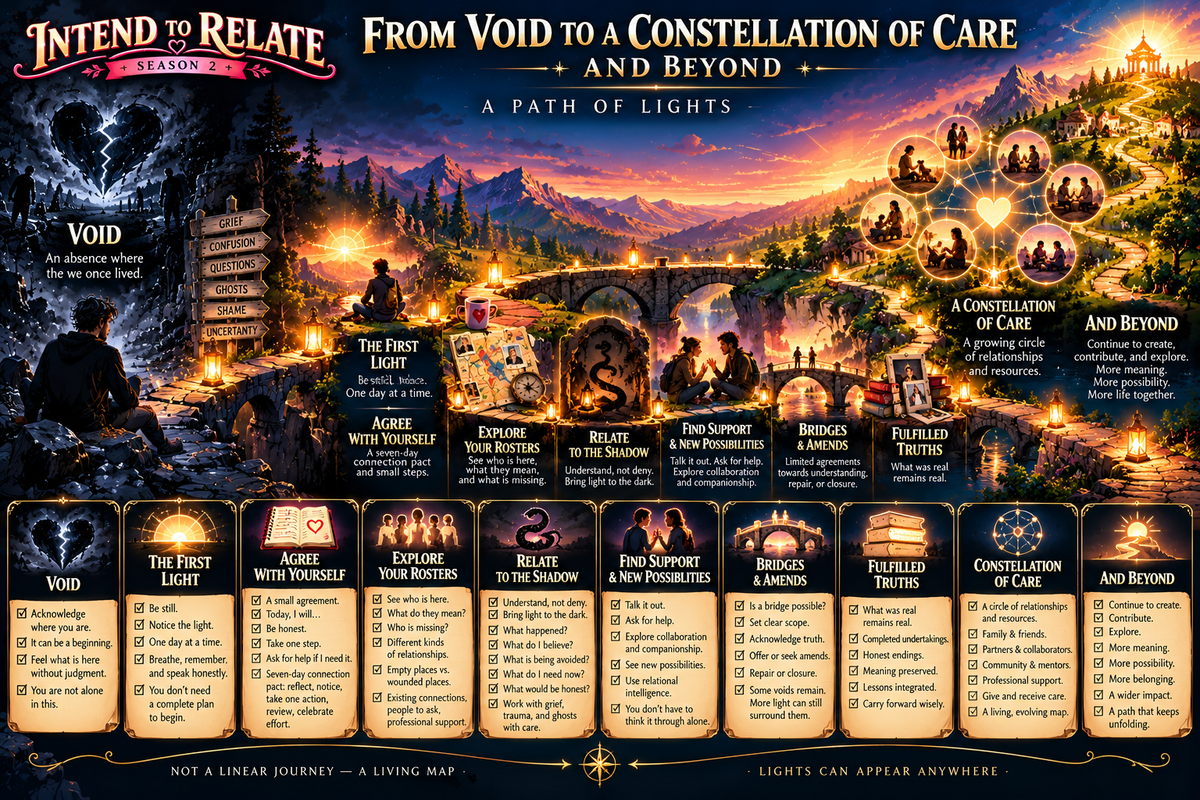
A Constellation of Care: Finding a Path Through the Void and Beyond
Season Two, Episode Seven approaches the framework from the place of loss, limited energy, and a next step that may be no larger than today.
Episode guide · Full transcript
The same tool can look different depending on where we encounter it. Someone with energy and possibilities may see a relationship framework as a way to design a life. Someone whose life has come apart may struggle to imagine next week.
Season Two, Episode Seven of The Intend2Relate Podcast changes the starting point. After the playful work with Cameron and the movement from individual experience to a meaningful entity, the inquiry enters the void: an absence where belonging, identity, or shared meaning was expected.
From there, the question becomes smaller and more immediate. Who is actually present? What can be undertaken today? What care can be requested, received, or offered? How can something learned in loss remain available when a new possibility appears?
The loss of a life, or the absence of an expected one
The episode considers both the collapse of an actual relationship and the non-arrival of an imagined future. A partnership, business, or family arrangement may disintegrate. Alternatively, someone reaches the age at which they expected marriage, children, or companionship and discovers that the life has not arrived with the birthday.
These are different experiences. They can nevertheless share a disorientation: something through which the person expected to understand life is missing. The word “void” describes that absence within the model. It does not declare the person worthless or their life without meaning.
The episode also places the author inside the relational world being discussed. A new podcast directs an intention toward an audience and may encounter quiet before receiving feedback. That experience does not equate the creator’s situation with every listener’s loss. It shows that the project is participating in uncertainty, rather than speaking from outside it.
Make the undertaking fit the person
The full My Future Self Agreement may be too large a beginning for someone struggling to find their footing. The episode therefore offers a smaller adaptation: My One Day at a Time Agreement.
Today, I will give my life some attention. I will take a manageable action of care. I will be honest about where I need help. The invitation to “start with the light” brings attention back to the day that is actually available, without requiring a magnificent experience.
A seven-day undertaking can extend that beginning. Return, notice, write something down, and review. The purpose is not to demand recovery in a week. It is to make a modest promise that can generate experience and information.
If the promise proves unrealistic, the review concerns what made it unrealistic. What support was missing? What was too large? What could be changed tomorrow? Intention, agreement, participation, and feedback remain present, but the scale has changed.
This is a significant application of the framework. It asks the agreement to fit the person’s circumstances instead of making an oversized agreement another measure by which the person condemns themselves.
Notice who is present
The roster model now turns toward a constellation of care. The first question is not who could replace the lost partner. It is who is already in this person’s life.
Family, friends, neighbors, teachers, mentors, collaborators, and professional support may occupy different places. A person who offers good company may not be available for practical assistance. Someone equipped to help with a particular difficulty should not be treated as interchangeable with a romantic partner. A relationship can give meaning through our care for someone without promising equivalent care in return.
Seeing these relationships together helps make both resources and gaps more visible. Someone has been checking in. Someone may welcome a conversation. Someone might help if asked, but their willingness cannot be assumed.
The constellation does not require pretending that every need is met. It widens the picture enough to hold two truths together: the lost relationship mattered, and other things matter too. Recognizing what remains need not erase what is absent.
An empty place and a wounded place
Some areas of the relational map concern an unmet need: company, conversation, affection, practical help. Others carry memories, fear, unfinished expectations, or the continuing significance of someone no longer present.
A lover roster that appears empty may contain the memory of a deceased spouse. An earlier harmful relationship may have attached fear to an entire category of future possibility. These are not simply vacancies waiting for a new person.
The distinction helps us ask a better question. Does this place invite a new connection, remembrance, a boundary, or help understanding what remains painful? Attending to a history does not necessarily mean restoring contact with the person involved.
The Path of Lights concerns movement through that map. The next light may be a conversation, a clearer request, a record of something understood, or support from someone equipped to help. The map can remain incomplete while a next step becomes possible.
Ethical instrumentalism in a moment of need
“I need something from another person” can be an honest beginning. Someone may need company, guidance, care, or assistance with a practical problem. Denying the need does not make the relationship more ethical.
The relevant questions concern how the need is expressed and how participation is chosen. Can I say what I am asking for? Can the other person decide what they are willing and able to offer? Can I respect the limits of that offer?
Sometimes payment is involved. Sometimes there is another exchange. Sometimes the offer is simply care. The presence of a purpose does not settle the whole character of the relationship. What matters includes whether that purpose is intelligible and whether people can choose honestly around it.
From the position of exhaustion, questions of cost also change their appearance. Time, money, and attention may be scarce. Asking what a relationship requires can help someone avoid promising more than they can sustain. The inquiry concerns the conditions of participation, rather than the price of a human being.
A bridge need not be a reunion
As the person becomes more able to participate, familiar instruments may take on new meaning. An ending addendum can help people discuss change before a crisis. A parting and understanding agreement can distinguish what ended, what remains, and what is no longer offered.
A limited meeting might have a narrow purpose: understanding an event, acknowledging harm, or discussing an unresolved matter. It need not imply that the prior relationship is restarting. The other person also remains free to decline.
An apology does not purchase forgiveness. Shared history does not create automatic access. Sometimes the bridge across a particular absence is a boundary; sometimes the next act is recognizing a completed truth.
The band recorded the album. There may be no next tour. We can honor what was made while naming what failed, what remains unfinished, and what should not resume. Specificity helps the past become more understandable than either total success or total erasure.
Refuse the insult; examine the proposition
The episode approaches shadow work through statements such as “It is all my fault” and “You were an idiot to believe them.” These are different kinds of problems. One makes a sweeping claim about responsibility. The other humiliates the person reviewing a decision.
The framework invites examination of the actual proposition. What happened? What information was available? What was overlooked? What did another person choose and remain responsible for? A forceful statement is not a completed account merely because it feels convincing.
The person can refuse humiliation while remaining willing to learn. Compassion and inquiry belong together here. The point is to create enough room for a more accurate understanding, including an understanding that is less punishing than the first explanation that arrived.
Values into rules
The episode repeatedly returns to this demand: values into rules. Experience becomes more usable when it changes how we will participate.
Dependability can become a rule to clarify recurring commitments and how changes will be addressed. Independence can become a commitment to preserve relationships outside a partnership. Respect for limited energy can become a smaller, more credible promise.
These rules are revisable. They carry learning forward without requiring the entire painful lesson to be repeated at every new beginning. The feedback loop applies to the rule as well as the conduct it informs.
A simple reflection can begin with four lines: Who is present? What care do I need? What can I realistically undertake? What did I learn that should change my next choice?
The constellation is not a finish line. It is a living arrangement to cultivate, receive from, and contribute to. “Beyond” means that care, meaning, and learning can remain available as life changes. We need not assemble the whole constellation tonight to begin with a light we can reach.
Continue with Intend to Relate
Explore the framework at Intend2Relate.com and continue reading in the Intend to Relate journal. New to the original podcast? Begin with Season One for the foundational language and models.
Read and listen through the Primer and audiobook page, or join as a free member for the ebook. The Present and Future Self Creditor Assessment offers a further reflective exercise.
Questions, disagreements, and experiences with the tools are welcome in the YouTube community. What became clearer for you, and what would you examine differently?
Be free, and be good to each other—intentionally.
Episode guide
Chapter points derived from the supplied transcript.
- 00:00 — A different starting point
- 02:39 — Encountering the void
- 04:08 — One day and seven days
- 05:20 — The constellation of care
- 07:12 — The Path of Lights
- 08:43 — Ethical instrumentalism
- 12:27 — Bridges, boundaries, and completion
- 15:27 — Values into rules
Full episode transcript
The full supplied transcript is reproduced below, formatted into paragraphs with editorial section headings. Timing and speaker markup have been removed from the running text; minor typographical corrections are identified in the draft’s editorial notes. This is a reading copy, not an audio-verified verbatim transcript.
00:00 · A different starting point
Welcome back to the Intend2Relate Podcast. We are picking up with something heavy, something dark. You were told this was coming. For a while, we were heading in a more playful direction. We were following Cameron, experimenting with our tools and exploring the relationships she might create. Then we started building from the orgasm to the entity. That was the fun part. But instead of staying there and enjoying a nice climax, a little tantric podcasting, perhaps we took the next turn from the entity to the void into the shadow.
Now, I did promise some fun, and this does not initially sound like much fun, but there is a reveal here, another way of understanding what these tools are for. Let me put the author inside the story for a moment. This podcast is itself a relationship between Intend2Relate and the audience. We intend toward you to express something, share information, and develop ideas. In a small conversation, I can ask a question and receive an answer immediately.
Speaking toward an audience is different. We are a new podcast. Feedback takes time. You put something into the world, hoping it will be encountered. And then there is some quiet. That can feel lonely. I mention it because we are not standing outside the relational world, pointing at a diagram. We are participating in it too. And today we are looking at that world from a different starting point. Some people encounter this work and say, everything sounds transactional.
You are turning relationships into a business. Others say, this is idealistic. People are supposed to journal, examine themselves, develop rules, and ask each other for agreements. Those reactions make sense from certain vantage points. Think about the path we followed from season one through Cameron. We oriented toward a future self. We examined values, desires, intentions, and possibilities. We acknowledged instrumentalism and began assembling a tool kit. We explored the phenomenology of relating, including the possibility of reaching towards someone and encountering an absence rather than the relationship we imagined.
But we were moving with energy. We were learning to express our intentions and boundaries. We examined the idealized marriage and considered whether that was really the arrangement we wanted. Then there was Cameron. What else could I create? What do I want? What kind of relational life would fit me? Roster, optionality, different archetypal aims. That is an empowered perspective, someone with some energy looking outward toward possibilities.
02:39 · Encountering the void
But someone else may encounter these same tools from inside the void. Perhaps a relationship has disintegrated, perhaps a business, a family arrangement, or an entire way of life has come apart. Something through which they understood themselves is no longer there. Or perhaps the relationship never arrived. They thought that by this point they would be married, have children, or have experienced a particular kind of companionship. They have arrived at the age their younger self imagined, but they have not arrived at the life.
One person has lost an actual relationship and its meaning. Another is confronting the absence of an expected future. We are not calling either person worthless. We are not saying the void is godless. We are describing an absence where someone expected belonging, identity, or shared meaning. From there, a grand invitation to design the next chapter may be too much. So we change the scale. Imagine this person moving through the days, waking, sleeping, dreaming, then waking again.
We return to our simplest invitation. Start with the light, before imagining an entirely different life, encounter the day that is here. Perhaps that means getting out of bed and stepping into comfortable daylight. Perhaps it means sitting somewhere quiet and noticing the world beyond the room. We are returning to the practice we offered in Season 1 but without demanding a magnificent experience. For now, show up for this day.
04:08 · One day and seven days
Instead of beginning with the full My Future Self agreement, with its inquiries, values, priorities, and imagined possibilities, we begin with something smaller, my one day at a time agreement. Today, I will give my life some attention. I will take one manageable action of care. I will be honest about where I need help. Then perhaps we adapt the seven day connection pact into an undertaking with ourselves. For seven days, I will return to this.
I will make a little time to notice what happened and write something down. At the end of the week, I will review. Not because seven days will resolve the loss, because the person may be able to say, I promised myself something manageable and I did it. And if the undertaking proved too much, that is information for the review, not another occasion to declare the person a failure. What was realistic? What got in the way?
What would make tomorrow's commitment more workable? We are still using intention, agreement, participation, and feedback. But the agreement now fits someone who is trying to find their footing. The future does not have to arrive as another enormous demand. It can begin as tomorrow.
05:20 · The constellation of care
Now, perhaps we look at our rosters. Not because we are immediately sending this person out to find a replacement partner. We begin with a question. Who is in your life? Family, friends, neighbors, mentors, teachers, people with whom you have worked or created something. Perhaps someone you like but have not been speaking with because you have little energy right now. Who is actually there? What do these relationships mean to you? How much do you value them?
What participation is genuinely available? From this position, we are orienting our relational world toward an archetypal aim we call a constellation of care. This constellation is not organized primarily to generate attention, money or sexual rotation. It is organized around care. We can look across different relational lanes, friendship, companionship, family, affection, collaboration, guidance, practical support. Not everyone offers the same thing. A friend might be wonderful company, but unable to help with a particular problem.
A counselor might offer a kind of support that should not be assigned to a romantic partner. Someone we care for may also give our life meaning without being responsible for caring for us in the same way. The constellation lets us see those relationships together without making them interchangeable. Before concentrating on who is missing, notice who is present. Someone has been checking in. Someone might welcome a conversation. Someone may be able to help, but we need to ask rather than assume.
The map can remain incomplete. We do not have to pretend every need is met. But perhaps we can begin to say, the relationship I lost was real. Its absence matters. It mattered, but it was not everything that matters. That is different from telling ourselves it meant nothing. We are widening the picture without erasing the loss.
07:12 · The Path of Lights
This brings us to the path of lights. The constellation helps us see relationships and resources. The path concerns how we move among them, whom to approach, what to understand, what action is possible next. Some parts of the map show an unmet need. I need company. I need someone to talk with. I miss physical affection. Other parts show something more complicated. A roster may appear empty, but it is full of ghosts, memories, absences, unfinished expectations, or the continuing significance of someone no longer present.
Perhaps the lover roster contains the memory of a deceased spouse. Perhaps an earlier relationship has left fear attached to that entire possibility. That may not be a vacancy waiting for the next person. It may be something that needs attention. An empty place and a wounded place are not necessarily asking for the same response. One might invite a new connection. Another might invite remembrance, a boundary or help understanding grief or trauma. We are not asking someone to enter those places alone, nor does attending to a painful history require restoring contact with someone who harmed them.
Sometimes the relationship we need to examine is our present relationship with a memory, an expectation, or a conclusion we have been carrying. The next light might be a conversation with someone equipped to help. It might be recognizing a need clearly enough to ask for something specific. We do not have to fill the whole map before taking that step.
08:43 · Ethical instrumentalism
Now, let's revisit instrumentalism. Something this person depended on has broken, and they are trying to find their footing. They may need more help than usual. I need a counselor. I need a friend. I need some company. I need help understanding what happened. This is precisely where I need something from the other person should not automatically sound like an accusation. There are people and resources whose purpose includes offering particular kinds of help.
Someone's time is involved. Sometimes there is payment. Sometimes there is another kind of exchange. Sometimes the offer is simply an act of care. The question is whether the purpose and participation are understood. Can I state what I need? Can the other person decide what they are willing and able to offer? Can I respect the limits of that offer? That is an application of ethical instrumentalism. The alternative is not to need nothing.
The alternative is to relate honestly around the need. We do not want someone leaving a significant need unattended because asking feels shameful. Nor do we want them hiding their circumstances and drawing someone into a relationship under a false understanding of what is being offered. And we do not want them trying to seize what they need through force or falsehood. They can ask, the other person can answer. There is dignity in that exchange.
Now consider the business world side. Our person is exhausted. Time and attention are limited. Perhaps they took time away from work, and money is limited too. Suddenly questions about cost and value look different. What can I realistically undertake? What do I have the energy for? What kind of help addresses the need I actually have? From another vantage point, those questions might sound cold. From here, they concern whether someone can participate without promising more than they have, or spending resources they cannot spare.
We are not pricing another person's worth. We are understanding the conditions of participation. The same tools that help someone design ambitiously, can help someone rebuild carefully. As the constellation becomes clearer, new possibilities may become visible. Someone enjoys the same kind of quiet companionship. A conversation reveals a shared creative interest. There is something we would like to contribute to. This is where we return to the phenomenology of relating. We notice our experience and become curious about our intention.
Then we encounter the other person's intention rather than supplying it from our imagination. Would you enjoy doing this together? Perhaps the offer is one afternoon, a regular walk, or a small collaboration. We do not have to organize an entire future around the first possibility. We participate. Then we learn. Perhaps we discover that what matters is not constant contact, but dependable contact. Perhaps a difference we expected to dislike becomes part of what makes the collaboration enjoyable.
Perhaps we realize that we accepted an offer because we were afraid there would not be another. Not because it fit what we wanted. Now the feedback loop has something to work with. And when the experience is confusing, we can think with someone else. Could you help me separate what happened from what I assumed? What am I actually asking for? Am I trying to understand this relationship or make it become something it never was?
Relational intelligence does not require us to privately produce every answer. The conversation can be one of the lights. A journal or shared reflection can help preserve what became clear. So the next difficult day does not have to begin from nothing.
12:27 · Bridges, boundaries, and completion
Let's move forward a little. This person understands more about their needs, their resources, and the relationships they want to cultivate. Now some of the earlier instruments look different. The seven-day connection pact has become a practice of returning to oneself. My future self-agreement has been reduced to a manageable beginning and can expand as circumstances change. An ending addendum may now look less like pessimism and more like a way to discuss change before everyone is trying to negotiate in a crisis.
A parting and understanding agreement may help distinguish what ended, what remains, and what is no longer being offered. Another mutually wanted bounded experience, including a blindfold agreement in an appropriate context, might serve a different purpose. But the point is not to work through every instrument. The question is which, if any, fits what these people genuinely want to undertake. Sometimes a limited agreement can create a bridge across a particular void. We are meeting to understand this event.
We are not agreeing to restart the relationship. An acknowledgement or an opportunity for amends might become possible, but the other person remains free to decline. An apology does not purchase forgiveness, and a shared history does not create automatic access. Sometimes the bridge is a boundary, not a reunion, and sometimes the work is recognizing a completed truth. The band recorded the album, there is no next tour, but the music was made. We do not need to label every broken promise fulfilled.
We can distinguish what was completed, what failed, what remains meaningful, and what should not resume. That is how the past becomes more specific than everything worked or none of it mattered. We have approached the shadow gently throughout this episode. There is the loneliness, the fear, the thought that nothing worthwhile is available. There is the part that says, do not get out of bed. Our invitation is light. There is the part that says, the future is bleak.
Our first response is one day at a time. Then there is the statement, it is all my fault. Now there is a proposition worth examining, what would have to be true for that statement to hold? What is it including? What is it leaving out? We will develop our tools of confrontational logic for that work. We do not have to accept the statement as a completed judgment merely because it arrives with force.
There is also the attack, you are an idiot, you should never have believed her. You should never have believed him. That is the wolf-like voice in this example. We can refuse the humiliation without refusing to learn. We can step away from the attack and return to the actual question. What happened? What did we know? What did we miss? What was someone else responsible for? The insult does not get to conduct the entire review.
Understanding a decision is different from condemning the person who made it.
15:27 · Values into rules
Now we reach the practical demand at the center of this episode. Values into rules, values into rules, values into rules. What did the experience teach us? And how will that knowledge affect our next commitment? After a loss, time and energy may feel especially precious. We may see more clearly what we invested, what we have available now, and what we do not want to repeat. That information needs a usable form, a clearer question, a boundary, a decision rule, a more realistic promise.
For example, dependability matters to me. Good. What does that change? Before I organize my life around a recurring commitment, I need us to agree on what we are each offering and how we will address changes. Now the value has begun to become a rule. Independence matters to me. What does that change? I will preserve meaningful relationships outside my partnership, rather than expecting one person to become my entire constellation. Again, a value becomes something we can act upon.
This is what we mean by operationalizing the information. Not merely having an insight, but giving it language that can affect participation. We sometimes compare law to code, expressed rules that organize conduct. We are borrowing that idea to write the rules of our own participation. A good rule helps us remember what we learned without relearning the whole lesson every time. And when experience shows that the rule no longer fits, we return to it.
The feedback loop governs the rules too. They are not a substitute for judgment. They help carry judgment forward. Otherwise, the next exciting possibility may arrive, and everything we learned gets left at the entrance to the same roller coaster. Orgasm to entity, entity to void. We cannot remove every possibility of loss, but we do not have to discard our learning each time we begin. So the constellation is becoming clearer. There may be more care available or a more honest understanding of where care is still needed.
Some voids may have more light around them. Some may have a bridge. Others may remain painful without occupying the whole sky. Our feedback loops have given us information. Our values have become more articulate. Some of that understanding has become rules we can use. And perhaps looking back, we notice that we are now living as one of the future selves we were trying to care for. Before demanding the next transformation, we can acknowledge the earlier effort.
Someone got up, someone asked, someone returned to a modest promise without knowing where it would lead. That person deserves attention too. This path can move outward toward others, inward toward understanding, backward toward memory, and forward toward possibility. It is not a requirement to complete every tool before living again. For the person with energy and options, the framework can help with design. For the person who feels they have almost neither, it can help them find a next act of relating.
The constellation is not a finish line. It is a living arrangement we can continue to cultivate, receive care from, and contribute to. That is part of what and beyond means. We are not simply trying to escape one void before entering the next relationship. We are trying to build enough continuity that meaning, care, and learning can travel with us. That gives us somewhere to stand as we continue into the shadow and begin examining the snake's propositions, including the ones we may have started repeating to ourselves.
We do not need the entire constellation tonight. We can begin with the light we can reach, and asking someone to help us find it is already an act of relating. Until next time, be free and be good to each other intentionally.
Published by Intend2Relate, LLC. The transcript preserves the episode’s spoken perspective; the companion article develops its ideas for reading.
If you are joining the podcast here, begin with Season One for the foundational terminology and models developed in this episode.
Explore the project at Intend2Relate.com and continue reading in the Intend to Relate journal.