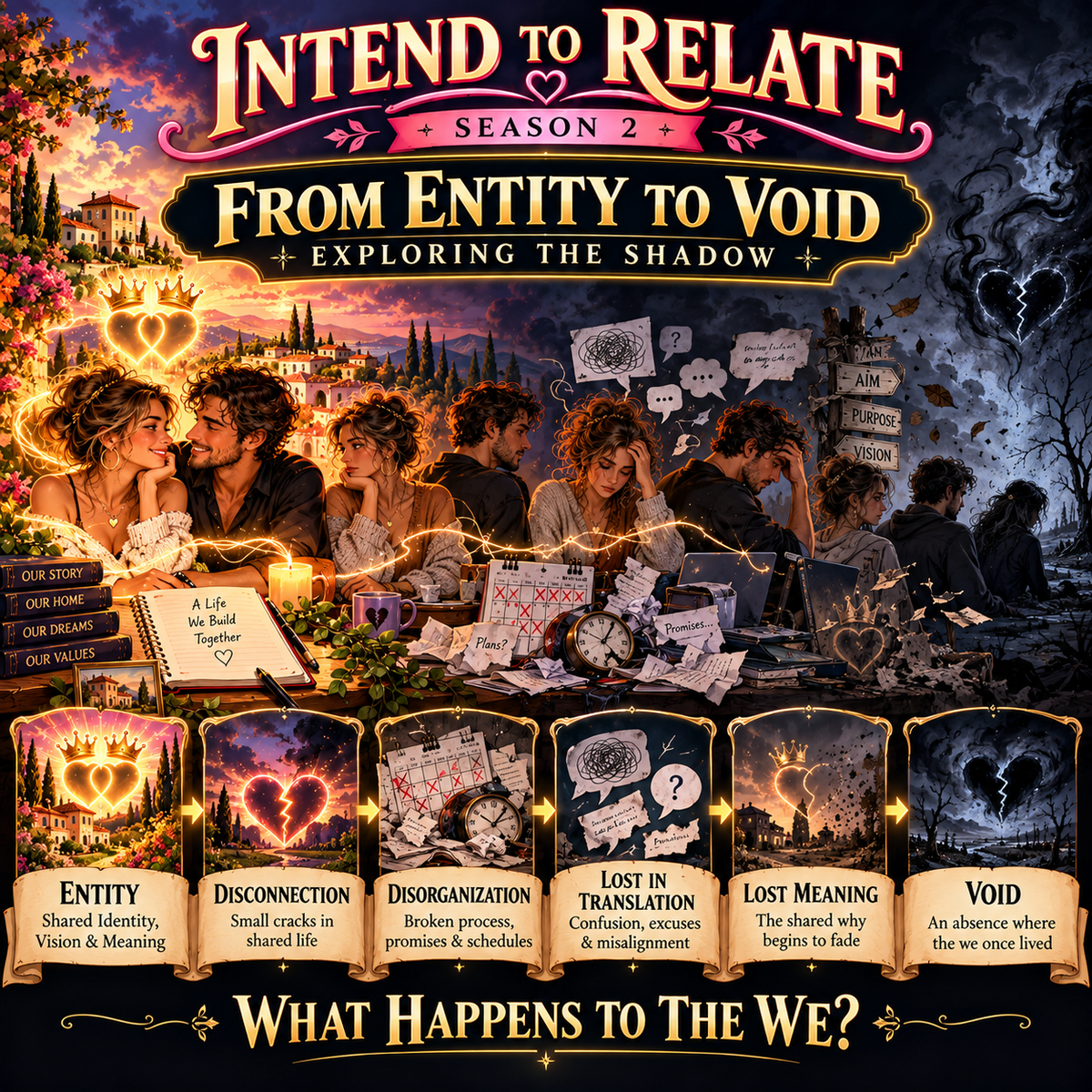
From Entity to Void: When the Relationship’s Name Outlasts Its Shared Life
Season Two, Episode Six explores disconnection, broken coordination, conflicting meanings, and the difference between a relationship that ends and one that becomes an absence.
Episode guide · Full transcript
“I’ve missed you.”
“I’m right here.”
Both statements can describe something real. One person is physically present. The other is asking for a kind of encounter that physical proximity has not provided. The difficulty begins when neither can bring those two meanings into a conversation that changes what happens next.
Season Two, Episode Six of The Intend2Relate Podcast follows a shared relationship as it loses coherence. The episode begins with the entity developed in Episode Five: people who have created a love life, organized their participation, and formed a recognizable “we.” It then asks how that real undertaking can come apart while its name, promises, and outward appearance remain.
The model moves through entity, disconnection, disorganization, lost translation, lost meaning, and void. These are possible movements to examine. They can overlap, reverse, or reinforce one another. The episode gives us a way to notice what is happening without declaring that every missed evening begins an inevitable collapse.
Begin with something that was real
A painful ending can cast doubt backward over an entire history. Was any of it genuine? Did the shared life ever exist, or did one person imagine everything?
This episode deliberately begins elsewhere. Suppose the participants created something real. They enjoyed each other, made plans, developed familiar rhythms, and understood something of what they were undertaking together. Their particular “we” had a lived basis.
That premise allows the inquiry to distinguish the loss of a relationship’s coherence from the discovery that it was false from the start. Those are different possibilities. A relationship’s present failure does not automatically determine the truth of every earlier experience.
The shared undertaking need not be a marriage or an entire household. A more limited relationship can still have a rhythm, a purpose, and a meaning that matters deeply to its participants. The question is what happens to that particular undertaking.
Disconnection: being beside each other
The first disconnect may be small. A conversation gets postponed. Attention goes elsewhere. Something important happens, but the participants do not encounter each other around it. Time together becomes time beside each other.
The episode makes room for rest, independence, and difficult circumstances. One tired evening is not sufficient evidence that the relationship is collapsing. The concern is recurring distance that remains unattended.
The distinction between proximity and connection helps identify the actual question. “I’m right here” answers where someone is. It may leave unanswered whether they have received what the other person is trying to express.
Repair might begin with a more particular inquiry: what kind of connection has been missing? A conversation, a shared activity, attention to an event, or an acknowledgement may involve different requests. The model directs us toward what the participants are living, rather than allowing their physical arrangement to answer for the relationship.
Disorganization: the promise loses contact with participation
Small disconnects can begin affecting the organization. The usual evening is missed and never rescheduled. A check-in disappears. A responsibility remains unattended. A promise is postponed, repeated, and missed again.
“Next week becomes a place where this relationship stores everything it is not doing.”
The calendar, agreement, and journal may still exist. Their continued existence does not establish that they are organizing participation. What the people said they would do is losing its connection with what they actually do.
This is a significant limit on relational instruments. A calendar can hold a commitment, but it cannot attend the evening. An agreement can record an intention, but it cannot supply the intention indefinitely after participation has changed.
Changed circumstances are not themselves the problem. A schedule can become unrealistic. A promise can become difficult to fulfill. The necessary movement is to bring that reality back into shared understanding. In this example, the participants are neither maintaining the old arrangement reliably nor establishing a new one they can live.
Lost in translation: two different conversations
The people begin talking about what happened. One explains why a promise was missed. The other asks whether the promise still exists. Each may believe they are addressing the problem while answering a different question.
An explanation can be honest and useful. It can make a missed commitment understandable. It still does not establish what is being offered for the future.
The episode follows several ways this distinction can disappear. An apology is heard as a renewed commitment. What sounds like commitment was intended only as reassurance. A request for clarification is received as criticism. The conversation shifts toward tone while the failed arrangement remains unresolved.
They may talk more while understanding less. The shared language, memory, and processes that once helped them think together no longer carry meaning reliably between them.
Even a written record may become contested. “That is what we wrote.” “That isn’t what I meant.” The record can help identify the earlier expression, but the next question still needs an answer: what do you mean now, and what are we choosing next?
The model asks whether communication reaches an understanding capable of organizing another action. More words alone do not establish that it has.
The questions beneath the conversation
One practical extension of the episode is to distinguish the questions that may be getting mixed together. The following prompts are applications of its analysis, rather than a prescribed script.
| Question | What it helps clarify |
|---|---|
| What happened to the earlier commitment? | The event and the circumstances surrounding it |
| What did each person understand the commitment to mean? | Differences in the earlier understanding |
| What is being offered now? | Present intention, capacity, and limits |
| What do we each want to undertake next? | Whether a shared arrangement is still available |
| What will happen differently after this conversation? | Whether the new understanding can guide participation |
The questions need not all be answered at once. Their value is in making it harder for one kind of answer to substitute unnoticed for another. Reassurance may matter emotionally while leaving the practical undertaking unsettled. An explanation of the past may be complete while a decision about the future remains open.
Lost meaning: the familiar image and the missing aim
Eventually the question expands. “Why did you miss Friday?” becomes “What are we doing?” “What am I waiting for?” “Do we still want the same relationship?”
The title may remain. The public image may still be recognizable. The couple may look like the same couple while struggling to identify a shared vision beneath the presentation.
The band analogy makes the difference visible. The name, photographs, and matching jackets remain, but the musicians no longer have a shared answer about what they are creating. The presentation has continued beyond the understanding that once gave it direction.
This does not make the earlier music false. It means that the meaning connecting their participation is no longer doing the same work. Preserving the recognizable image cannot, by itself, recover that connection.
The question reaches beyond whether the participants can keep the calendar. They may need to examine whether the aim toward which the calendar was organized is still shared.
The void can exist inside a relationship title
In this model, the void is an absence where a living shared undertaking used to be—or where a continuing promise still leads someone to expect one.
There can be contact without meaningful connection, repeated promises without coordination, and a relationship title without an understood relationship beneath it. The “we” is invoked while becoming harder to locate in lived participation.
The people have not become nothing. Their history has not disappeared. The model is naming a particular absence within the relational world, not declaring that either person lacks worth or that everything in their life has lost meaning.
This also explains why the void is not synonymous with being single, spending time apart, or ending a relationship. A relationship can retain its title while its undertaking becomes absent. Another can end with a clearer understanding of what was created and completed.
The pattern can change direction
The episode explicitly allows the arrows to turn back. Disorganization can produce disconnection. Confusion can undermine a promise. A changed vision can affect the entire undertaking. A difficult truth can also interrupt the pattern.
“I cannot keep offering the time I offered before.”
“I still want this relationship, but our arrangement is not working.”
“I have been reassuring you because I did not want to admit that my intentions changed.”
Such statements give the participants something more definite to consider. They might repair coordination, revise the undertaking, or recognize that they no longer want the same relationship. Understanding the pattern does not oblige them to preserve its existing form at any cost.
Nor does describing a shared process assign equal responsibility. One person may be seeking clarity while the other continues to evade it. The framework should not turn the person doing the clarifying into someone responsible for producing both sides of a mutual repair.
What is hiding inside the explanation?
The movement toward the shadow concerns what has become difficult to acknowledge. Desire may have changed. Someone may have offered more than they can provide. A person may be retaining the benefits of a promise they no longer intend to fulfill. Another may hear the answer they need rather than the answer actually offered.
These possibilities require different interpretations. Not understanding, not wanting to understand, and exploiting confusion are not the same situation. A missed promise alone does not establish a scheme.
The episode points ahead to confrontational logic: examining what a stated principle implies, whether conduct fits it, and whether the principle is being applied consistently, including to ourselves. Its purpose is to clarify what is represented and lived. It cannot manufacture another person’s willingness to participate.
Completion and the truth of an ending
The episode closes by contrasting deterioration with a fulfilled, honorable truth. The band recorded the album. The undertaking reached completion. No additional tour is needed simply to prove that the music was real.
That is different from continuing to promise a performance nobody is preparing to give. The distinction makes room for endings that preserve truthful meaning instead of maintaining expectations of participation that is no longer being offered.
It also prepares the next episode’s constellation of care. What was completed can remain part of a life. What failed can be understood more specifically. The absence of one undertaking need not erase every other relationship or every capacity developed within it.
What has happened to our “we”?
For reflection, choose one recurring difficulty and identify its level. Is the connection missing? Has coordination failed? Are the words carrying different meanings? Has the shared aim changed? More than one may be involved.
Then ask what happens after the difficulty appears. Do the participants reconnect, clarify, and choose something they actually intend to live? Or do they keep invoking the relationship’s name while becoming less able to explain what it means?
Episode Six supplies the missing movement between the creation of a meaningful entity and the later search for care within the void. Before deciding what a “we” might become, it invites us to encounter what has happened to it.
Continue with Intend to Relate
This episode follows Episode Five’s movement from individual experience to a meaningful entity and leads into Episode Seven’s constellation of care. Episodes Eight and Nine develop the questions of renewed participation, truthful understanding, and carrying learning into conduct.
Explore the framework at Intend2Relate.com, read further in the Intend to Relate journal, and find the Primer and audiobook. You can also join as a free member for the ebook.
Questions, disagreements, and experiences with the tools are welcome in the YouTube community. What has this distinction brought into view for you?
Be free, and be good to each other—intentionally.
Episode guide
Chapter times derive from the supplied transcript. A differently edited video may require adjustments.
- 00:00 · From shared experience to entity
- 01:04 · Begin with a real shared undertaking
- 01:29 · Disconnection
- 02:16 · Disorganization
- 03:19 · Lost in translation
- 04:40 · Lost meaning
- 05:38 · The void
- 06:20 · The arrows can turn back
- 07:25 · The shadow and the explanation
- 08:24 · Honorable completion
- 08:56 · What has happened to our we?
Full episode transcript
The full supplied transcript is reproduced below in a readable format. Paragraphs and section headings are editorial additions. This is a reading copy, not an audio-verified verbatim transcript.
00:00 · From shared experience to entity
Welcome back to the Intend2Relate Podcast. Last time, we began with an individual experience. An individual can have an orgasm. Two individuals can have a love life. Their orgasms become an organism. Give that shared life a schedule and an aim, and the organism becomes an organization. Give that organization a shared vision, identity, and meaning, and we begin to recognize an entity. There are the people, and there is their particular we. Today, we begin with that entity.
Not with something that was necessarily false from the beginning. Let's suppose these people created something real. They enjoyed each other. They made plans. They developed a shared life. Now, we're going to explore how that shared life can come apart. Entity, disconnection, disorganization, lost in translation, lost meaning, void. This is not a fixed sequence or an inevitable destination. It is a model to experiment with. The movements can overlap, reverse, and reinforce one another.
But let's follow one possible path into the shadow.
01:04 · Begin with a real shared undertaking
There was a we. Imagine our couple. They have a love life, a rhythm, and a vision. Perhaps they are building a home. Perhaps they have a more limited undertaking that matters deeply to them. They have their jokes, their memories, and their ways of doing things. They can say, this is what we are creating together and reasonably understand each other. There is an entity. Now, introduce a small disconnect.
01:29 · Disconnection
Disconnection. Someone stops paying quite as much attention. A conversation gets postponed. Time together becomes time beside each other. Something important happens, but they do not quite encounter each other around it. One person says, I've missed you. The other says, I'm right here. And both statements describe something real. They are physically present. But the connection the first person is asking for is not happening. One tired evening does not mean the relationship is collapsing.
People need rest, independence, and room for difficult circumstances. In this example, the issue is what happens when the distance keeps appearing and is not attended to. They are still us, but they are participating in less of the shared life that made us meaningful.
02:16 · Disorganization
Disorganization. Now the small disconnects begin affecting the organization. They miss their usual evening together. They say they will reschedule it, but they do not. A check-in disappears. A responsibility goes unattended. A promise gets postponed, then repeated, then missed again. What happened to our plan? I know. We'll do it next week. Next week becomes a place where this relationship stores everything it is not doing. The calendar still exists, so does the agreement.
The journal may be sitting on the table, but those artifacts are no longer organizing their participation. What they said they would do is losing its connection to what they actually do. A schedule can change. A promise can become difficult to fulfill. The important process is bringing that reality back into shared understanding. Here, that process is slipping too. They're not reliably maintaining the old arrangement or agreeing on a new one. The organism is still having experiences, but the organization is losing coordination.
03:19 · Lost in translation
Lost in translation. Now, they try to talk about it, and this is where the explanations begin. I said I would try. I thought we agreed. You know how busy I am. I know, but what are we agreeing to now? One person is explaining why the promise was missed. The other is asking whether the promise still exists. Those are different conversations. An explanation can be honest and useful, but explaining what happened is not the same as deciding what happens next.
In our example, the distinction keeps getting lost. The apology is heard as a renewed commitment. The renewed commitment was only intended as reassurance. The request for clarification is heard as criticism, and now they are discussing the tone of the conversation instead of the arrangement that failed. They may be talking more while understanding less. This is lost in translation. The bridge we discussed last time, shared language, meanings, memories, and processes is no longer carrying understanding reliably.
They cannot quite establish what happened, what each means, or what they are choosing next. Even the journal can become contested. That is what we wrote. That isn't what I meant. All right, what do you mean now? And that question never quite gets answered. Negotiation is happening, but it is not reaching a shared understanding that can organize their next actions.
04:40 · Lost meaning
Lost meaning. Eventually the question becomes larger. It is no longer only, why did you miss Friday? It becomes, what are we doing? What am I waiting for? Do we still want the same relationship? Perhaps they still use the old title. Perhaps they still present the same image. They may still look like the power couple, but the public story and the lived relationship are moving apart. The brand remains recognizable while the shared vision becomes difficult to locate.
Our imaginary band still has its name, its photographs, and its matching jackets. But when the musicians discuss what they are creating, they discover that they no longer have a shared answer. That does not necessarily mean the earlier music was false. It means the meaning that once connected, their present participation is no longer doing that work. The why is becoming difficult to find beneath the explanations.
05:38 · The void
And then we reach the void. The people have not become nothing. Their history has not disappeared. But there is an absence where a living shared undertaking used to be, or where its promise still leads them to expect one. There may be contact without meaningful connection. There may be promises without coordinated participation. There may be a relationship title without an understood relationship beneath it. The we is still being invoked, but it is no longer being lived in the same way.
That is the void in this model. Not simply being single, not simply spending time apart, not simply ending a relationship, an absence where the shared life was supposed to be.
06:20 · The arrows can turn back
The arrows can turn back. Now remember, this is a model, not a conveyor belt. Disorganization can create disconnection. Confusion can undermine a promise. A changed vision can affect every other part, and an honest conversation can interrupt the pattern. I cannot keep offering the time I offered before. I still want this relationship, but our arrangement is not working. I have been reassuring you because I did not want to admit that my intentions changed.
Those statements can be difficult. They also give the participants something more definite to work with. They might repair the organization. They might revise the undertaking. They might conclude that they no longer want the same thing. Understanding the pattern does not oblige them to preserve the relationship at any cost. Nor does a shared process imply equal responsibility for its failure. One person may be trying to clarify while the other keeps evading. The relational hill could not be climbed alone.
Its repair cannot be accomplished entirely by one person either.
07:25 · The shadow and the explanation
What is hiding inside the explanation? This is where we turn toward the shadow. Not every disconnect is deception. Not every missed promise is a scheme. But we can ask what has become difficult to acknowledge. Has someone's desire changed? Has someone offered more than they can give? Is one person enjoying the benefits of a promise they no longer intend to fulfill? Or am I hearing the answer I need instead of the answer being offered?
Sometimes the problem is what we do not understand. Sometimes it is what we do not want to understand. And sometimes someone is using that confusion. Those are different situations. As we continue, we will explore confrontational logic, taking a stated principle seriously enough to examine what it implies, whether conduct fits it, and whether we apply it consistently, including to ourselves. Not to argue someone into a yes, to find out what is actually being offered, represented, and lived.
08:24 · Honorable completion
An ending is not necessarily a void. Later, we will contrast this descent with something different, a fulfilled, honorable truth. The band recorded the album. The music was made. The undertaking reached its completion. The musicians do not owe another tour simply to prove the album was real. That is different from continuing to promise a performance nobody is preparing to give. We will return to that distinction, and to how completed truths can become part of a life with a growing constellation of care.
08:56 · What has happened to our we?
For now, remember the contrast. Last time, we explored how individual experience can become shared life, organization, and meaning. Today, we explored one way that shared entity can lose its coherence. Entity. Disconnection. Disorganization. Lost in translation. Lost meaning. Void. The purpose is not to become suspicious of every missed evening. It is to notice what happens next. Do we reconnect? Do we clarify? Do we make an agreement we actually intend to live? Or do we keep repeating the name of a relationship while becoming less able to say what it means?
Before we ask what our we can become, sometimes we need to ask what has happened to it. Until next time, be free and be good to each other intentionally.
Published by Intend2Relate, LLC.
If you are joining the podcast here, begin with Season One for the foundational terminology and models developed in this episode.
Explore the project at Intend2Relate.com and continue reading in the Intend to Relate journal.