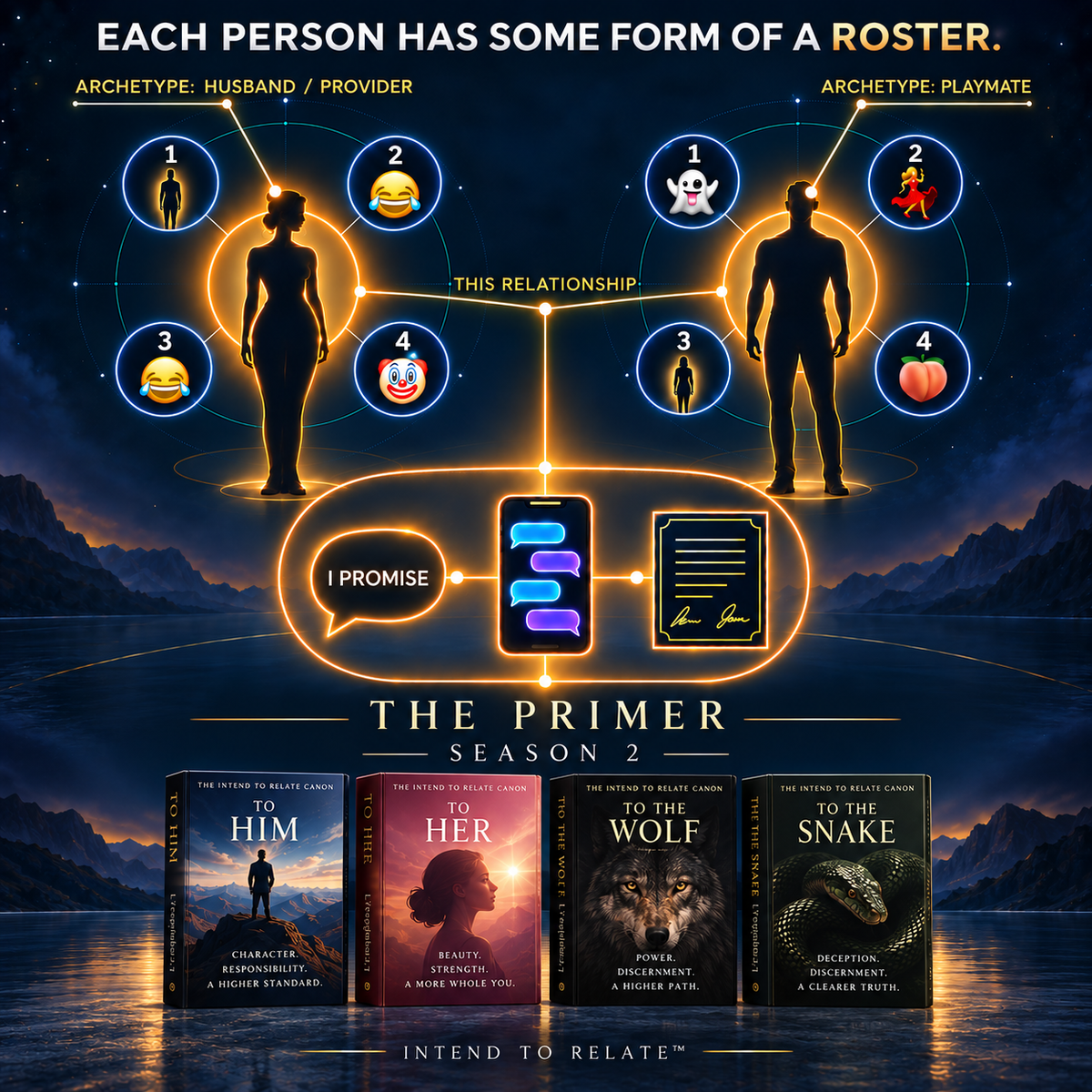
Dealing with Wolves and Snakes and Exploring the Idealized Cognitive Model of Marriage
From the structure of an agreement to the experience of relating: a new season begins with the world we encounter, the tendencies we recognize, and the future we choose to move toward.
Before we can talk about intending to relate, we have to talk about relating itself.
We encounter someone. We hear a voice. We notice frustration in another person—or resentment in ourselves. We come home expecting something to be there and encounter its absence. Something presents itself, and we begin to understand what it might mean.
Season Two, Episode One of The Intend2Relate Podcast returns to that beginning. Building on the concepts introduced in Season One, the episode moves into a more conversational exploration of how those concepts appear in experience. It introduces an approach to the Wolf and Snake, revisits our relationship with the future self, and uses an idealized marriage to bring the framework’s different parts into view.
Throughout, the question is practical: when we encounter something, how do we recognize it and orient ourselves toward what comes next?
The presentation is part of the practice
The episode begins by looking back at the invitation that opens the podcast. We ask listeners to assent to a limited relationship: consider some ideas while retaining your judgment and critical thinking.
“We do not seek a deed to your mind in this relationship.”
That introduction models the kind of relating the project advocates. There is an expressed intention, a description of the relationship, an acknowledgment of its limits, and respect for the other participant’s capacity to choose.
The host offers a direction for the listener’s attention. The listener remains free to consider, question, reject, revise, or use what is presented. Even this brief encounter through a recording has a form, a purpose, and boundaries.
The episode also changes the manner of presentation. The host works from a loose outline with light editing, while continuing to use a digitized voice. The words emerge through a freer discussion. The intention remains clear even when every sentence has not been planned.
That matters to the lesson. Intentional relating can have structure while remaining spontaneous, responsive, and alive.
Encountering a person, a recording, or an absence
A podcast makes a useful example of an encounter. The host addresses an audience he cannot see. A listener encounters a voice whose speaker is absent and may have recorded it years earlier. An intention has been expressed, embodied in a recording, and carried forward to someone unknown.
The episode places this alongside more familiar encounters: seeing a person in a park, or discovering that your car is missing from the driveway. In the last example, what you encounter is an absence. What you expected to find helps give meaning to what is actually there.
These situations differ, but the episode sketches a recurring process: encountering, apprehending, assessing possibilities, choosing, orienting, receiving another’s intention, and eventually parting. At this stage of the season, the emphasis is on the early movements.
To apprehend, in this discussion, is to begin grasping what we have encountered. Something has our attention; we start to understand its meaning. That understanding creates the possibility of a more deliberate response.
This is where the framework begins to become useful in ordinary experience. Before deciding what a relationship should become, we need some clarity about what is happening within it.
Humor, shadow, and the change in tone
The episode revisits the playful turn at the end of Season One, including the business of “swiping” on divine archetypes. After a structured and intellectual presentation, that shift could understandably feel surprising.
Here, the host explains it as a glimpse of the project’s wider range. The framework will be explored through theory, application, narrative, humor, and other literary forms. The form of an encounter affects how we experience what is being presented.
That range also makes room for the less comfortable parts of relating: anxiety, sadness, frustration, disappointment, and the tendencies we may prefer to leave unexamined. The episode uses the language of shadow and darkness as it approaches those experiences.
The Wolf and Snake give two of those encounters a recognizable form.
The Wolf: recognizing the signal in two directions
For this introductory discussion, the Wolf appears in the form of aggression or violence. The episode explicitly leaves room for other aspects of the archetype to be explored later. Its immediate focus is a basic approach to signals that can precede aggression, particularly frustration and resentment.
The first example is external. Someone down the street is yelling, throwing things, and threatening a taxi driver. You notice the situation before becoming involved. If another route is available, you can take it. You have encountered something without taking on the task of resolving it.
Then the episode turns the same process inward. What happens when the frustration or resentment you encounter is your own?
Here, simply refusing to recognize the signal would undermine the intention being developed. The invitation is to notice it, apprehend it, and become more deliberate about your relationship with it.
The distinction is between avoiding involvement in someone else’s threatening behavior and avoiding awareness of a tendency within yourself. Those are different choices, even though both begin with recognizing a signal.
The episode also keeps proportion in view. Frustration over leaving your keys in the car may be entirely understandable. You recognize it, experience it, and wait. Recognizing frustration does not establish that violence will follow; it gives you something to consider in context.
The Snake: encountering deception without making it the whole person
The Snake enters this discussion through dishonesty and falsehood. Again, the episode emphasizes a distinction between the person and the tendency being encountered.
There is a difference between recognizing that someone has lied and treating “liar” as the complete meaning of that person. There is also a difference between noticing a deceptive tendency in yourself and using a totalizing identity to avoid looking closely at the particular act.
The archetype gives a pattern a name and a form. It helps us attend to something that might otherwise remain vague. Its usefulness depends on continuing to examine the actual encounter.
Even within this episode, the Snake has more than one association: “snake wisdom” describes the discernment that notices warning signals, while the later discussion addresses deception. The symbol’s meaning depends on the aspect under examination.
The host also uses the term idealized cognitive model to describe a broader way of organizing thought about phenomena. Within the episode, these models provide structures we can reuse across situations. With practice, recognizing, considering, and responding can become easier to embody.
Your future self has an aim—or arrives somewhere anyway
The discussion of shadow leads back to the future self. Recognizing a present tendency matters partly because of the person we intend to become.
The episode draws a useful distinction between an aim and a destination. An aim is what we intend toward. A destination can be somewhere we arrive without having chosen it—even somewhere a vehicle takes us by mistake.
Applied to relating, that distinction asks us to consider whether our present direction corresponds to an intended future. We can accumulate habits, resentments, evasions, and misunderstandings until we arrive somewhere we never consciously selected.
Apprehending a tendency creates an opportunity to reconsider that direction.
The future self also exists in a world. We begin among relationships, responsibilities, and circumstances that are already present. The person we become affects other people, just as our surroundings affect us. In that sense, attending to the shadow within ourselves participates in the larger task of attending to the world we inhabit.
Why an idealized marriage helps explain the framework
The episode then addresses a recurring question: is Intend2Relate opposed to marriage, or making dating unnecessarily complicated?
The host answers by placing an idealized marriage and family at the center of an explanatory model. A relationship in which the relevant elements are aligned can help us see those elements clearly—and understand what changes when they are not aligned.
In the model presented, the couple shares an aim for the relationship. They have an established framework of meaning and commitment. In the project’s roster terminology, there are “two rosters frozen with aligned MVPs”: each occupies the intended central position for the other within this marital arrangement.
Their valuation systems are also aligned across the framework’s three worlds:
- The natural world: their embodied relationship, including their sexual life.
- The business or transactional world: the practical and economic arrangements through which they organize their life together.
- The divine world: their intentions, grace, and the meaning toward which their shared life is directed.
For the particular couple imagined in the episode, children are a central expression of that shared meaning. The model also posits alignment regarding their ultimate orientation, whether they are religious or atheist. These are features of the example being constructed, rather than a claim that every couple must have the same family aims or beliefs.
The feedback loop between relational intelligence and intentionality is steady in this idealized picture. The couple communicates, learns, and grows together. Their alignment allows much of the underlying structure to recede into the background of everyday life.
That is why the model is useful. It brings the framework’s components together in one recognizable relationship. From there, we can ask where another relationship differs: in its aims, its meanings, its commitments, its valuations, or the way its participants respond to new information.
A shared label can leave those questions unanswered. The model gives us a way to examine them.
When the tools can recede into the background
One of the episode’s most practical observations is that, in the idealized relationship just described, the models almost disappear. The people are living the alignment that the models help us describe.
The tools become more visible when there is something to understand, work through, or deliberately create. A couple may discover that they have been using the same word for different expectations. A person may notice a growing resentment. Partners may need to examine whether their future aims still fit together.
The episode invites listeners to apply what they find useful. Its closing returns to the freedom established at the beginning: retain your judgment, offer feedback, and decide what to carry forward.
Season Two opens, then, with a practice of attention. Encounter what is there. Begin to understand it. Consider your direction. Let that understanding inform the relationships—and the future self—you intend.
The episode closes by introducing the season’s planned readings from the Primer, alongside further exploration of the ideas opened here.
Episode guide
- 00:00 — Intentional relating: the listener relationship, Season One, and the shift in presentation.
- 03:59 — Encountering phenomena: presence, absence, apprehension, and experience.
- 08:06 — The Wolf and Snake: aggression, deception, discernment, and the future self.
- 15:09 — An idealized marriage: shared aims, meaning, valuation, and the three worlds.
- 19:09 — Recap and the season ahead: applying the models and introducing the Primer readings.
Episode transcript
Lightly edited for readability. Paragraph breaks and section headings have been added; the spoken sequence and meaning have been preserved.
Opening invitation
You're listening to The Intend2Relate Podcast, published by Intend2Relate, LLC. Intend2Relate is interested in expanding human freedom and creativity in relationships. We would like to enter into a podcast listener relationship involving a short-term, limited power exchange dynamic, where you consent to considering some ideas as we present them, while retaining your judgment and critical thinking. We do not seek a deed to your mind in this relationship. We ask for your assent to go on a journey with us into some ideas and tools regarding relationships. If you assent, let's Intend2Relate.
Intentional relating and the move into Season Two
Good morning and welcome back to Intend2Relate. I'm your author and host today. This is the first time we're doing a free-form discussion, and we're still doing it through a digitized voice for various reasons. I'm working from a loose outline and we're keeping the editing light. This is not a prescripted discussion this morning, but we do have intentions. Now, this is the first actual episode of Season Two. And really, we're doing these seasons very fast, right? The reason is that we have a lot of things we're going to be putting out in the organization as we've outlined these various projects and developed them. It's not about time; it's about the message, right?
So let's take a quick look back at Season One. I want to give some more context about what we were doing and why. Hopefully, you were with us all through Season One. If you weren't and you're just joining us now, I would suggest going back. The meaning of the things we're going to be talking about, the terminology, the structures, the architecture of thinking, we might call it—they're cumulative.
Last season, we did something that a lot of people found curious. At the beginning of the show, we effectively asked for consent. We asked for assent to listen. We acknowledged a power transfer. There's a power transfer when someone is in a purely receptive mode listening to media.
Why were we doing that? We were modeling the structure of behavior and relating with intention that we're advocating for, right? Expressed intention, acknowledgement of the definition and bounds of the relationship and its limitations. Respect between two sovereign sides for the other's capacity.
Within that last season, in how we broke down the topics and proceeded through them, there was a structure because it reflected something we were trying to show. That show embodied a process and a way of being in itself that we wanted to advocate for.
I'm not going to go through that whole model again. Instead, let's pick up on the last part of the season.
After a very structured, very intellectual, almost non-experiential narrative, we suddenly found ourselves having a good time and a big laugh. We were playing around, swiping left and right on divine archetypes, saying some very funny things, we thought.
If you encountered that after everything we'd been doing, that's a bit of a shock, right? What? How am I supposed to interpret this? Are they messing with me? Are they trolling me?
What were we showing? We were showing what's coming.
Earlier in the season, we talked about the Wolf, the Snake, the archetypal aim, the agreement with the future self, and relationship with a higher power. All of that is, in a certain respect, shadow and archetypal self work. There's more to it. There's theology, there's sociology, there's social dynamics. But in this context, we're starting to some extent with that archetypal work.
And I'm going to show you how the archetype works alongside another term I'm going to use. We're not going to use it too much, but it's an idealized cognitive model. An idealized cognitive model expands beyond the archetype context, but that's what it effectively is in a broader way. So we're using idealized cognitive models to structure thinking about phenomena in the world.
Encountering phenomena
Before we can get into the intention of relating, we need to talk about relating. Right now, I am encountering an audience I can't see. I don't know you. I have no information about you per se. But I believe in that audience. I am encountering something I can't see.
At the same time, you're listening to my voice. I'm not there. You could be listening to this in two years, ten years, if it's still online and you find it. So you're having an encounter with a person who's not there, who is part of a bigger intention, incorporated and then embodied in a recording, digitally transferred.
Very strange, right? But it's the same process of encountering a future spouse for the first time. They're walking in the park or whatever, and you encounter. That map—encountering, apprehending, assessing the possibilities, choosing, orienting, tending towards, receiving the other's intention, parting, feeling the absence—is a similar map, with differentiation, for all of relating.
Now, you'll see that some of the differentiation is in the simplicity of intentionality and in the difference in absence. But for right now, we don't need to go there.
Right now, we're talking about the earlier stages of encountering. You are in the world. You encounter the podcast playing. You encounter the person in the park. You encounter your car missing from the driveway. Instead of the car being there, you're encountering an absence. We wake up into the world, we encounter and we apprehend the situation. We start to understand the meaning of what we've encountered.
We ended the season with a sneak peek of the end of our canon, the end of the night. You may not be aware of this, but we have a big plan, a number of different ways we're going to look at and apply this framework. That was reflective of a later part of what we want to communicate.
After our base theory, philosophy, and applications are distributed, available, and communicated through these mediums, there will be related bodies of literary work, different ways of looking at the same framework.
One reason we're shifting from that theoretical, cold technocratic approach to this more embodied experiential approach is that if I want to model encountering all the way to the shadow and beyond, part of that has to happen through my actual narrative experience. Through the fact that these are words that have not been pre-planned, perhaps within a structure of intention, but they would never be the same again.
That's part of what we're modeling here. So as we proceed, I'm going to encounter and model, but it's going to be real.
We're going to jump straight to two of the scariest things to encounter. Remember, we encountered the Divine Dom, and it was silly. There was a lot of intended meaning in there, but it was silly.
There's that biblical idea, and I believe it quite rightly, that fear of God is the beginning of wisdom. The beginning, not the end. Apprehending in the form of fear and trembling is the beginning. Not a relationship per se, but wisdom.
And so we're focused on this issue of relating to romantic partners and the options and possible forms we want to experience. We can look at those experiences of trying to relate. Most people haven't had a perfect path, knew what to do, met one person, fell in love, got married, and everything worked out. For most people, that's not how it went.
Most people looking into this at a minimum are having some frustration, some kind of issue in their relationship. It may be great, but there's something they want to work out there. They're not on the same level about something, or maybe they're struggling after divorce, whatever it could be.
And I bet in that process, even if it's not that bad, even if it's not the fear of God and the trembling, there's some darkness, some anxiety, some sadness. There may be tears. There may be, ‘I'm just going to party a bunch,’ when, at a certain level, that isn't really what you want to be doing.
So we're moving forward, knowing we're going to encounter the shadow. And in a poetic sense, I'll use the word again, the darkness.
The Wolf: frustration, resentment, and aggression
With that being said, the Wolf and the Snake. I'm going to begin explaining our framework’s approach to two primary manifestations. We're not going all the way today, but we're going to get into it.
The Wolf we're facing here is the Wolf in the form of aggression or violence. The Wolf is not just violence and aggression. There are other forms we'll address, but this is one of the most important.
So it's 101, you know, Freshman 101. We're looking at a basic logic and algorithm, not a complete one, a basic one.
First, in this formulation, we're focused on two things that can precede it. Those two things are frustration and resentment. So if you observe frustration and resentment in varying forms, more is more of a signal, less may be the start of one. That's the kind of signal your Snake wisdom should catch.
Those frustrations and that resentment, those signals have to be monitored from two directions. It's the same process at the start. We're going to start with the easier one, right? Perceiving frustration or resentment in the other.
Of course, you're encountering the being themselves. But it's important to start differentiating the being from the thing you're encountering. It's not all one; there's a relationship. You're encountering frustration or resentment. That's your signal.
Now, when you encounter potential for violence or aggression, here in the form of early or late compounded stages of resentment or frustration, there's a range of possible responses. We're just going to focus on the basic rule and a basic example.
Classic. Someone out in public is yelling, they're angry, they're throwing things, they're threatening the taxi driver, all those kinds of signals. You're not up against them yet. You see them down the street.
The basic logic we all know is, if you can just go down another street, you go down the other street. You are avoiding and evading. You have the discernment to know: ‘I don't need to solve that. I don't need to get involved in that frustration and anger. It's a signal I'm encountering in the world, and I'm going to avoid it and get on with my day.’
Exactly right. We build from there. You know where that could go into the other options from there. Easy example.
Now here's the thing: we look at the self. The self encounters the frustration and resentment, but it's not in the other. They're encountering it in the self.
Maybe they actually encounter the signal before it manifests as frustration or resentment. Right now though, there is an experience, an encounter of frustration or resentment.
For the self, the choice to evade, to not apprehend, to ignore—in our framework, that is not the intention we want to have. We want to have it known that we don't want to experience and manifest frustration and anger, especially to the extent that they could turn into a violent or aggressive compulsion.
So we get the signal. The signal causes us to apprehend. We'll pause there. These are the early stages of the phenomenological process. We're building up the models we'll be working through.
The Snake: dishonesty and falsehood
Now, the Snake. Just as we're looking at violence and aggression for the Wolf, the Snake tendency we're looking at here is dishonesty and falsehood.
Again, that distinction between the being and the thing matters. We're looking at a tendency, something we can encounter rather than making it the whole identity of the person.
I am not a violent person. I am not a liar. There is a tendency to lie. I have lied. I am encountering lies. I am encountering the archetypal Snake of deception.
Why use archetypes? They give a name. They give a form, some meaning and identity. We apprehend and we want to get into a relationship with what we're encountering. We aren't just trying to interact with it the way we interact with our car keys. We're trying to go from apprehension to a relationship.
You've seen the archetypes, apprehension, the world, the phenomenological model, a little bit of the logic and the ethics, the repetition of these models in multiple domains so that we're not learning new models every time.
We're learning compounding methods, repeatable algorithms, repeatable methodologies. We don't want to have to think through all of this every time. It needs to become ingrained, easy, natural to embody.
The future self, the aim, and the destination
What are we trying to embody? We're going back to the beginning, an intended future self.
I want to model this for you. If you exist in this present and suddenly do not exist, you have no future self. You have nothing to intend towards. Now, of course, you're gone, but there is nothing to intend towards.
But that's not the case we're working from. We are in the world and we're moving into the future. In the absence of that non-existent circumstance, there is in theory a future self to orient and intend towards.
Now, here's the thing. When we orient toward the future self, yes, it's focused on us, but we start in the world, remember? We are starting in the world.
We wake up into a world with existing relationships, responsibilities, political situations, global situations. We're intending toward a future self that implies an entire world.
That issue of self-knowledge, of managing the shadow within you, is part of managing the shadow of the world.
When we're orienting toward the future, there's a context. So when I'm choosing, instead of ignoring my frustration, to apprehend it with an intention to relate to it, I'm doing that with the knowledge that there's something there.
It's the same thing when you tell a lie. There's something there. I haven't condemned it yet. I haven't said it is the Snake or the Wolf. We're not there yet. But that's the model we're using to make sense of it.
What happens when we apprehend it? Maybe I'm frustrated because I left my keys in the car, and now I'm waiting. In all honesty, that's probably a reasonable frustration. It's probably not going to go anywhere. You recognize it, feel it, and then sit there and get on your cell phone.
Maybe you get pulled over by a cop. You were going five over, but you say, ‘I don't know how fast I was going.’ You're not a Snake, and the cop isn't a Wolf.
It's the intention to orient to certain things when we apprehend them. So the future self doesn't end up at that archetypal—here we're not going to call it an aim—that destination.
The difference between an aim and a destination is that an aim is what you're intending toward. A destination could be somewhere you're taken in a vehicle, even to the wrong place. That's your destination. You didn't intend it. Now the aim—that's the intention.
So now we're going to stop with the Wolf and the Snake. We're going to stop with the phenomenological model oriented toward the shadow, and instead look at an archetypal aim that causes confusion with this framework, which we're clarifying.
An idealized marriage and family structure
A question that came up was, ‘Why are you opposed to marriage? Why are you trying to complicate dating? It should just be natural.’
That's not what we're doing at all. We don't attack those things. In fact, they're critically important to this framework. Why?
I posit that the idealized structure of marriage, partnership, family is the relational structure through which we can understand, map, diagnose, or plan for alternative or problematic structures.
What do I mean by that? We've given you certain models such as the roster, the agreements, and the values calculus. So what makes the idealized cognitive model of a perfect marital family, partnership family structure?
First, from an archetypal aim perspective, you have two individuals aligned in their aim for the relationship.
Next, they have a meaning fixed between them. They're bound by law, which establishes a meaning framework. They may have a further agreement between them, but the law defines it. They have a relationship agreement. It's very clear on a lot of things. It's fixed. It's not very easy to exit. Some people think it's unfair in certain respects, but that's the current circumstance.
In this model, they have two rosters frozen with aligned MVPs. They have an agreement fixed for the sake of meaning and achieving the end of their family and matrimony until death do they part.
What else do they have? In theory, that frozen roster and that marriage being perfect would mean their valuation systems are aligned. They're operating through the three worlds in alignment. The natural world, the business, transactional world, the divine world of intentions and grace.
They're aligned in valuation, which means they're aligned in decision making. They're aligned in intention. So, all of that is aligned. Whatever their marital future aim is, in theory from that point is aligned.
All that part of the structure. Now let's look at the divine.
For this couple, in the model I'm positing, the divine intention into the future is children. They have a child or multiple children. For them, that is the most divine and meaningful thing they'll ever do. They know it and they're intending toward it. It's aligned with the entire structure from the natural through the divine.
Now they have the children, they have the transaction, the economics, whatever they need that to be. They have the alignment in the natural. They have their sex life, how they want it to be, the divine.
The last piece of this model for our purposes, the archetypal aim and then the MVP God. Whatever their ultimate is, they can be atheists, Muslim, Christian, whatever. This idealized model posits alignment.
So I guess the last part of the structure would be that loop, the feedback loop between relational intelligence and intentionality.
In this idealized structure, at this point for them, that's very steady. It's almost not a loop. It's just the flow of time. They're having conversations every day. They're in alignment. They're just growing together.
Why would that be idealized? They would have started a process of relating that led to their idealized marriage at some point in the past, and they had worked through that loop together.
By this point, with kids and a family, they're more oriented toward the kids than toward working on themselves. They're good. Now they're able to focus on the divine intention for the family structure. Okay?
All the elements of those models now shown on an idealized structure, we can use that mapped out structure to diagnose, to plan, to see new variables and new forms, to revolutionize. And we can measure and plan different outcomes.
And of course, law, ethics, and religion, look at those variations in certain ways. In a certain sense, the law and much of religion are oriented toward that idealized structure. That's part of what we're working on, but we're not there yet in this particular path of the project.
Recap and the season ahead
So what have we discussed today? To wrap it up, we've reviewed the earlier model embodied in our presentation, the medium we used.
We've explained why this is a different process and why the model embodied here is about exemplifying intentional relating and presenting in the world.
The words are not pre-planned, but the intention is clear. I am not being deceptive. There's no alternative aim here beyond the mission of our project, conveying our information with an intention toward the people who receive it.
For you to receive something, be critical about it, give us feedback and apply what you find useful. If you find something good, implement it. If you don't want to do something, don't implement it. If there's a problem it applies to, use it. If you're studying it, study it.
Those are our intentions. That is a critical part of our process.
So earlier we showed reaching agreement, the clarity of boundaries. Now we're showing encountering. We're encountering a variety of phenomena. I'm encountering an unknown audience. I can't see you. You may be someone who doesn't like this position.
I'm meeting that in this moment in alignment with our intention through authentic, honest communication, not deception.
We've shown the models again. Except instead of being technical about it, I showed you a very easy way to map them and see how they work in an idealized structure. They almost disappeared. They aren't needed.
That's why people say, ‘Why are you complicating it?’ If it's perfect, you don't need it. It maps right on. Don't worry about it.
It's not perfect out here. It's a very bad world. That's why we've looked at the Snake and the Wolf and a parallel algorithm for approaching them.
We've seen how those parallel algorithms also lead into the work we have to do to align with the future self and the future.
This season, we're going to look more closely at some of the things we've started discussing. We're going to be reading from our audiobook, our Primer, which will also be available. We'll read it all to finish the season, and we'll be doing some things in parallel.
If you found our swiping on the divine interesting, there may be some other things coming in different tracks.
Anyway, that's it for us today. Thank you so much for your attention, and we'll see you next time.
Closing the listener relationship
You've been listening to The Intend2Relate Podcast, published by Intend2Relate LLC. Our short-term podcast listener relationship is now complete.
You retain your judgment, your critical thinking, and your freedom to accept, reject, revise, or carry forward any idea we have explored together. We do not ask you to surrender your mind to us.
We hope only that something here has helped you see yourself, another person, or a relationship with greater clarity and possibility.
Thank you for going on this journey with us. Until next time, be free and be good to each other, intentionally.
If you are joining the podcast here, begin with Season One for the foundational terminology and models developed in this episode.
Explore the project at Intend2Relate.com and continue reading in the Intend to Relate journal.