The Intend to Relate Podcast | Season One, Episode Eight
Sovereign and Good, Among Wolves and Snakes
The Ethics of Instrumentalism and Relational Sovereignty
Wanting something from another person is not the ethical problem. How we pursue it is.
Attention, sex, status, money, companionship, opportunity. We seek things from one another. The question is whether we pursue those things through honest exchange or through deception, coercion, and exploitation.
Season One, Episode Eight turns toward the serious ethical dimension of Intend to Relate. Alongside rosters, relational seasons, the polystable, and the constellation, the project asks not only what relationships we want, but how we ethically pursue what we want from another sovereign person.
Key Ideas
What is instrumentalism?
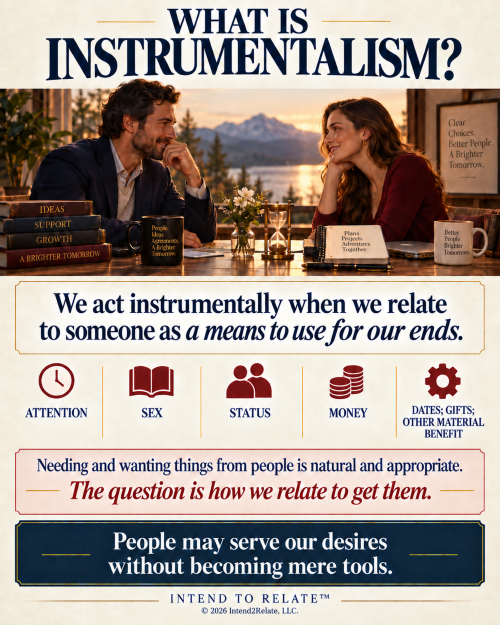
We act instrumentally when we relate to someone as a means to one of our ends. Those ends may involve material or emotional benefits: attention, sex, dates, gifts, access, companionship, or opportunity.
Needing and wanting things from other people is natural. The episode does not ask us to pretend otherwise. It makes a distinction:
People may serve our desires without becoming mere tools.
The ethical question is how we relate to the other person in seeking what we want.
Three forms of instrumentalism
The framework distinguishes ethical, unethical, and criminal instrumentalism.
Ethical instrumentalism is based on honesty, consent, fair exchange, clear boundaries, and respect for human dignity.
Unethical instrumentalism uses deception, coercion, exploitation, concealed agendas, or disregard for another person's interests.
Criminal instrumentalism, as described in the episode, crosses into conduct such as fraud, theft, violence, trafficking, extortion, or other unlawful means.
Exchange is not exploitation. Two people may openly want different things, negotiate the terms of their relationship, and freely decide that the exchange is good for both of them. Different desires do not prevent an ethical exchange.
Unconditional what?
The word unconditional can sound noble. But sometimes it becomes a demand for a blank check:
If you love me, you will give me what I want, and you will not ask questions.
Or a demand for unrestricted access:
If you love me, you will always be available when I call.
When "if you love me" means obey, provide, cancel, submit, or surrender your boundaries, love becomes leverage. That is why the episode asks: unconditional what?
Love is not one undifferentiated obligation. Desire, friendship, family attachment, generous care, enduring commitment, and playful affection can involve different intentions, expectations, and boundaries.
Love may be freely given. Access, money, sex, time, obedience, and continuing participation in a relationship are not automatically owed merely because someone invokes the word love.
Independent relational contractors
The framework describes sovereign individuals as independent relational contractors. The metaphor is not an assertion that relationships are merely commercial or that every human interaction should become a cold negotiation. It rejects relational ownership.
We do not belong to one another unconditionally. We are not indentured servants owing relationships as debts, domestic servants existing only to advance another person's purposes, or conscripts drafted into someone else's vision of the greater good. Nor are we employees living permanently under another person's direction and control.
We communicate, we choose, we agree conditionally.
Two sovereign people may build something profound together without either becoming the property, instrument, or permanent resource of the other.
Sovereignty alone is not enough
A person may be independent and still be deceptive, predatory, or cruel. Our aim is to be sovereign and good.
The episode states that aim in terms of enthusiastic and honest assent, the pursuit of mutual relational good, and "a refusal either to create victims or to become victims, in any sense or degree."
The ethical commitment concerns both how we seek what we want and how we respond to those who would take from us.
Wolves and snakes: different methods, the same wrong
The wolf takes by power without assent. The wolf intimidates, dominates, threatens, or overwhelms.
The snake obtains consent by falsehood. The snake conceals, manipulates, and misrepresents. It creates the appearance of choice while corrupting the information necessary for a real choice.
One takes your freedom openly. The other tricks you into surrendering it.
Different methods. The same wrong.
Serpent wisdom, never serpent methods
The episode draws a relational lesson from Jesus' instruction to his apostles to be wise as serpents and innocent as doves.
Sovereign does not mean naive. We should understand predators and deceivers, develop the discernment necessary to recognize manipulation, and retain the freedom to avoid it.
But understanding deception does not require adopting it.
Our answer to deception is not better deception.
The answer offered here is powerful authenticity: express intentions, express communication, express boundaries, and radical honesty.
More powerful than the wolves, wiser than the snakes, and always innocent as the dove.
Ethical exchange is a foundation, not the highest form of relationship
The ethics part of Intend to Relate has two directions. We want to identify new and socially accepted forms of relational predation and deception, and help people who presently rely on power or falsehood move toward ethical transactional instrumentalism. We also want people to understand instrumentalism so they can recognize exploitation, avoid victimization, and choose their relationships with open eyes.
This does not make transaction the highest form of relationship. The episode presents honest exchange as the minimum moral foundation upon which something higher can be built.
Intend to relate with discernment. Express your intentions, wants, rules, and boundaries. Seek what you desire without denying another person's sovereignty.
Remain sovereign and good, even among wolves and snakes.
Show Notes & Chapters
Timestamps follow the original episode transcript. Chapter titles are editorial navigation.
00:00 An Invitation to the Listener
00:38 The Serious Side of Intend to Relate
01:18 What Is Instrumentalism?
01:56 Ethical, Unethical, and Criminal Instrumentalism
02:23 Exchange Is Not Exploitation
02:36 Unconditional What?
03:33 Independent Relational Contractors
04:29 Sovereign and Good
04:49 Wolves and Snakes
05:17 Serpent Wisdom, Never Serpent Methods
06:00 The Ethics Part of the Project
06:34 Intend to Relate with Discernment
06:50 Closing the Listener Relationship
Full Transcript
Transcript note: Speaker labels have been removed, and paragraph breaks and timestamped headings added for readability. The supplied automatic transcript wording is preserved.
00:00 | An Invitation to the Listener
You're listening to The Intend2Relate Podcast, published by Intend2Relate LLC. Intend2Relate is interested in expanding human freedom and creativity in relationships.
We would like to enter into a non-exclusive podcast listener relationship involving a short-term limited power exchange dynamic, where you consent to considering some ideas as we present them, while retaining your judgment and critical thinking. We do not seek a deed to your mind in this relationship.
We ask for your assent to go on a journey with us into some ideas and tools regarding relationships. If you assent, let's intend to relate.
00:38 | The Serious Side of Intend to Relate
We have a lot to say about relationships, and some of it is about the fun stuff. We explore rosters, relational seasons, and the different people who may or may not belong in your batting line-up. We explore archetypal aims, including the polystable and the constellation, a freer network of meaningful connections, each with its own place, purpose, and possibility.
These models can be playful. They invite imagination and experimentation.
But Intend2Relate also has a very serious dimension. This project is concerned not only with what relationships we want, but with how human beings ethically pursue what they want from one another.
01:18 | What Is Instrumentalism?
That brings us to instrumentalism. The word sounds clinical, but the idea is ordinary. We act instrumentally when we relate to someone as a means to one of our ends. We may want attention, sex, status, money, dates, gifts, access, companionship, opportunity, or some other material or emotional benefit.
And there is nothing inherently wrong with that. Needing and wanting things from other people is natural. It is part of being human. People may serve our desires without becoming mere tools.
The ethical question is not whether we want something. The question is how we relate to another sovereign person in seeking it.
01:56 | Ethical, Unethical, and Criminal Instrumentalism
Our framework distinguishes three forms of instrumentalism.
Ethical instrumentalism is based on honesty, consent, fair exchange, clear boundaries, and respect for human dignity.
Unethical instrumentalism uses deception, coercion, exploitation, concealed agendas, or disregard for another person's interests.
And criminal instrumentalism crosses into conduct such as fraud, theft, violence, trafficking, extortion, or other unlawful means.
02:23 | Exchange Is Not Exploitation
Exchange is not exploitation. Two people may openly want different things, negotiate the terms of their relationship, and freely decide that the exchange is good for both of them. Ethical exchange is the good.
02:36 | Unconditional What?
This becomes especially important when we speak about unconditional love. Unconditional can sound noble, but sometimes it is used to demand a blank check. If you love me, you will give me what I want, and you will not ask questions.
Sometimes it becomes a demand for unrestricted access. If you love me, you will always be available when I call.
When if you love me means obey, provide, cancel, submit, or surrender your boundaries, love becomes leverage. That is why we ask, unconditional what?
Love is not one undifferentiated obligation. Desire, friendship, family attachment, generous care, enduring commitment, and playful affection are different forms of love. Each may involve different intentions, expectations, and boundaries.
Love may be freely given, but access, money, sex, time, obedience, and continuing participation in a relationship are not automatically owed merely because someone invokes the word love.
03:33 | Independent Relational Contractors
This is also why our model describes sovereign individuals as independent relational contractors. Not because relationships are merely commercial, and not because every human interaction should become a cold negotiation. The metaphor matters because it rejects relational ownership.
We are not masters and slaves. We do not belong to one another unconditionally. We are not indentured servants owing relationships as debts. We are not domestic servants existing only to advance another person's purposes. We are not conscripts drafted into someone else's vision of the greater good, and we are not employees living permanently under another person's direction and control.
We are independent relational contractors. We communicate, we choose, we agree conditionally.
Two sovereign people may build something profound together without either becoming the property, instrument, or permanent resource of the other.
04:29 | Sovereign and Good
But sovereignty alone is not enough. A person may be independent and still be deceptive, predatory, or cruel.
Our aim is to be sovereign and good. That means enthusiastic and honest assent, the pursuit of mutual relational good, and a refusal either to create victims or to become victims, in any sense or degree.
04:49 | Wolves and Snakes
The world, however, contains wolves and snakes.
The wolf takes by power without assent. The wolf intimidates, dominates, threatens, or overwhelms.
The snake obtains consent by falsehood. The snake conceals, manipulates, misrepresents, and creates the appearance of choice, while corrupting the information necessary for a real choice.
Different methods. The same wrong. One takes your freedom openly. The other tricks you into surrendering it.
05:17 | Serpent Wisdom, Never Serpent Methods
Jesus warned his apostles that they were being sent as sheep among wolves. He instructed them to be wise as serpents and innocent as doves. For us, that instruction carries a powerful relational lesson.
Sovereign does not mean naive. We should understand predators and deceivers. We should develop the discernment necessary to recognize manipulation and the freedom to avoid it.
But serpent wisdom does not require serpent methods. Our answer to deception is not better deception.
Our answer is powerful authenticity. Express intentions, express communication, express boundaries, and radical honesty.
More powerful than the wolves, wiser than the snakes, and always innocent as the dove.
06:00 | The Ethics Part of the Project
That is the ethics part of Intend2Relate. We want to identify new and socially accepted forms of relational predation and deception.
We want people who presently rely on power or falsehood to move toward ethical transactional instrumentalism. Not because transaction is the highest form of relationship, but because honest exchange is the minimum moral foundation upon which something higher can be built.
And we want people to understand instrumentalism so they can recognize exploitation, avoid victimization, and choose their relationships with open eyes.
06:34 | Intend to Relate with Discernment
The broader goal is simple. Intend to relate with discernment. Express your intentions, wants, rules, and boundaries. Seek what you desire without denying another person's sovereignty. Remain sovereign and good, even among wolves and snakes.
06:50 | Closing the Listener Relationship
You've been listening to The Intend2Relate Podcast, published by Intend2Relate LLC. Our short-term podcast listener relationship is now complete.
You retain your judgment, your critical thinking, and your freedom to accept, reject, revise, or carry forward any idea we have explored together. We do not ask you to surrender your mind to us.
We hope only that something here has helped you see yourself, another person, or a relationship with greater clarity and possibility. Thank you for going on this journey with us.
Until next time, be free and be good to each other intentionally.
Related Concepts
Ethical instrumentalism; unethical and criminal instrumentalism; consent and assent; relational sovereignty; independent relational contractors; unconditional love; mutual relational good; wolves and snakes; discernment; powerful authenticity; express intentions and boundaries.
Join the Conversation
Where do you most need greater clarity: in what you want, what you are offering, or the boundaries of your participation?
About Intend to Relate
Intend to Relate is interested in expanding human freedom and creativity in relationships. These ideas and tools are offered for consideration while you retain your judgment, your critical thinking, and your freedom to accept, reject, revise, or carry forward what you find here.
Published by Intend2Relate, LLC.
Be free and be good to each other—intentionally.
Member discussion: