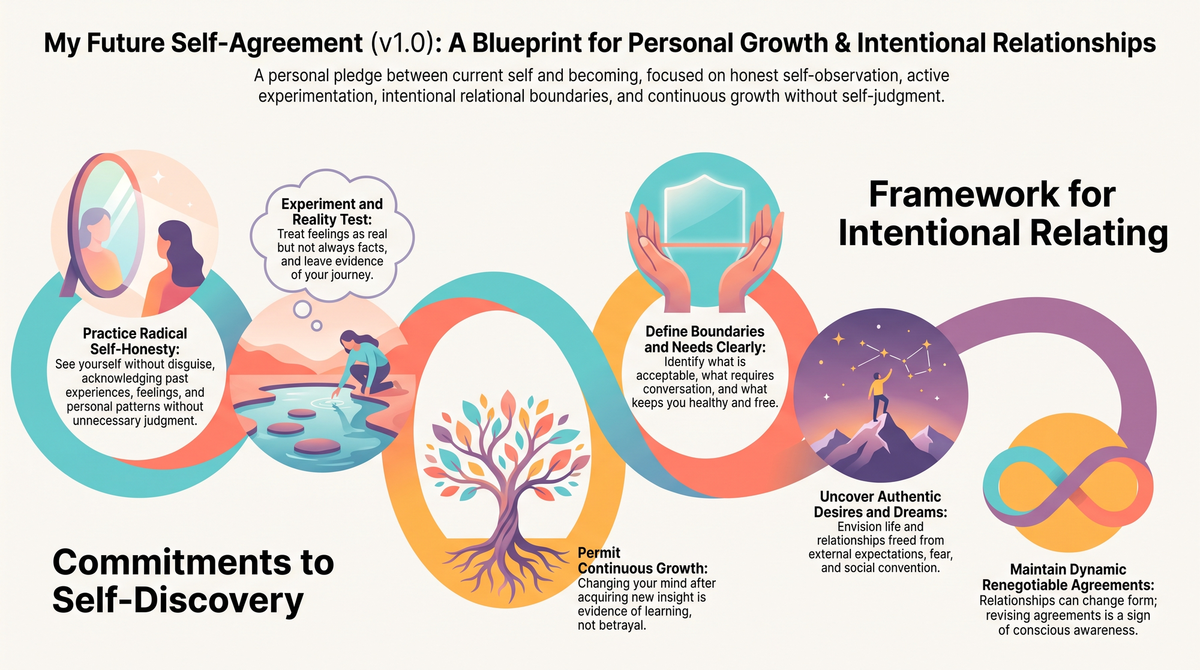
Season One, Episode Three: Do you intend to relate? The My Future Self Agreement
Member Resource: My Future Self-Agreement, Version 1.0
Members can download the working agreement introduced in this episode and use it as a starting point for their own reflection, revision, and future-self practice.
Become a member to access the agreement.
My Future Self-Agreement, Version 1.0
An Agreement Between Who I Am Now and Whoever I Become
What obligations do you owe the person you are becoming?
We routinely make agreements with other people. We promise to show up, pay, perform, remain faithful, keep something confidential, care for someone, complete a project, or respect a boundary.
But there is another person whose life is profoundly affected by what we undertake today:
our future self.
My Future Self-Agreement, Version 1.0 begins there.
It is not a promise to become one predetermined person. It is almost the opposite.
The agreement is a commitment to pay attention.
To know yourself more honestly.
To experiment rather than merely speculate.
To remember what happened.
To distinguish feelings from facts.
To understand your boundaries, needs, desires, hopes, dreams, and agreements.
And to allow what you learn to change what comes next.
The agreement therefore treats identity as something neither completely fixed nor infinitely disposable.
Your future self is not a stranger.
You are participating in that person's creation now.
The Agreement Begins With Self-Knowledge
The first undertaking is simple to state and difficult to practice:
I want to know me.
Not merely the person I perform for other people.
Not only the person I have already been.
The person I am—and the person I am becoming.
That requires a kind of radical self-honesty.
What happened?
What did I love?
What hurt?
What worked?
What did not?
What patterns keep appearing?
What do my choices, fears, desires, habits, contradictions, body, and intuition seem to be telling me?
The purpose is not relentless self-judgment.
It is better information.
You cannot intentionally design a life around a person you refuse to encounter honestly.
Experiment, Remember, and Reality-Test
Self-knowledge does not emerge entirely through introspection.
Sometimes we have to live something to learn something.
The Future Self Agreement therefore gives permission to experiment:
Try things.
Experience.
Study.
Change your mind.
Ask for help.
Journal.
Leave evidence for the person you will become about what it actually felt like to be you today.
That record matters because memory changes.
A journal, photograph, note, recording, or other artifact can let a future version of you encounter evidence from an earlier season rather than reconstructing everything through hindsight.
But experience also needs reality testing.
One of the agreement's central propositions is:
My feelings are real. They are not always facts. My assumptions may be wrong.
The point is not to distrust emotion.
Feelings are information about experience.
But they do not automatically establish what another person intended, what occurred outside our perception, or what conclusion the evidence supports.
Relational intelligence requires room for both experience and correction.
Know How You Want to Relate
Self-knowledge eventually becomes relational.
The agreement therefore asks us to examine several dimensions of participation with other people.
Boundaries
What is okay with me?
What is not?
What requires a conversation?
Needs
What do I genuinely require to remain healthy, free, safe, connected, and myself?
Desires
What do I actually want?
And how much of what I think I want was simply handed to me by convention, fear, family, culture, or expectation?
Hopes
What possibilities do I want to leave open?
Dreams
If fear, convention, and expectation disappeared for a moment, what kind of life and relationships might I imagine?
Agreements
What do I want to offer another person?
What am I genuinely willing to promise?
What would I like another person to undertake toward me?
And what should remain entirely free?
These questions do not provide one universal relationship model.
They help us understand the conditions of our own participation.
Only then can another person meaningfully answer what we offer.
Revision Is Part of the Agreement
An agreement with the future cannot sensibly require the future never to teach us anything.
So Version 1.0 expressly permits revision.
A boundary may become clearer.
A desire may change.
A dream may grow.
An agreement may be renegotiated.
A relationship may change form.
Something we once sincerely wanted may turn out not to fit us at all.
The important distinction is between careless inconsistency and revision informed by attention.
Changing after learning is not necessarily failure.
It may be evidence that we were paying attention.
That does not eliminate responsibility for commitments already made to other people. Learning something new does not magically cancel an undertaking.
But it does mean growth should eventually become new information for the way we live and relate.
The Future Self Is Already Being Made
The agreement closes by shifting the future from abstraction into participation.
My future self is not a stranger. I am creating that person now.
So the undertaking is not to predict precisely who that person will be.
It is to leave them something useful.
Experience.
Memory.
Evidence.
Reflection.
Better questions.
More honest boundaries.
Revised rules.
And the knowledge that their earlier self was trying to pay attention.
The final commitments are therefore active:
Live.
Remember.
Experiment.
Reflect.
Choose.
I intend to know myself.
I intend to know how I want to relate.
I intend to become consciously.
Intention today. Awareness tomorrow. Freedom forever.
Key Ideas
The Future Self as a Relational Partner
The Future Self Agreement treats the person you are becoming as someone affected by today's choices.
That does not mean the future self gets to dictate the present.
It means present choices create conditions the future self will inherit.
Radical Self-Honesty
Self-discovery begins by distinguishing the performed self from the experienced self and examining desires, fears, habits, contradictions, choices, and patterns without unnecessary judgment.
Experimentation
Understanding yourself sometimes requires participation rather than prediction.
Try, experience, record, and learn.
Reality Testing
Feelings are genuine experiences without automatically being proof of every conclusion attached to them.
My feelings are real. They are not always facts. My assumptions may be wrong.
Relational Architecture
Boundaries, needs, desires, hopes, dreams, and agreements provide a practical vocabulary for understanding how we want to participate with others.
Revision
Growth requires the ability to revise our understanding when experience supplies better information.
Changing after learning is not failure. It is evidence that I was paying attention.
Watch: Companion Video Brief
How to Draft a Contract with Your Future Self
This short visual companion explores the Future Self Agreement as a practical framework for self-knowledge, experimentation, intentional boundaries, and continuous revision.
The companion video is an AI-assisted interpretation of Intend to Relate source material. The episode and written agreement remain the primary source.
Show Notes & Chapters
00:00 — The Podcast-Listener Agreement
Intend to Relate's recurring invitation: consider the ideas being presented while retaining judgment, critical thinking, and freedom to accept, reject, revise, or carry them forward.
00:39 — My Future Self-Agreement, Version 1.0
The agreement begins between the present self and whoever that person becomes.
Radical self-honesty, memory, experimentation, study, asking for help, journaling, and reality testing.
01:59 — Know How You Want to Relate
The relational inquiry:
- boundaries
- needs
- desires
- hopes
- dreams
- agreements
What do I want to offer?
What am I willing to promise?
What do I want another person to promise?
What should remain free?
02:37 — Permission to Revise
Boundaries clarify.
Desires change.
Dreams grow.
Agreements can be renegotiated.
Relationships can change form.
Learning may require revision rather than rigid consistency.
02:55 — Becoming Consciously
The future self is being created through present participation.
Live.
Remember.
Experiment.
Reflect.
Choose.
03:14 — Closing the Listener Relationship
The short-term podcast-listener relationship ends, and judgment returns explicitly to the listener.
Transcript
00:00 — The Podcast-Listener Agreement
You're listening to The Intend to Relate Podcast, published by Intend2Relate, LLC.
Intend to Relate is interested in expanding human freedom and creativity in relationships.
We would like to enter into a non-exclusive podcast-listener relationship involving a short-term limited power-exchange dynamic, where you consent to considering some ideas as we present them while retaining your judgment and critical thinking.
We do not seek a deed to your mind in this relationship.
We ask for your assent to go on a journey with us into some ideas and tools regarding relationships.
If you assent, let's Intend to Relate.
00:39 — My Future Self-Agreement, Version 1.0
An agreement between who I am now and whoever I become.
I want to know me.
Not the person I perform.
Not merely the person I have been.
The person I am, and the person I am becoming.
So I agree:
To be honest with myself, especially when the truth is inconvenient.
To look myself in the mirror.
To see myself without unnecessary judgment or disguise.
To remember where I came from, what happened, what I loved, what hurt, what worked, what didn't.
To pay attention to my desires, fears, habits, contradictions, body, intuition, choices, and patterns.
To experiment.
I am allowed to try things, to experience, to discover, to change my mind.
To journal.
To leave evidence for my future self of what it felt like to be me today.
To study life, philosophy, psychology, history, art, love, other people, and myself.
To ask for help.
I do not have to understand everything alone.
To reality-test myself.
My feelings are real.
They are not always facts.
My assumptions may be wrong.
To forgive revision.
Changing my mind after learning something new is not betrayal.
Growth is permitted.
To keep my word to myself—or acknowledge when I don't.
No bullshit promises, including the ones nobody else can hear.
To remain curious about who I am becoming.
There is more to learn.
And that's the point.
01:59 — Know How I Want to Relate
And I agree to know how I want to relate.
My boundaries.
What is okay with me?
What isn't?
What requires a conversation?
My needs.
What do I genuinely need to remain healthy, free, safe, connected, and myself?
My desires.
What do I actually want—not merely what I was taught to want?
My hopes.
What possibilities would I like to leave open?
My dreams.
If fear, convention, and expectation disappeared for a moment, what kind of life and relationships would I imagine?
My agreements.
What do I want to offer another person?
What am I willing to promise?
What do I want them to promise me?
And what should remain completely free?
02:37 — Revision
And I agree to revise.
A boundary can become clearer.
A desire can change.
A dream can grow.
An agreement can be renegotiated.
A relationship can change form.
I can discover that something I thought I wanted isn't for me.
Changing after learning is not failure.
It is evidence that I was paying attention.
02:55 — Becoming Consciously
My future self is not a stranger.
I am creating that person now.
So I will live, remember, experiment, reflect, and choose.
I intend to know myself.
I intend to know how I want to relate.
I intend to become consciously.
Intention today. Awareness tomorrow. Freedom forever.
Intend to Relate.
03:14 — Closing
You've been listening to The Intend to Relate Podcast, published by Intend2Relate, LLC.
Our short-term podcast-listener relationship is now complete.
You retain your judgment, your critical thinking, and your freedom to accept, reject, revise, or carry forward any idea we have explored together.
We do not ask you to surrender your mind to us.
We hope only that something here has helped you see yourself, another person, or a relationship with greater clarity and possibility.
Thank you for going on this journey with us.
Until next time:
Be free, and be good to each other—intentionally.
Related Intend to Relate Concepts
Future Self Agreement · Relational Intelligence · Boundaries · Needs & Desires · Reality Testing · Relational Agreements · Seasons · Revision · Seven-Day Connection Pact
Member discussion: