Mating Snakes and the Treat Yourself Principle
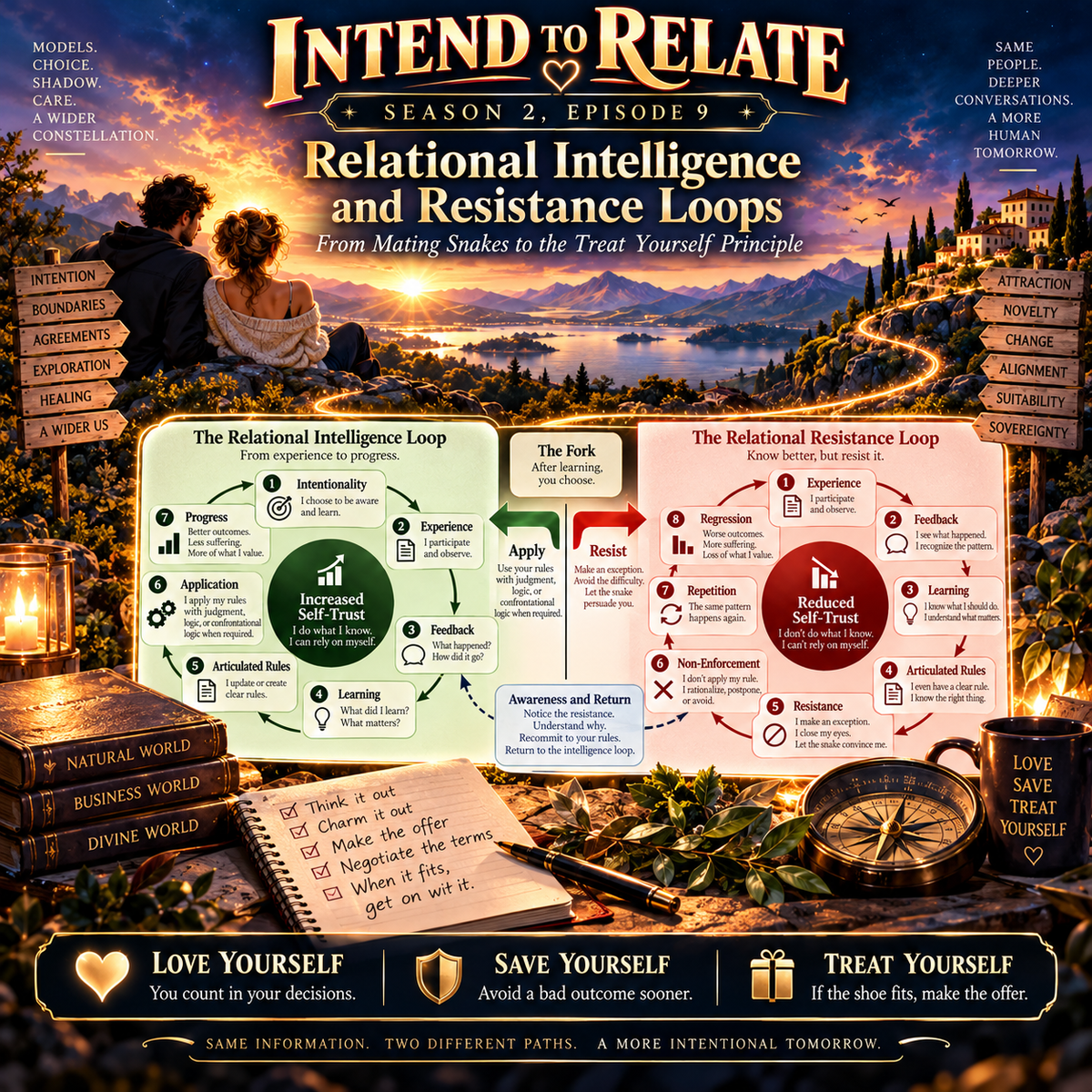
Season Two, Episode Nine asks how learning becomes conduct—and how the same tools can help us leave a painful pattern or begin a worthwhile relationship.
Episode guide · Full transcript
Knowing better is an achievement. Acting on that knowledge is another.
Season Two, Episode Nine of The Intend2Relate Podcast connects the project’s tools through two possible movements: the relational intelligence loop and the resistance loop. Both may begin with experience, learning, and an articulated rule. They diverge when the moment arrives to apply what has been understood.
The episode also introduces “mating snakes,” a metaphor for external deception and internal rationalization reinforcing one another. It then turns toward a positive demand: if a worthwhile relationship fits, make the offer. The framework should help us move toward participation as well as away from avoidable loss.
Three reasons to act
“Love yourself. Save yourself. Treat yourself.” These principles give the episode its direction.
Love yourself means that your well-being, joy, pain, and future belong in your own decisions. Other people matter, and you count too. Save yourself concerns avoidable loss: when a cost can reasonably be avoided, its emotional difficulty does not make the cost disappear.
Treat yourself turns attention toward opportunity. When there is a meaningful proposal and a worthwhile fit, bring the relationship agreement into conversation. Let the other person encounter an actual invitation, negotiate its terms, and begin if the undertaking works for both of you.
The three principles support a common practice: take what you understand seriously enough to let it influence participation. Sometimes that means a refusal. Sometimes it means an apology. Sometimes it means making the offer you have been afraid to make.
The relational intelligence loop
The loop begins with intentionality. We attend to what we are doing and what matters. We participate, receive feedback, interpret experience, and learn. Then the learning takes a usable form in an articulated rule.
“I value dependability” can become a decision not to organize major commitments around participation that remains repeatedly unreliable. “I value independence” can become a practice of preserving meaningful relationships and resources outside a partnership.
The rule then enters another decision. We consider the relevant facts, apply what we have learned, and act—or revise the rule honestly when new understanding warrants it. Experience supplies further feedback.
The reinforcing possibility is self-trust. There is evidence that when we notice something and make a considered commitment, we will respond to it. The action may still hurt. Grief after applying a boundary does not establish that learning failed to become useful.
A personal rule and a shared agreement also have different sources. A boundary governs our participation. A relationship agreement requires shared assent. Treating a private preference as though another person had accepted it would confuse the very terms the framework is meant to clarify.
Where resistance interrupts the movement
The resistance loop may contain the same learning and the same rule. The divergence is that we resist an implication we still consider appropriate: “I know, but not this time.” The rule remains persuasive in the abstract and becomes inconvenient in the actual encounter.
Rationalization, postponement, or avoidance can then preserve the familiar pattern. The cost may include both the outcome and the weakening of confidence in our own commitments. Another emphatic promise becomes less credible because the person who will live with it remembers what happened before.
The episode does not classify every difficulty acting as resistance. Dependence, uncertainty, practical constraints, and the lack of a safe way to act can require support. A defective rule may need revision. The model should illuminate the gap between understanding and participation, rather than turn every gap into a moral accusation.
What “mating snakes” names
One person supplies a deceptive account. Another begins protecting that account from examination despite evidence they no longer find credible. The external story and the internal exception support the same continuing arrangement.
Imagine a promised future that never becomes a workable undertaking. The external claim is that everything will change soon. The internal rationalization is that the promise itself is enough reason to suspend the rule again.
The metaphor does not assign equal responsibility. The person deceiving remains responsible for the deception. Being misled does not make someone responsible for another person’s dishonesty. The additional question is whether there is now a place where our own participation can change.
Affection makes that difficult. “I love this person” and “I want their promise to be true” may both be accurate. Neither establishes that the promised participation exists. The framework makes room for the feeling while asking a separate question about the facts.
Logic, application, and the proposed exception
The episode uses if–then reasoning, explicit premises, and the practical structure of Issue, Rule, Application, Conclusion. The aim is to make the reasoning visible enough to examine.
What decision is before me? What rule applies? What facts are established? What follows when the rule meets those facts?
Confrontational logic then examines the proposition that would interrupt the reasoning. “This time is different” needs a relevant difference. “They love me” does not by itself establish availability or reliability. Prior investment describes the past without automatically justifying another investment.
The confrontation is with the proposition, not the person’s dignity. It can take place privately. It does not require obtaining a confession or persuading the other person to endorse our boundary.
The rule itself remains examinable. It may be too broad, poorly founded, or inconsistent with our values. Honest revision in response to learning is part of intelligence. Quietly suspending a rule because we dislike its conclusion is a different process.
The third loan: reasoning is not yet follow-through
The first worked example concerns a new loan request while two earlier loans remain overdue. The stated rule is that no new credit will be extended while the previous loans remain unpaid. No relevant difference has been established. The conclusion is straightforward.
Then comes the emotionally difficult part: imagining the disappointment, fearing damage to the relationship, and deciding whether to act. The facts have not changed merely because the conclusion now feels costly.
One available response is to maintain the boundary. Another is deliberately to offer a bounded gift with no expectation of repayment. That would be a different undertaking, honestly named. Pretending that the unchanged loan is now supported by different evidence would preserve the rationalization.
After the choice comes review. What happened? What was learned? The complete loop includes both the reasoning and the lived consequences of acting on it.
The fifteen scenarios—and what they test
The episode’s examples cover more than deliberate dishonesty. Several concern uncertainty, inadequate terms, or a conclusion the person must correct. Read together, they show that the method needs to work in more than one direction.
| Situation | Distinction to examine | Proportionate next step |
|---|---|---|
| A third loan after two unpaid loans | A new promise versus changed evidence | Apply the credit boundary or explicitly choose a different undertaking, such as a bounded gift. |
| “We are basically done” with an existing relationship | A description versus actual availability | Clarify what has ended and what remains before building around the offer. |
| A repeatedly postponed move | Repeated intention versus an actionable plan | Stop treating the move as settled; discuss a workable plan. |
| “I will leave when the children are older” | Being loved versus being available | Evaluate the present arrangement rather than treat a possible future as an agreement. |
| Endless suggestions to meet | Interest versus an agreed plan | Make a specific invitation; stop reserving time if no plan emerges. |
| An updated dating profile during agreed exclusivity | Forgetting to delete versus actively updating | Address the established inconsistency without inventing additional conduct. |
| Denial of an established overnight boundary | An unwritten agreement versus no agreement | Address the conduct and the denial; record important terms going forward. |
| Exclusivity demanded without reciprocal terms | A label versus the actual commitments | Propose clear participation instead of relying on hoped-for reciprocity. |
| Deliberately concealed debt before a shared purchase | Discovery versus resolution | Pause the proposed commitment and address both the obligation and concealment. |
| Deleted messages and a dismissive insult | A concern versus proof of an affair | Discuss the specific discrepancy and applicable boundaries. |
| No public acknowledgement of the relationship | A privacy explanation versus agreed expectations | Ask what acknowledgement is available and assess fit. |
| A changed password | A reason for concern versus established betrayal | Discuss the change without assuming that phone access settles the issue. |
| Bottles after a claim to have stopped drinking | Observation versus when and by whom they were used | Seek clarity and consider available support and boundaries. |
| Intense chemistry and rapid commitment | A real feeling versus readiness for every undertaking | Match the commitment to what is actually understood and wanted. |
| Suspicious late nights supported by a real work deadline | Past injury versus this person’s conduct | Correct the unsupported accusation and acknowledge unfair treatment. |
The final example is essential. A method that can only confirm suspicion is unable to correct itself. Here, the evidence supports the other person’s explanation. Learning requires revising the accusation.
Returning to the intelligence loop
The gap between the rule and the conduct can itself become a subject of inquiry. What makes application difficult? Attachment, loneliness, fear, an unanswered question, a practical obstacle, or a genuine problem with the rule may require different responses.
A deliberate exception can also be named, bounded, and reviewed. People can knowingly accept a cost or extend another chance because a relationship matters. The distinction is between an acknowledged choice and a denied reality.
Returning may begin with a manageable step: clarifying an agreement, pausing a commitment, asking for support, or revising an unrealistic undertaking. The one-day and seven-day practices remain available. A lapse can become information without becoming a verdict on the person’s worth.
Treat yourself: make the offer
The payoff is affirmative. Preparation should make a worthwhile beginning easier to recognize and propose. “If the shoe fits, make the offer.”
Think it out: understand your aims, available participation, and material terms. Charm it out: make the invitation warm, appealing, and honest. Negotiate: let the other person’s answer shape what becomes shared.
The proposal can be modest. Perhaps it is a few weeks of intentional exploration, a recurring evening together, or a friendship with a clearer undertaking. The knowledge needed for that beginning differs from what would be needed to combine entire lives.
Promptness belongs to making the proposal, not demanding an immediate answer. The other person can counteroffer or decline. If one person wants exclusivity and the other is not offering it, the difference needs attention instead of being privately imagined away.
Resistance can occur here too. We may keep hinting because an actual offer would expose us to an actual answer. Then the question becomes whether we are withholding the action needed to discover if a wanted relationship is possible.
Four sentences to carry forward
- This is what I have learned.
- This is the rule that follows.
- This is what makes applying it difficult.
- This is the next action I will take—or the revision I can honestly explain.
The exercise can lead toward a boundary, an apology, or an invitation. Across those different outcomes, the task remains the same: let understanding influence participation, and let experience continue to refine understanding.
Love yourself. Save yourself. Treat yourself. There is a life to participate in, and a worthwhile agreement should help us begin.
Continue with Intend to Relate
Explore the framework at Intend2Relate.com and continue reading in the Intend to Relate journal. New to the original podcast? Begin with Season One for the foundational language and models.
Read and listen through the Primer and audiobook page, or join as a free member for the ebook. The Present and Future Self Creditor Assessment offers a further reflective exercise.
Questions, disagreements, and experiences with the tools are welcome in the YouTube community. What became clearer for you, and what would you examine differently?
Be free, and be good to each other—intentionally.
Episode guide
Chapter points derived from the supplied transcript.
- 00:00 — Opening and the three worlds
- 02:18 — Love, save, and treat yourself
- 03:23 — The intelligence loop
- 04:56 — The resistance loop
- 06:04 — Mating snakes
- 07:36 — Logic and application
- 09:23 — Fifteen worked scenarios
- 17:12 — Returning to the intelligence loop
- 19:05 — Treat yourself: make the offer
- 22:44 — Four sentences to carry forward
Full episode transcript
The full supplied transcript is reproduced below, formatted into paragraphs with editorial section headings. Timing and speaker markup have been removed from the running text; minor typographical corrections are identified in the draft’s editorial notes. This is a reading copy, not an audio-verified verbatim transcript.
00:00 · Opening and the three worlds
Welcome back to Intend2Relate. This is season two, episode nine, A Little Housekeeping First. Our companion podcasts, To Him, To Her, and To Them, are developing alongside this shared foundation. Our free audio book is available. The ebook comes with signing up for our updates, and the present and future self creditor assessment is there for you to explore. Today, we are connecting several tools through the relational intelligence and resistance loops. Then we are going to apply them in both directions, getting out of patterns we no longer intend, and getting into relationships we actually want.
The purpose remains straightforward. Navigate complex relational reality more successfully, create more of what we value, and reduce avoidable suffering and loss. That means bringing thinking into conversation with feeling. Affection, desire, fear, grief, and hope belong in the process. But a feeling does not by itself establish another person's intentions or determine our next decision. We want experience to become understanding and understanding to influence conduct. Sometimes we learn, articulate a rule, and apply it.
Sometimes we learn the same lesson, articulate the same rule, and close our eyes when the moment arrives to use it. That is the fork in today's model. This work belongs across our three worlds. In the natural world lens, the predator illustrates attention to vulnerability, opportunity, timing, and risk. Protection requires attention too. Being good does not remove the need to perceive what is happening. Someone else may be acting on information we are avoiding.
In the business world lens, information becomes consequential through decisions. We assess costs, opportunities, commitments, and returns. Time, energy, attention, and money are limited. Recognizing those limits does not reduce a person's worth to a price. In the divine world lens, our orientation is toward truth. Truth does not require our approval. Grace and forgiveness may shape our response, but they do not require us to deny what happened. Forgiving a betrayal is different from declaring that none occurred.
Across these worlds, we try to encounter reality, understand it, and decide how to participate. Our interpretation remains open to correction.
02:18 · Love, save, and treat yourself
Three working principles give that participation a direction. Love yourself. I count in my own decision making. My well-being, joy, pain, and future deserve consideration. Other things being equal, I prefer positive experiences to negative ones. Other people matter, and so do I. Save yourself. When a bad outcome can reasonably be avoided, avoid it sooner rather than absorb a greater loss later. If the same expense is $100 today and $150 next week, with no benefit to waiting, the preference is simple.
Relational decisions are more complicated, but foreseeable costs still deserve attention. Treat yourself. When a worthwhile opportunity fits, make the offer. Bring the relationship agreement into the conversation promptly. Negotiate what you actually want to undertake together, and begin when the terms work for both of you. Love yourself enough to count. Save yourself from avoidable loss. Treat yourself to worthwhile participation. These are not three competing slogans. They are three reasons to act on what we understand.
03:23 · The intelligence loop
The relational intelligence loop begins with intentionality. We give attention to what we are doing and what matters to us. We participate. Experience produces feedback. We interpret it and learn. Then we articulate the learning as a rule. I value dependability becomes, I will not organize major life commitments around participation that remains repeatedly unreliable. I value independence becomes, I will preserve meaningful relationships and resources outside my partnership. Some rules are with ourselves, boundaries, decision rules, and promises to our future selves.
Others are relationship agreements. A personal boundary governs my participation. A shared agreement requires shared assent. Other rules come from institutions, professions, religion, or law. Their source and application also need to be understood. Rules supply premises for reasoning. We bring the relevant facts together with the applicable rule and decide what follows. Intentionality, experience, feedback, learning, articulated rules, application, and progress. The reinforcing effect we are looking for is self-trust. I notice something, take it seriously, and make a considered commitment to myself.
When the relevant circumstances arise, I respond or honestly revise the commitment. That gives me evidence that I can rely on myself. Self-esteem may grow alongside it. Progress does not mean every decision feels good. Applying a sound boundary may bring grief. It means our learning is beginning to influence how we live.
04:56 · The resistance loop
The resistance loop starts with much of the same information. We experience, learn, and articulate a rule. Then we resist its implications. I know, but I do not want to deal with it. I know what I said I would do, just not this time. Resistance becomes non-enforcement. We rationalize, postpone, or avoid applying a rule we still consider appropriate. The familiar pattern repeats. There can be two costs. The cost of the pattern itself, and the loss of self-trust that comes from repeatedly abandoning our own considered commitments.
That can make the next commitment feel less credible and the next exception easier. Learning and rules, followed by resistance, non-enforcement, repetition, regression, and reduced self-trust. These are possible directions, not fixed kinds of people or guaranteed outcomes. And not every difficulty acting is resistance. Missing information, dependence, practical constraints, or the absence of a safe way to act may call for support rather than self-accusation. The distinction is between learning that carries forward and learning we keep setting aside.
06:04 · Mating snakes
One version of the resistance loop involves what I call mating snakes. We are naming two deceptive arguments that reinforce each other. One partner deceives the other about the facts or their intentions. The person being deceived also begins deceiving themselves about the evidence, their own rule, or what continuing participation means. Imagine someone promising a committed future they do not intend to build. Their partner notices repeated contradictions, but desperately wants that future. The external snake says, I mean it, everything will change soon.
The internal snake says, the promise is enough, I do not need to apply my rule yet. One supplies the story, the other protects it from examination. That is the mating. External deception and internal rationalization do not sustain the same arrangement. This does not make both people equally responsible. The deceiver remains responsible for the deception. Being deceived does not make someone responsible for another person's dishonesty. The additional place to interrupt the pattern is our own participation in preserving an explanation we no longer find credible, and feelings make this hard.
Applying the rule may require grieving the person, the arrangement, or the imagined future. We do not answer that difficulty with humiliation. I love this person can be true. I want their promise to be true can be true. Neither establishes that the promise is being fulfilled. We can acknowledge the feeling without asking it to establish the facts.
07:36 · Logic and application
Logic connects premises to conclusions. The simplest form is if then. If the rule applies and these are the relevant facts, then a conclusion follows. A deductive syllogism makes the premises and conclusion explicit. It still needs true premises and a valid inference. A practical structure borrowed from legal analysis is IRAC. Issue Rule Application Conclusion. We identify the decision, state the rule, apply it to the facts, and reach a conclusion. Confrontational logic examines the proposition or exception that would interrupt that reasoning.
This time is different needs a relevant difference. They love me does not establish dependable participation. I have already invested so much describes the past. It does not by itself justify the next investment. We confront the proposition, not the person's dignity. This can happen privately. It does not require an argument or a confession from someone else. We also examine our own rule. It may be too broad based on mistaken information or inconsistent with our values.
Honest revision belongs inside the intelligence loop. Revising a rule because we have learned something is different from suspending it because we dislike its conclusion. Keep three things separate. What happened, what we infer, and what we will do. We do not need certainty about every hidden intention before deciding what participation the available facts justify. These examples involve promises, agreements, suspicions, and emotionally difficult decisions. Some contain deception. Others contain uncertainty or an interpretation we need to correct.
Listen for the explanation offered, the exception we supply ourselves, and the action that follows from the rule. We will work the first case all the way through.
09:23 · Fifteen worked scenarios
A third loan request arrives. The first two loans are overdue. The explanation is, this time is different. I will pay you Friday. The internal exception is, they would do the same for me. Issue, whether to lend again. Rule, I do not extend new credit while the earlier loans remain unpaid. Application, the earlier loans remain unpaid and no relevant difference has been offered. Conclusion, no new loan. Now the reasoning is finished, but the decision is not.
I imagine their disappointment. I worry that refusing will damage the relationship. The facts have not changed. Applying my rule now has an emotional cost. In the resistance loop, I lend again while still believing my rule applies. If the familiar outcome repeats, I face both the loss and the recognition that I abandoned my own decision. In the intelligence loop, I follow through. I care about you, but I am not making another loan, or I deliberately choose a gift without expecting repayment.
That is a different undertaking. I name what I am choosing and its limits. Afterward, I review what happened and what I learned. That is the complete movement from reasoning into participation and feedback. They say, we are basically done. It is just paperwork. Their actual availability remains unclear. My internal exception is asking would make me look jealous. My rule is that I do not build around someone else's unfinished commitment. Basically done does not establish what has ended or what remains.
I hold further investment until the situation is clear enough for the relationship being proposed. I do not need an accusation to request clarity. For a year, the move has been coming after the next holiday. Four postponements later, there is still no workable plan. They say it is coming, I promise. I tell myself that repetition proves intention. My rule is that I do not organize my life around a move without an actionable plan.
Repeating the promise has not produced one. I stopped treating the move as settled and negotiate something specific. That conclusion does not require proving that they never meant it. I will leave when the children are older. I answer internally, I am the one they really love. Being loved and being available for the relationship I want are different propositions. Whatever the feelings, the present arrangement remains the marriage. I decide whether I want to participate in what is available, rather than treating a possible future as an existing agreement.
Months of we should get together soon, followed by no actual plans. They say, I have been busy. I say to myself, at least they think of me. My rule is that I organize time around agreed plans, not indefinite suggestions. I make one specific invitation. If no workable plan emerges, I stop reserving space for one. The facts establish unavailability for a plan, not necessarily an absence of care. We agreed to exclusivity. A recent profile update is confirmed.
They say, I forgot to delete it. I tell myself, it is just an app. Forgetting to delete a profile does not explain updating it. My rule is to address a material inconsistency with our agreement rather than explain it away. The conversation happens now. I do not need to invent additional conduct beyond what is established. We agreed that neither of us would host other dates overnight. An overnight visit occurs, and now the response is, we never agreed to that.
I begin telling myself that perhaps it did not count because we never wrote it down. In this example, the agreement and the departure from it are established. The absence of writing does not erase the agreement. I address both the conduct and its denial. Going forward, we record important terms so that recollection has something to work with. They expect exclusivity from me but will not discuss what they are offering. The explanation is, labels ruin things.
My internal exception is, eventually they will come around. The label is not the immediate issue. The terms are, my rule is that I do not undertake commitments on the assumption that another person will later reciprocate. I propose the actual arrangement I want. We can agree without a conventional label, but not without understanding the participation. A major debt surfaces while we are preparing to buy a home together. In this example, it was deliberately concealed.
They say, I was going to tell you, I tell myself, it is out now, so it no longer matters. My rule is no major shared commitment, while material dishonesty remains unresolved. There are two issues, the obligation and the concealment. Disclosure is not resolution. We pause the proposed purchase and address both before deciding whether to proceed. There is frequent contact, deleted messages, and a dismissive response when I raise a concern. You are paranoid.
I begin treating the insult as an answer. My rule is that a label does not resolve a specific concern. Deleted messages alone do not establish an affair, and friendship with an ex is not itself a breach. I identify the actual discrepancy and discuss the boundaries we have agreed to. I neither withdraw a reasonable question nor inflate it into a proven accusation. They share friends and outings publicly but never acknowledge our relationship.
The explanation is, I am private. My internal answer is, then I should not bring it up. Privacy can differ across parts of a person's life. The distinction does not prove deception, but the general explanation does not settle its meaning for our relationship. I ask directly about acknowledgement and decide whether what is offered fits what matters to me. A changed password and guarded phone prompts suspicion. They say, you do not trust me.
I tell myself that trust means never asking anything. My rule is that concern may be discussed without treating it as proof. A password alone does not establish betrayal, and trust does not require pretending concerns do not exist. I discuss the specific change in its effect on us. Neither a question nor refusal of phone access settles what has happened. They say they have stopped drinking. I see empty bottles and they say the bottles are old.
I tell myself that mentioning the discrepancy will ruin their progress. My rule is to distinguish observation from inference rather than protect a story or manufacture a verdict. I can state what I saw without claiming that bottles alone establish when or by whom they were used. I seek clarity and decide what support and boundaries I can offer. Three weeks in, there is strong chemistry, declarations of a shared future, and an invitation to make a much larger commitment.
They say, when you know, you know. I tell myself that intensity answers every question. My rule is to match the undertaking to what we actually understand and want. The feeling can be real without establishing readiness for every commitment. I can say yes to what fits now and negotiate the rest. Fast is not automatically false, but speed does not supply missing terms or facts. Their late nights at work look suspicious to me.
The information, however, supports a real deadline and a schedule consistent with what they told me. The internal snake says, I have been hurt before, so this must be the same. My history establishes something about my history, not this person's conduct. The facts do not support my accusation. I revise it, acknowledge any unfair treatment, and let the actual relationship supply the next experience. Confrontational logic is not a suspicion engine. It must be able to correct us.
17:12 · Returning to the intelligence loop
Across these cases, the method stays the same. Establish the relevant facts, examine the rule and the proposed exception, then make a proportionate decision. A description is not its own confirmation. A feeling is not proof of someone else's intentions. A conclusion is not yet follow through. Returning does not mean simply demanding that we enforce every rule harder. We can apply the intelligence loop to the resistance itself. Notice the gap between the rule and the conduct.
Identify what makes application difficult. Attachment, fear, loneliness, uncertainty, a practical obstacle, or a genuine problem with the rule. Separate what is known from what is assumed. Reconsider the rule honestly, then act. That may mean clarifying an agreement, pausing a commitment, seeking support, or taking a manageable step we can sustain. Awareness begins the return. Action carries it forward. This connects with our earlier Void and Bardo metaphor. The old way of relating no longer fits, but the new way has not yet taken form.
That in between is not itself failure. Resistance can keep drawing us back into the familiar, instead of letting the learning change our participation. The one-day agreement and the seven-day practice remain available. We do not have to complete the whole transition at once. There is also room for love and grace. You do not have to turn every loving act into a formal proof. You can knowingly give another chance, accept a cost, or take a risk because the relationship matters.
The distinction is between an acknowledged choice and a denied reality. A deliberate exception can be named, bounded, and reviewed. It need not erase the rule whenever the rule becomes difficult. A lapse remains information, not a verdict on our worth. The model should help us return, not become another voice declaring us hopeless.
19:05 · Treat yourself: make the offer
Now, the payoff. This system is not only for saying no, backing away, and protecting ourselves. We are also learning to recognize fit and act on it. The treat yourself rule is if the shoe fits, make the offer. Bring forward the relationship agreement as soon as you have a meaningful proposal. Negotiate. When the terms fit both of you, get on with it. Think it out, charm it out, be ready to rock. Preparation is what makes that possible.
You have given attention to your aims, your available participation, your boundaries, and the kinds of relationships you want. You do not need to invent all of that from nothing every time someone interesting appears, and you do not need to know the whole future before offering a real beginning. The agreement might be a seven-day connection pact, a friendship, a recurring evening together, or an intentional exploration of partnership. The proposal should fit the relationship you are actually offering, not the largest relationship you can imagine.
Think it out, know what you are offering and what matters to you. Charm it out, make the invitation warm, appealing, and honest. Let the other person encounter your interest, not merely your conditions. Charm should express the offer, not conceal its terms. Then negotiate. Their intentions are not an inconvenience to your proposal. Their answer is how a proposal becomes shared. For example, I like you, I like what we are doing. I would like us to explore this deliberately for the next month, an evening together each week, clarity about what else we are involved in, and a conversation at the end about continuing.
They say, I would like that. Two weeks first though, and I am not offering exclusivity yet. Now there is something real to work with. If two weeks without exclusivity fits, agree to that. If exclusivity is essential to either person, resolve the difference rather than quietly imagine it away. You have expressed, disclosed, inquired, and asserted. You have not spent months performing an arrangement, neither person has actually proposed. Promptness belongs to making the offer, not demanding an immediate yes.
The other person remains free to negotiate or decline. But when both people understand the proposal and want it, delay is not automatically wisdom. When it is right for what you're proposing, let it be right. This also clarifies the fast intensity case. Enthusiasm is not the enemy. We do not impose an arbitrary waiting period on every good possibility. We match the commitment to the fit we can actually recognize. A clear, limited beginning does not need the same knowledge as combining entire lives.
And the resistance loop can operate here too. I know what I want. This person is interested. The available arrangement fits. But I will keep hinting rather than make an offer. We protect ourselves from a possible answer, and then repeat the same complaint that nothing develops. Confrontational logic can test that exception as firmly as it tests the next loan or the next postponed promise. A possibility is not an agreement. If I intend to find out whether this can become one, I need to propose it.
There does not have to be an external snake. Sometimes we are resisting the good we say we want. So make the offer. Negotiate the terms. Record the understanding clearly enough to return to it. Participate, receive feedback and refine. The agreement is not a substitute for chemistry, affection or courage. It gives those things a shared direction. It should help us begin, not furnish another excuse to postpone living.
22:44 · Four sentences to carry forward
Here's the practice. Take one situation and write four sentences. This is what I have learned. This is the rule that follows. This is what makes applying it difficult. This is the next action I will take, or the revision I can honestly explain. Sometimes the action is a boundary. Sometimes it is an apology. Sometimes it is a relationship offer that is ready to be made. The intelligence loop carries learning into conduct. The resistance loop describes how we interrupt that movement while still knowing the lesson.
Logic helps us apply the rule. Confrontational logic examines the exception. Feedback helps us correct both the conduct and the rule. Relational intelligence is not merely knowing better. It is progressively converting experience into rules and rules into conduct. Love yourself, save yourself, treat yourself. If the shoe fits, make the offer. Think it out, charm it out, be ready to rock. Until next time, be free and be good to each other intentionally.
Published by Intend2Relate, LLC. The transcript preserves the episode’s spoken perspective; the companion article develops its ideas for reading
If you are joining the podcast here, begin with Season One for the foundational terminology and models developed in this episode.
Explore the project at Intend2Relate.com and continue reading in the Intend to Relate journal.