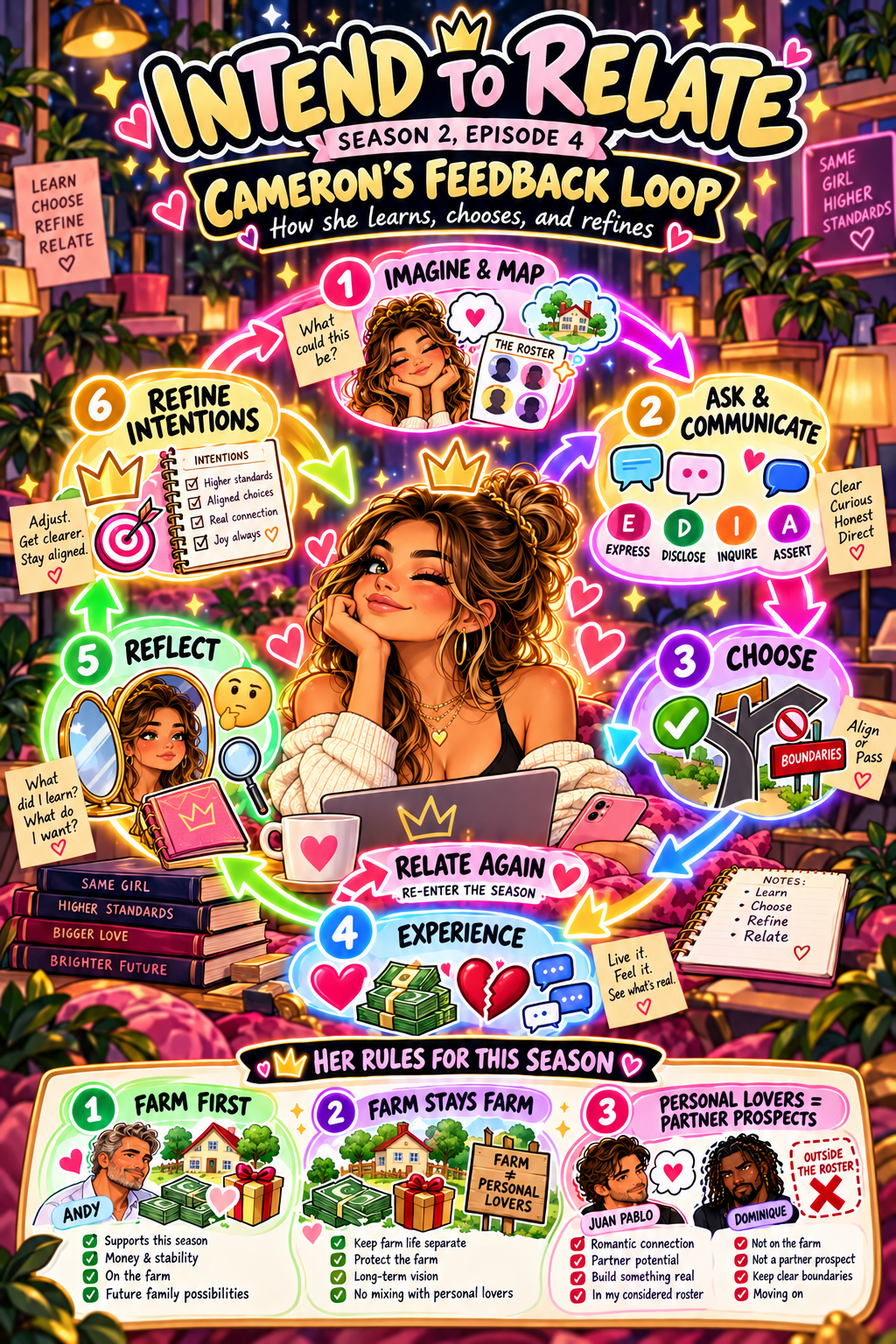
INTEND TO RELATE · ORIGINAL PODCAST · SEASON TWO, EPISODE 4
What Cameron Actually Chooses: From Private Guesses to Shared Understanding
Season Two, Episode Four follows Cameron through inquiry, boundaries, disappointment, and the practical work of turning an aim into a rule.
Spotify / YouTube / Apple
Understanding a possible relationship does not oblige us to enter it. Finding an arrangement that could work on paper does not establish that it fits the life we want to live.
Season Two, Episode Four of The Intend2Relate Podcast makes that distinction concrete. Cameron returns with the relational world introduced in Episode Three: a content business, a promising lover, a former boyfriend, and a business connection whose language has become increasingly personal. This time, her private interpretations meet other people’s intentions—and then the consequences of her choices.
The episode gives the feedback loop a full narrative form. Cameron imagines, inquires, evaluates, communicates, chooses, experiences, and revises. She does not finish with every relationship preserved or every aim fulfilled. She finishes with a clearer understanding of what deserves her participation.
What Cameron does not yet know
Because this is fiction, the storyteller can reveal information to us before Cameron receives it. The device matters: it exposes the distance between a plausible interpretation and the facts that would support it.
Andy, who has spoken about having a baby with Cameron, is married with children and has no intention of leaving his wife. In this branch of the story, he wants greater closeness with Cameron rather than the future his language appears to describe.
Dominique, her domineering former boyfriend, may be pursuing a set of continuing sexual connections—a “stable”—rather than restoring their previous monogamous relationship. His return does not automatically mean he wants the old arrangement back.
Juan Pablo has a long-term boyfriend and an understanding that permits certain involvement with women. He is available for a lover relationship with Cameron, but is not offering the partnership she has begun imagining. His bisexuality does not determine his availability. His actual intentions and existing commitments do.
The people have not changed simply because the audience receives this information. What changes is our understanding of the available relationships. Cameron needs a way to reach better understanding herself.
Four communication functions
The episode offers four practical functions: express, disclose, inquire, and assert. They need not become a formal script or occur in a fixed order.
To express is to make an intention, feeling, or desire intelligible: “I like you, and I’m interested in a partnership.” To disclose is to provide information relevant to the other person’s decision. To inquire is to ask what is still unknown. To assert is to state a boundary, condition, or decision.
One conversation may use all four. One sentence may perform several functions. Their value is in helping us notice what communication is needed, rather than requiring people to speak in the framework’s terminology.
Cameron can ask Dominique what he wants by reconnecting. She need not disclose every private thought about where he might fit in her rosters. If she already knows she wants no further contact, she need not investigate every possible offer before declining.
With Andy, she can ask whether his words about a child are an actual proposal and clarify that she is not offering a future family. With Juan Pablo, she can express her interest in partnership and ask what he is available to undertake. The question is how to make a decision possible on a more truthful basis.
An available agreement may still be the wrong choice
The episode sketches a possible arrangement with each man. Cameron and Juan Pablo could become non-monogamous lovers. Cameron and Andy could revise their existing relationship. Cameron and Dominique could theoretically negotiate a bounded transactional connection.
That is a set of possibilities, not an optimal solution. Keeping every relationship would also mean accepting every relationship’s demands. More potential benefit brings more participation to evaluate: time, attention, emotional involvement, and the particular concerns created by their history.
The three worlds help Cameron examine different aspects of that burden. What does she desire and enjoy? What would the arrangement produce and require? Is the participation honest, compatible with existing commitments, and free of coercion?
Those questions need not produce the same answer. Attraction can coexist with incompatibility. A materially beneficial offer can demand more than someone wants to give. An ethically available relationship can still be unappealing. Understanding expands the choice; it does not choose for her.
Dominique: a boundary is a real outcome
Cameron initially considers whether Dominique belongs at the bottom of her farm roster. Then she notices that he is not a customer arriving through the business. He is an ex-boyfriend whose history would have to be carried into any new arrangement.
The question changes. Instead of asking where he ranks, she asks whether she wants to create that relationship at all. She decides she does not.
His later angry messages reinforce information she already had about his conduct. But she did not need another demonstration to justify the decision. The gifts had briefly encouraged her to discount a history that remained relevant.
The lesson is specific: a possible benefit does not erase prior behavior, and a theoretical use for a relationship does not create an obligation to negotiate it. Her refusal is an application of the model. The absence of a new agreement is not a failure of the tools.
Juan Pablo: clarity can have a cost
Cameron likes Juan Pablo. A lover relationship could be real and enjoyable within its actual limits. The issue is whether she wants that relationship in this season, while also recognizing her partner aim.
She cannot honestly accept his limited offer while privately treating it as a campaign to change his answer. She tells him what matters to her and considers whether the available arrangement fits. When he becomes distant, she asks what changed rather than supplying an explanation herself.
In this version of the story, the conversation made the relationship feel too serious to him. He declines to continue. The episode acknowledges that communication can change an encounter; it is not always a neutral instrument that reveals an answer already waiting unchanged.
Cameron can review her timing and expression without deciding that articulating a genuine intention was inherently wrong. She loses a possibility she enjoyed. She also stops allocating hope to a partnership he was not offering. Juan Pablo need not become a villain for her to conclude that the clarity was worth the disappointment.
Andy: different aims can meet in shared terms
With Andy, inquiry may improve a relationship Cameron wants to continue. He wants more closeness; she remains oriented toward her business and is open to a different level of involvement. They need to clarify the actual offer, including what neither is promising.
More material support does not automatically purchase unlimited access. Affection does not automatically imply exclusivity or a future family. Conversely, a material purpose does not require every feeling in the relationship to be false.
The favorable outcome is expressly conditional. Andy’s existing marital commitments must be addressed honestly. An understanding between Andy and Cameron cannot substitute for the understanding he has with his wife. Until that question is answered, ethical compatibility remains unresolved.
On the workable branch, the revised arrangement becomes clearer and more valuable to both participants. Their private aims need not be identical, but the terms they share must be intelligible and honestly chosen. Then actual experience tests whether the additional benefit is worth the additional involvement.
An aim becomes a rule for this season
Cameron’s experience produces three related decisions. Her business is the priority for the present season. Her business relationships will remain distinct from her personal search for partnership. In the limited romantic time outside that business, she will focus on people for whom the kind of partnership she seeks is a genuine possibility.
These rules make sense together. Andy’s relationship can become more personally involved while retaining its understood business purpose. Her restriction on unavailable lovers concerns a different part of her life. The distinction is about purpose and allocation, not a denial that business relationships involve real people and feelings.
Her partner aim existed before the rule. Experience helped her decide how much authority to give that aim over present choices. Motherhood can remain a future possibility without becoming today’s project. An unfilled position can remain open without being a defect she must immediately repair.
The learning loop in practice
Cameron’s path runs from imagination to inquiry, from inquiry to choice, and from experience to revised participation. Each relationship yields a different result: a boundary, a disappointment, and a conditional improvement.
That variety is the point. A useful framework should be able to support different answers when the circumstances differ. It should also help us understand why an attractive option is not always the option we intend to pursue.
For reflection, ask: What am I currently assuming? What conversation would make the next decision clearer? Which possibility deserves no further investment even if an arrangement could be devised? What has experience taught me that still has not changed my conduct?
Cameron returns to her life with fewer ambiguities and more deliberate priorities. She has not completed her future. She has become better able to choose what to carry toward it.
Continue with Intend to Relate
Explore the framework at Intend2Relate.com and continue reading in the Intend to Relate journal. New to the original podcast? Begin with Season One for the foundational language and models.
Read and listen through the Primer and audiobook page, or join as a free member for the ebook. The Present and Future Self Creditor Assessment offers a further reflective exercise.
Questions, disagreements, and experiences with the tools are welcome in the YouTube community. What became clearer for you, and what would you examine differently?
Be free, and be good to each other—intentionally.
Episode guide
Chapter points derived from the supplied transcript.
- 00:39 — Returning to Cameron
- 02:09 — What Cameron does not know
- 07:56 — Express, disclose, inquire, assert
- 11:14 — Aims, seasons, and the three worlds
- 16:51 — Choices and conversations
- 20:57 — Experience and feedback
- 24:33 — Values into rules
Full episode transcript
The full supplied transcript is reproduced below, formatted into paragraphs with editorial section headings. Timing and speaker markup have been removed from the running text; minor typographical corrections are identified in the draft’s editorial notes. This is a reading copy, not an audio-verified verbatim transcript.
You're listening to the Intend2Relate Podcast, published by Intend2Relate, LLC. Intend2Relate is interested in expanding human freedom and creativity in relationships. We would like to enter into a non-exclusive podcast listener relationship, involving a short-term limited power exchange dynamic, where you consent to considering some ideas as we present them, while retaining your judgment and critical thinking. We do not seek a deed to your mind in this relationship. We ask for your assent to go on a journey with us into some ideas and tools regarding relationships.
If you assent, let's Intend2Relate.
00:39 · Returning to Cameron
Welcome back to the Intend2Relate Podcast, Season 2, Episode 4. At the end of Episode 3, we were playing with some of our tools, concepts, and models, not trying to turn every relationship into a technical exercise, not trying to take all the excitement out of relating. We were looking at how a few of these tools might help us understand a complicated relational life. Our imaginary protagonist was Cameron, the cam girl. Cameron is 22.
She's building a content business, and some of the gentlemen who came through that business have developed more involved relationships with her. We called that her farm, a set of relationships oriented toward material benefit. Then there was Juan Pablo. She really liked him. He was her lover MVP, and in her imagination, he was beginning to look like her partner MVP too. There was Dominique, the domineering ex-boyfriend. Their history included the controlling behavior that helped end their relationship.
But now he was back, being nice, sending gifts, even sending money. And there was Andy, the attached, one of the gentlemen on the farm, saying that he loved her and wanted her to have his baby someday. Cameron had played along a little. Then she started wondering, what am I actually doing here? What do I want with these people? And what are they aiming toward with me? Today, we're going to take that further.
Not just what she might imagine, what she might ask, what she might choose, and what she might learn after making those choices.
02:09 · What Cameron does not know
Let's start by stepping behind the scenes. Remember, we're making up a story. We can give the audience information Cameron doesn't have yet, and then watch her find out. Andy first. Suppose Andy is married with children. He has no intention of leaving his wife. He's been trying to make his life a little more exciting, and he enjoys what he has with Cameron. When he talks about a baby, he isn't actually proposing parenthood.
His words are going beyond what he intends to undertake. What he wants is more involvement with her. In the language we're playing with, he wants to move her from his playmate roster toward his lover roster. Here, playmate describes the transactional relationship within an understood scope of play and involvement. Lover suggests the greater personal closeness he's seeking. Those are our working distinctions in this example. The labels themselves don't tell us all the terms.
Cameron wonders whether she's become a potential wife or mother in his imagination. But Andy is aiming toward an escalation of the relationship they already have, not the larger future his words suggest. Now Dominique, she thinks, he's my ex-boyfriend, he's back. Presumably he wants me back as his girlfriend. What else could this be? Well, perhaps Dominique isn't trying to resume monogamy at all. He's building a stable. He has reached out to people from his past and Cameron answered, at this point, she is a potential hookup, perhaps a continuing connection if that develops.
Not necessarily his intended girlfriend. A possibility on the way toward a stable is not the same thing as an established place in one. But even that possibility is different from the story Cameron has been supplying. And Juan Pablo, let's make this interesting. Suppose Juan Pablo is bisexual. He has a long-term boyfriend. They have an understanding that permits relating and play with women within certain limits. Cameron doesn't know that yet. The important question is not whether bisexuality prevents partnership.
It doesn't tell us what partnership he can offer. The question is what this particular man wants, what his existing commitments allow, and what he's proposing with her. For the branch we're following, he is available for a lover relationship. He is not offering the kind of partnership Cameron has begun to imagine. Now look at the difference. Same people, same recent messages and gifts, but the possible meaning of each relationship has changed. Her private model gave her somewhere to begin.
It did not give her access to everybody else's intentions. Before we start designing agreements, let's look back at the wolf and snake questions. Where have we actually identified a concern about coercive or aggressive conduct? Dominique's history. We don't need to invent a new dramatic incident to remember what Cameron already knows about how he treated her. The practical point about avoiding the prior wolf belongs here. A possible material benefit doesn't erase that history.
And the concern is his conduct, not the mere fact that he was called a dom or now wants a non-monogamous relationship. What about snakes? You might have noticed that Cameron played along with Andy. You might also notice that Andy talks about a future he doesn't intend to pursue. We need to know what that communication actually consisted of. Were they knowingly sharing a fantasy? Was one taking it seriously while the other encouraged that belief?
Had either made an actual promise? Played along is a place to inquire. Not enough information to settle the question by itself. And the same goes for Andy's explanation that he didn't mean it that way. What did he lead her to understand? Juan Pablo's existing relationship matters too. What had he told Cameron? What decisions had she already been making without that information? We don't have to pronounce a verdict on every character before proceeding.
But we shouldn't use the model to explain away deception or coercion, if that's what the facts show. Understanding someone's aim is not the same as approving their methods. Now let's jump ahead and imagine the arrangements that could be available, assuming the people actually want them and can honestly offer them. Juan Pablo and Cameron could choose to be non-monogamous lovers with whatever limits and commitments they both accept. Andy and Cameron could amend their existing transactional relationship.
More involvement, perhaps more material benefit, a different level of closeness, and a clearer understanding of what each is undertaking. Dominique and Cameron could, in principle, choose a limited transactional relationship too. From Cameron's perspective, he could belong on the farm. From his perspective, she could belong in his stable. Notice that last one. They wouldn't have to use identical roster labels. They would have to understand the actual arrangement well enough to choose it.
And none of that necessarily requires a formal written document. They need terms they understand, not a performance of paperwork. But this is the set of possibilities, not our recommendation. It isn't an optimal outcome, merely because we found a possible agreement for everybody. In that version, Cameron keeps a lover, but doesn't get the partner she wanted. She expands the farm and may increase its material benefit. She also takes on more involvement, more demands on her attention, and whatever additional commitments she accepts.
With Dominique, she adds a particular concern from their history. More relationships, more possible benefit, more to carry. Does she actually want that life?
07:56 · Express, disclose, inquire, assert
How do we get from private guesses to something people can actually agree to? Let's use four communication functions. Express, disclose, inquire, and assert. Express what you feel, want, or intend. I like you, and I'm interested in a partnership. Disclose information the other person needs for the decision at hand. I have an existing partner, and here's what I can actually offer. Inquire when you need information. When you say that, what are you proposing?
Assert a boundary, a condition, or a decision. I'm not willing to do that. These aren't four speeches everybody has to deliver in a prescribed order. One sentence might do two of those things. A particular moment might call for only one. Take Dominique. Cameron might be thinking, maybe he wants me back as his girlfriend. Maybe I would only want him on the farm. Does she need to tell him all of that? Not necessarily.
She hasn't even decided that she wants to offer a new relationship. Her private speculation is not automatically something she needs to disclose. She could simply ask, what are you hoping for by reconnecting? That's inquiry. And if she already knows she doesn't want to reconnect, she doesn't have to investigate every possible offer before saying no. Let's say she does ask. His answer amounts to, I thought we could have some fun. I'm not trying to get back together.
Well, that changes her model. The girlfriend assumption was hers, not an agreement between them. With Andy, the obvious question is different. When you say you want me to have your baby, do you actually mean that? Or are you talking about wanting something more between us now? She can ask about his marriage, his commitments, and what he is actually available to do. He can clarify whether he wants more contact, greater closeness, or some other change to their existing arrangement.
And she has a part in that clarification. I know I've played along when you've said that. I need to be clear that I'm not planning a family with you. That could be expression, disclosure, and assertion together depending on what they had previously understood. With Juan Pablo, inquiry and expression fit naturally beside each other. I really like what we have. I could see myself wanting a partnership with you. What are you looking for with me?
Now, he needs to tell her about the existing boyfriend and the actual scope of his offer. She can ask what their arrangement permits. Nobody has to publish every private detail of another relationship, but she needs enough information to choose the relationship being proposed to her. For our story, let's say he tells her, I like you, I want to keep seeing you, but I have a boyfriend and I'm not available for the kind of partnership you're talking about.
That answer matters, not because it resolves every feeling, but because it gives her a different decision to make. She doesn't have to announce, you have been removed from my partner roster and reassigned to lover status. She can speak like a person. I hear you, I need to think about whether that works for me. And no, inquiry doesn't guarantee a complete or truthful answer. It's one part of understanding. What people do afterward remains part of the information.
11:14 · Aims, seasons, and the three worlds
Now, Cameron turns back toward herself. We've been talking about individuals, archetypal aims and rosters. What about the season? She thinks I'm 22. I'm building something. This is a young focus on the money season for me. She sees the opportunity in her current work as potentially seasonal. She thinks that settling down, building a household or having a child later could make it harder to work in exactly the same way. That's her appraisal of the life she's considering, not a timetable we're prescribing to everybody else.
So maybe she wants to take this business seriously now, not just respond to whoever messages her, but build it with intention. At the same time, she starts thinking about motherhood. Nothing in the particular fantasies she examined last time had featured a child. That doesn't settle what she'll want for the rest of her life. She thinks, I may want to be a mother one day, and a man with some of Andy's qualities, successful, wealthy, kind, might fit something I imagine in a father and provider.
That doesn't mean Andy is the person she should have a child with. Those are qualities she notices, not a completed evaluation of him as a father, and certainly not an offer he's made to build that future with her. She is learning something about her own possible future aim through what she encounters in the present. Maybe someday, not what I'm pursuing now. Then she looks more closely at the partner aim. She does want a partner.
She has been evaluating people for that. Juan Pablo didn't end up in that part of her imagination by accident. But what does partner mean to her? She begins to see a larger pattern. Someone she might eventually marry. Someone who could potentially be a lover, a provider, and the father of her child. Someone who might become an MVP across those overlapping aims as their life develops. Making her own money doesn't erase that desire.
Wanting that future doesn't require her to start pursuing motherhood this afternoon. And she's not asking a new person to promise all of it at the beginning. She's asking whether that kind of future is a genuine possibility. Something they might both choose if the relationship develops. Here's an important distinction. The aim was already in her. It influenced her imagination and her evaluations. But she had not been setting her rules by it. She could want a partner and still spend her personal time with lovers who were unavailable for partnership.
That isn't necessarily a contradiction. She might enjoy that combination. But now she's asking whether it works for this season, with the business she wants to build and the time she actually has. An aim can exist without being today's priority, and a future aim can influence today's decisions without becoming today's project. Let's bring in the three worlds for a moment. In the natural world, Cameron asks, how do I feel with these people?
What do I desire? What do I enjoy? What troubles me? What do I find myself imagining? In the business world, she asks, what does this arrangement actually produce? What does it require? How much time, attention and effort am I committing? What am I giving up by choosing it? And in the divine or ethical world, she asks, am I being honest? Is the other person able to choose knowingly? Are we respecting existing commitments?
Am I using deception or accepting coercion because there's something here I want? Those questions don't all give the same answer automatically. She might desire a person whose offer doesn't fit her life. An arrangement might generate money and still bring demands or risks she doesn't want. A clear, ethical offer might simply not interest her. Now apply that to the possible three agreement outcome. Juan Pablo. Pleasure, attraction, maybe real affection, but no available path to the partnership she's describing.
Andy. A business relationship she enjoys that may become more valuable to both of them if they clarify its scope and the relevant existing commitments. Possible gifts and money, but difficult history, uncertain expectations, and the work of trying to create a business relationship out of an old personal one. She can understand all three offers and still decide that only one of them deserves continued investment. Understanding is not an obligation to accept. Cameron thinks about the farm as its own roster.
Andy might become the MVP there, not the best human being in the universe. The strongest fit for that particular aim among the relationship she actually has, considering both what it contributes and what it requires. Where would Dominique be? At the bottom, she thinks. Based on our background, he starts at the bottom. Then she pauses. He's not even a customer. He didn't come through her content business. He isn't particularly interested in the content.
He came back through a former boyfriend connection, and now she's thinking about converting that into something else. Could she propose a defined arrangement? Possibly. Would she actually want to? She imagines the conversation, the expectations she'd have to correct, and the involvement she would be inviting back into her life. And she decides, no, it's not worth it to her. That's the moment when the question changes from, where does he rank, to should he be on this roster at all?
Being at the bottom doesn't entitle someone to a place, and finding a possible use for a relationship doesn't mean she has to create it.
16:51 · Choices and conversations
So she doesn't make a farm proposal. She holds the boundary. I don't want to restart this connection. I'm not offering a different arrangement either. I wish you well, but I'm leaving it here. She doesn't need him to agree that her reasons are correct. She needs to be clear about her decision. There we go. One of our possible agreements is not going to happen. The model helped her decide not to negotiate it.
With Juan Pablo, it's harder because she likes him. She understands what he said. She tells him she's interested in an eventual partnership, not just an indefinite lover connection. He's been clear that he isn't offering that. At first, she thinks, maybe I can still enjoy him as a lover. I don't have to make him everything. They could choose that. There could be a perfectly real relationship there within the actual limits if they both want it.
But she doesn't want to pretend to accept his offer while privately treating it as a campaign to change his answer. So she explains where she is. I like you, and I've enjoyed this. I understand that you're not offering a partnership. I'm deciding whether a lover relationship without that possibility makes sense for me right now. She isn't asking for a marriage proposal. She is telling him the distinction matters to her. Then, as time passes, he starts getting distant.
We'll come back to that, because it becomes part of her learning. What they could agree to is one thing. What they continue to choose after that conversation is another. With Andy, the inquiry gives them somewhere useful to go. No, he tells her. I'm not actually proposing that we have a child. I'm not leaving my marriage. I like what we have, and I want to feel closer to you. I got carried away with how I was saying it.
That explains his intention. It doesn't automatically resolve any misleading impression his words created. They still need to clarify what each had understood. Cameron tells him that her involvement is real, but she isn't offering a future family. The business purpose is still part of the relationship for her. She isn't pretending to want something else in order to maintain it. Maybe she says, I enjoy you. I'm open to talking about more involvement, but I want us to be clear about what that means.
So they discuss the actual changes. The time and attention each wants, the material side of the arrangement, the limits on contact, and what neither is promising. More support is not an agreement to unlimited access. A warmer relationship is not automatically a promise of exclusivity. They don't have to use our words. He doesn't need to say, I hereby request your transfer from the playmate roster to the lover roster. They need to understand the change they're choosing.
There is also a question our story hasn't answered. What does Andy's spouse understand and agree to? Being married tells us there are existing commitments. It doesn't tell us what those commitments permit. For this to be an ethically workable improvement, that question needs a real answer. A good understanding between Andy and Cameron cannot stand in for the understanding he has with his wife. So let's follow the favorable branch conditionally. If the proposed relationship is consistent with his existing commitments, and they both want the clarified terms, they can choose a more involved arrangement.
Otherwise, the possibility changes. And Cameron has another decision to make. On that favorable branch, she receives more material benefit and accepts a level of involvement she actually wants to undertake. He gets more of the closeness he was trying to ask for without her promising to become his future wife or the mother of another child. She's still oriented toward the farm. He may now think of her more as a lover. Different aims can meet in an honestly shared arrangement.
And material benefit doesn't require every feeling in it to be fake. The point is not to pretend that the relationship is something other than what they are choosing.
20:57 · Experience and feedback
Now we've had some conversations. We've had a boundary, a possible ending, and a conditional improvement to an existing relationship. But this isn't the end of the model. They have to live with what follows. Let's go back to Dominique. He gets angry. He sends a series of mean messages. He tells Cameron she owes him after what he's given her. She doesn't take that as a reason to reopen the relationship. She doesn't agree that his gifts were a promise she made.
Then, in this version of the story, the messages stop. Nothing further happens. That's the ending we're giving this branch, not a guarantee about what happens whenever someone responds aggressively to a boundary. Cameron reflects on it. First, I already knew something about how this man behaved. I didn't need another demonstration before I was allowed to say no. The nice messages and the money had briefly made me discount information I already had. Avoid the prior wolf.
That's the practical lesson she takes from this particular history. Second, if I'm building business relationships, I want them to develop through that business. I don't want to keep looking at former boyfriends and asking whether I could convert them into revenue. Not because no relationship can ever change form, because for her, the old expectations and the effort of changing the relationship aren't worth it. Now Juan Pablo, he's distant and Cameron notices. Instead of completing the explanation in her head, she asks, has something changed since we talked?
Let's say he answers honestly. Yes, since you brought all that up, it felt too serious to me. I don't think this is for me. Well, that isn't the outcome she wanted, and we should be honest about what happened. The conversation may have changed his attitude. It wasn't necessarily a magic window revealing the answer that had always existed in exactly that form. People respond to each other. Saying something can change the relationship.
She can reflect on the way she said it. Could she have been simpler? Was the timing right? Did she make it sound as though she needed a commitment immediately? Those are useful questions. They don't require her to decide that expressing a real intention was a mistake. She thinks, I liked him. I would have enjoyed more time with him, but I was starting to invest in a future he wasn't offering. And when I made that part of myself visible, he didn't want to continue.
That's disappointing. It also gives her something she can use. She decides the clarity was worth it. It saved her from continuing to allocate time and hope to that possibility. The experience wasn't worthless. Continuing would have competed with things she now knows matter more to her. Juan Pablo doesn't have to be the villain. He gets to decline. She gets to decide she doesn't want to keep pursuing unavailable partnership prospects. And Andy, on the favorable branch we described, they try their revised arrangement.
Let's say the actual experience is better. Less ambiguity, a clearer scope, more value to both of them, and commitments they can actually keep. Her lesson is different here. I asked what he meant instead of assuming. I said what I was and wasn't offering, and we improved a relationship I wanted to continue. Inquiry didn't just protect her from a bad outcome, it helped create a better one. She also checks whether the additional benefit is worth the additional involvement.
The agreement is a starting point for experience, not proof in advance that every part of it will work.
24:33 · Values into rules
Now Cameron comes back around to herself again. What has she learned? Not just about these men, about what she wants to do next. Her first intention becomes clear. The farm is my priority for this season. She's building a business. Her decisions about time, effort, and attention need to reflect that. She doesn't want a business plan that is constantly displaced by the emotional urgency of whichever message just arrived. Her second rule, the farm stays the farm.
My other relationships stay distinct. For her, that means developing business relationships through the business, not recruiting ex-boyfriends into it. It also means not confusing business affection with an offer of marriage or family. The people on the farm are still people. The relationships are still real. She's distinguishing their understood purposes, not declaring that some people have no feelings or deserve no consideration. And she is making a rule for this season, not announcing that a relationship can never evolve.
If an aim changes later, she can recognize that and discuss it instead of letting the relationship drift under an old description. Then her third rule, I want a partner. Outside my business relationships, I'm not spending my limited romantic time on lovers who aren't genuine partner prospects. That distinction matters. Andy's relationship can become more lover-like while remaining part of the farm's honestly understood purpose. Her new restriction concerns the separate personal life in which she's looking for partnership.
She's not saying every pleasant encounter must become a marriage. She's not making strangers promise children. She's deciding not to pursue a lover relationship when the kind of partnership she ultimately wants is already off the table. Now you can see how the rules work together. The farm gets the priority. The partner aim guides the smaller amount of personal time she chooses to allocate elsewhere. Her rule wasn't fully formed when we began. The aim was there.
Experience helped her decide how much authority to give it over her actual choices. Look at the progression. She noticed her fantasies and her possible archetypal aims. She made some tentative models of her relationships. Then she asked questions and learned that other people's intentions weren't identical to her interpretations. She considered what could be agreed. She looked at her season, her priorities, the value, the demands, and the ethical questions. She expressed, disclosed, inquired, and asserted where those functions were useful.
Then she chose. Not the same choice with everybody. After that came experience. Dominique's reaction, Juan Pablo's withdrawal, the possible improvement with Andy. She reflected on what happened and revised her intentions and rules. That's the feedback and learning loop at work. Not a machine that guarantees a desired ending, a way to keep learning from what you actually encounter, choose and live. At the end, she hasn't acquired the perfect partner. She hasn't made an agreement with every person who could theoretically serve an aim.
Dominique is out. Juan Pablo isn't continuing. On the workable Andy branch, that relationship is clearer and more valuable to her. Her partner aim remains open and motherhood remains a possibility for another season. She hasn't filled every position. She's become more deliberate about which positions she wants to fill, which ones she wants to leave open, and which relationships she doesn't want to create at all. And that brings us back to the playful spirit from Episode 3.
We didn't build all this architecture so Cameron could carry every possible relationship up the hill. We gave her some ways to decide what she wants to carry, what she wants to build, and what she wants to let go. She's still free to change her mind. She's still free to enjoy herself. She's just going back into her life with a better understanding of what she intends. Not every possibility needs an agreement. Not every aim belongs to this season.
And clearer intentions can leave more room for the life you actually want to live. You've been listening to The Intend2Relate Podcast, published by Intend2Relate LLC. Our short-term podcast listener relationship is now complete. You retain your judgment, your critical thinking, and your freedom to accept, reject, revise, or carry forward any idea we have explored together. We do not ask you to surrender your mind to us. We hope only that something here has helped you see yourself, another person, or a relationship with greater clarity and possibility.
Thank you for going on this journey with us. Until next time, be free and be good to each other intentionally.
Published by Intend2Relate, LLC. The transcript preserves the episode’s spoken perspective; the companion article develops its ideas for reading.