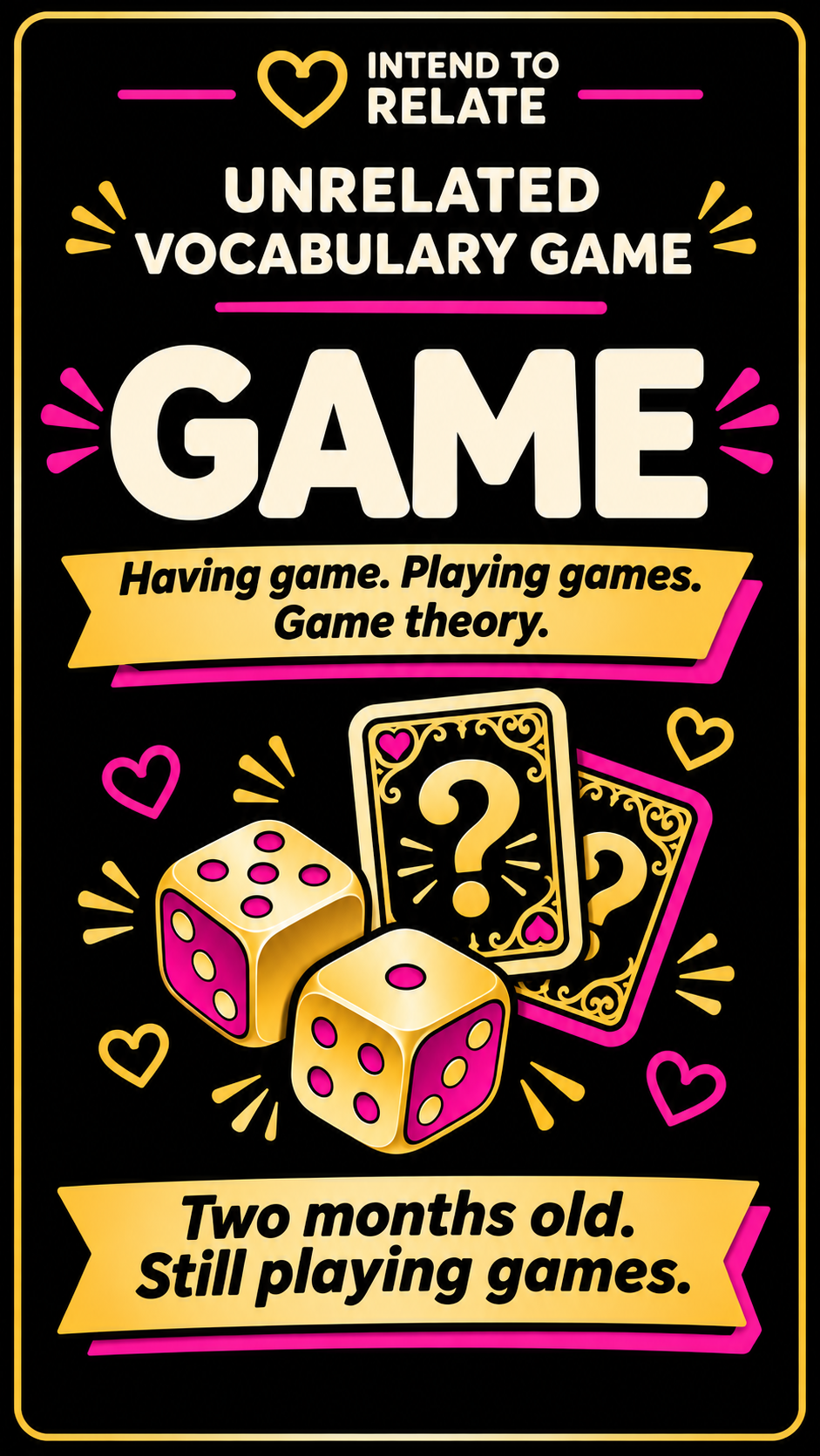
Having game is one thing. Knowing what you’re both playing for is another.
Intend to Relate is two months old. Apparently, we are still playing games.
For this installment of the Unrelated Vocabulary Game, our word is game: a small word carrying several different conversations. Having game. Playing games. “The Game.” Game theory.
The short keeps things simple. One person is trying to impress a date. The other is trying to find out whether their plans for having children align.
One thinks the evening is going brilliantly. The other thinks a fairly important question remains unanswered.
Same date. Different scoreboards.
A little birthday play
The birthday reference is a light acknowledgment of the company’s first two months. The vocabulary game is one of the ways we can share the work with some humor: introduce an association, turn it around, and leave people with a question worth discussing.
This installment returns to PAPE—Personality Assessment Play & Exchange. We use the prompt as an opportunity to express something, hear another person’s answer, and compare understandings.
The point is to get a conversation moving. Nobody needs a complicated theory of dating to ask what the other person hopes will happen.
What do we mean by “game”?
For this article, it helps to distinguish a few uses. These are working descriptions for the conversation, rather than claims that everyone uses the phrases identically.
| Expression | The meaning we are exploring |
|---|---|
| Having game | Social skill, charm, confidence, or an ability to attract interest. |
| Playing a game | Shared play, perhaps with agreed rules and an enjoyable challenge. |
| Playing games with someone | Conduct experienced as evasive, manipulative, or designed to keep the other person guessing. |
| “The Game” | A way of imagining dating or social life as a larger contest, with supposed rules, ranks, tactics, and winners. |
| Game theory | An analytical study of strategic interaction: situations in which the consequences of a choice depend partly on other participants’ choices. |
The same word moves among attraction, enjoyment, suspicion, competition, and analysis. A conversation can become confused if we slide between those meanings without noticing.
Someone may enjoy playful flirting and dislike deliberate uncertainty. Someone may think carefully about a relationship without treating their partner as an opponent. Being good company, being deceptive, and understanding strategic interaction are different things.
The date in the short
Our example gives the two participants different immediate aims. He wants to impress her. She wants to learn whether he wants children. The roles could be reversed, and the same problem can arise between people of any gender.
Neither aim is inherently unreasonable. Attraction matters. So does learning whether a potential relationship fits your intended life.
The difficulty arises when one person treats a success on their own measure as evidence of success on the other person’s measure. Laughter, chemistry, or an enjoyable evening may be real, while the question that matters to the other person remains open.
You think you’re winning. She thinks you haven’t answered the question.
The surprise is the mismatch in their assessments. They can leave the same encounter with very different accounts of how well it went.
The short does not establish that he is deliberately avoiding the question. He might be nervous, distracted, uncertain, or simply mistaken about what needs attention. If he knowingly creates a misleading impression to keep her interested, that introduces a different ethical issue. Misunderstanding and intentional deception require different responses.
Where game theory enters
Game theory provides tools for analyzing interactions among decision-makers whose choices affect one another. A model may specify participants, available actions, information, and preferences over outcomes. Eric Pacuit’s introductory lecture notes on game theory provide background for this analytical usage.
A “game” in that sense need not be entertainment, deception, or a contest in which one person’s gain must be another’s loss. Applying the language does not establish what anyone ought to want or what conduct is ethical.
Our date is an illustration of different aims and incomplete understanding, rather than a solved mathematical model. We have not specified enough to calculate an optimal strategy or identify an equilibrium.
For this vocabulary exercise, the useful connection is modest: each person’s choices matter to the other, and their preferences may differ. That makes inquiry about those preferences useful. The conversation that follows is our practical application, not a theorem promising a successful relationship.
What counts as a good outcome?
Before discussing the best strategy, consider what that strategy is supposed to achieve.
For a particular date, a good outcome might be an enjoyable evening, another meeting, a truthful answer, discovery of a shared purpose, or recognition that the relationship is unlikely to fit.
Those outcomes can overlap. They can also pull in different directions. Keeping someone interested for another week may feel like progress if continued attention is your measure. It may be costly if the other person is trying to make a timely decision about family plans.
In our approach, a useful outcome can include a respectful conclusion. Two people discovering a significant incompatibility have learned something important, even if neither gets the relationship they initially hoped for.
Clarity does not require every preference to be settled in advance. “I don’t know yet” can be an honest answer. It gives the other person information with which to make their own choice.
From separate aims to a shared understanding
Relationship agreements give us a way to work with these differences. The starting point is understanding what people are actually seeking, offering, and willing to undertake.
That work may begin in ordinary conversation. It becomes more specific as people discuss expectations, negotiate terms, and decide whether a shared arrangement makes sense.
Our communication duties are useful here: express your aims, disclose relevant information, inquire into the other person’s understanding, and assert a position or limit when it matters.
You might say: “I’m enjoying this, and I also want to come back to your question.” Or: “A fun evening matters to me, but I need to understand whether our longer-term plans could fit.”
There is room for charm, spontaneity, and humor within a clear conversation. Knowing what matters to each other can help people direct their creativity toward something they both want.
Your PAPE exercise: compare outcomes
What would a good outcome look like for each of you?
Choose a specific interaction: a date, a difficult conversation, a shared project, or a discussion about changing your relationship. Each person answers independently, then exchanges answers.
- Name your desired outcome. Describe what you hope will happen in terms the other person can understand.
- Name what you believe the other person wants. Present it as a guess they can correct.
- Compare the two accounts. Where do your aims overlap? What surprised you? What important question remains unanswered?
- Choose a next step together. You might ask another question, make a specific agreement, take time to think, or recognize that your aims do not fit.
This is a conversation prompt, not a diagnostic assessment. An answer is information about someone at a particular moment, and an invitation to ask more. It does not contain the whole person.
You do not have to want identical things to find a worthwhile shared outcome. You do need enough understanding to decide whether the arrangement works for you.
Still playing games
At two months old, Intend to Relate is continuing to build its concepts, tools, and body of work—and enjoying a little play along the way.
The vocabulary game gives us a light entrance into a serious practical question. Before celebrating how well you are doing, check what doing well means to the other participant.
Having game is one thing. Knowing what you’re both playing for is another.
Transcript of the short
Intend to Relate is two months old. Still playing games.
Today’s word: game.
Having game. Playing games. Game theory.
You’re trying to impress her. She’s trying to find out whether you want children.
You think you’re winning. She thinks you haven’t answered the question.
Having game is one thing. Knowing what you’re both playing for is another.
Today’s PAPE question: what would a good outcome look like for each of you?
Compare answers. You might be keeping score on different things.
Background reading: Eric Pacuit, “Game Theory,” introductory lecture notes. Referenced for the analytical meaning of game theory. The dating example, PAPE exercise, and relationship-agreement applications above are Intend to Relate’s framing.
Explore the project and tools at intend2relate.com. Read more at our Ghost publication.