Volume Two · Season One · Episode Three
By L’republique Z’jip · Intend to Relate
Our agreements with the future self have to make room for the whole life. Dreams, beginnings, love, and ambition belong there. So do aging, illness, dependence, loss, and death.
In To Her, Volume Two, Episode Three: A Magical School Bus Detour Over the Hills and Far Away…, that conversation arrived earlier than the planned sequence might have suggested. The detour brought us to a question that belongs within the project’s examination of sovereignty: what standing should a person’s own considered wishes have in decisions about the end of their life?
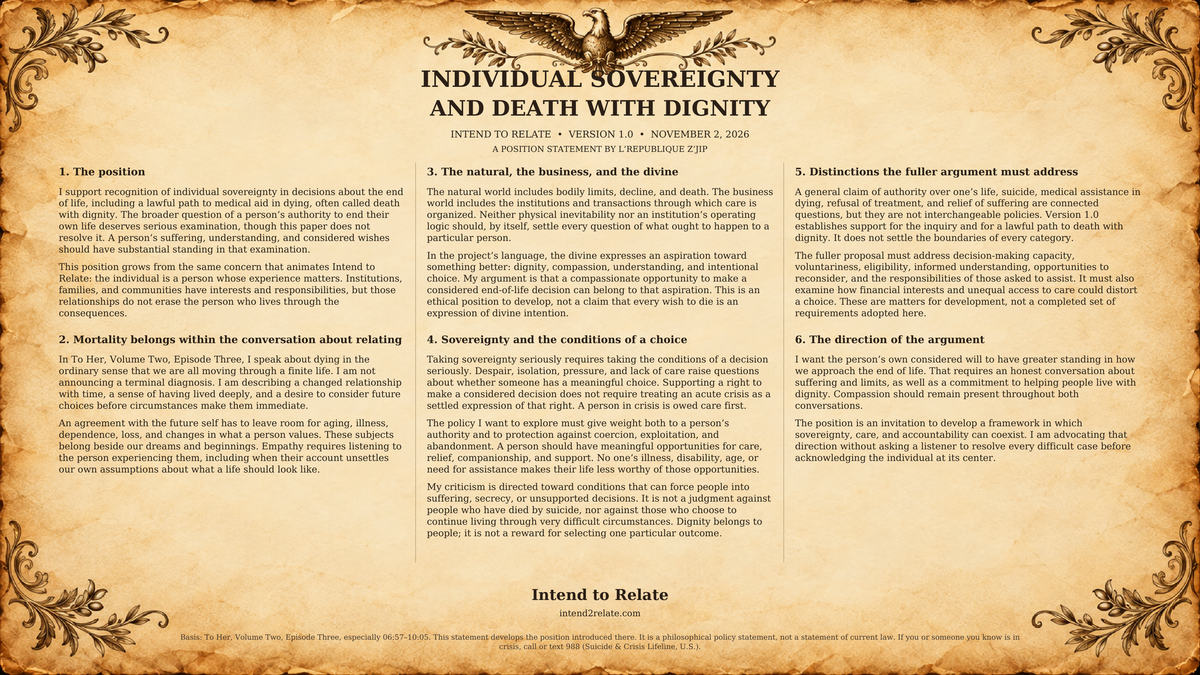
I have now put an initial position into writing.
I support recognition of individual sovereignty in decisions about the end of life, including a lawful path to medical aid in dying, often called death with dignity.
The accompanying statement is Version 1.0. It establishes a direction for the argument and identifies some of the work ahead.\
https://youtu.be/VuoUo7nEzVA?si=4YkTg9OSE-7hB1eG
Mortality within the conversation about relating
When I speak about dying in the episode, I am speaking about the ordinary condition of moving through a finite life. I am not announcing a terminal diagnosis. I am considering my relationship with time, what it means to have lived deeply, and how we might think about future choices before circumstances make them immediate.
Our lives are relational even at their most personal. Family, community, medicine, and institutions all enter the picture. Their interests and responsibilities matter. The person living through the experience must also have substantial standing within it.
That is where empathy becomes demanding. Listening to another person means allowing their account of suffering, dependence, hope, and meaning to unsettle our assumptions. We cannot understand their experience solely by imagining what we would want in their place.
Sovereignty and the conditions of choice
The project’s natural, business, and divine worlds offer one way to approach the question. The natural world includes our bodily limits. The business world includes the institutions and transactions through which care is organized. The divine, in the project’s language, expresses an aspiration toward dignity, compassion, understanding, and intentional choice.
A compassionate opportunity to make a considered end-of-life decision can belong within that aspiration. Taking the decision seriously also requires examining the circumstances in which it is made.
Isolation, coercion, financial pressure, and lack of care can distort a choice. People should have meaningful opportunities for relief, companionship, and support. A person in acute crisis is owed care first. Illness, disability, age, or dependence does not diminish anyone’s claim to that care.
The statement’s principle is simple: dignity belongs to people. It is not a reward for choosing one particular outcome.
What remains to be developed
Medical aid in dying, refusal of treatment, relief of suffering, suicide, and the broader philosophical question of authority over one’s life require careful distinctions. This statement supports a lawful path to death with dignity while leaving the broader question open for serious examination.
The fuller argument must address capacity, voluntariness, eligibility, informed understanding, opportunities to reconsider, and the responsibilities of those asked to assist. It must also examine unequal access to care and financial interests that could influence a decision.
I am publishing this first position so that its development can be examined openly. The direction is a framework in which sovereignty, care, and accountability can coexist, with the individual’s experience remaining at its center.