VBy L’republique Z’jip · Intend to Relate
A person’s sovereignty includes the ability to consider an opportunity, decide what matters to them, set terms, and decline. That agency deserves serious attention when the relationship involves companionship, romance, sexuality, or compensation.
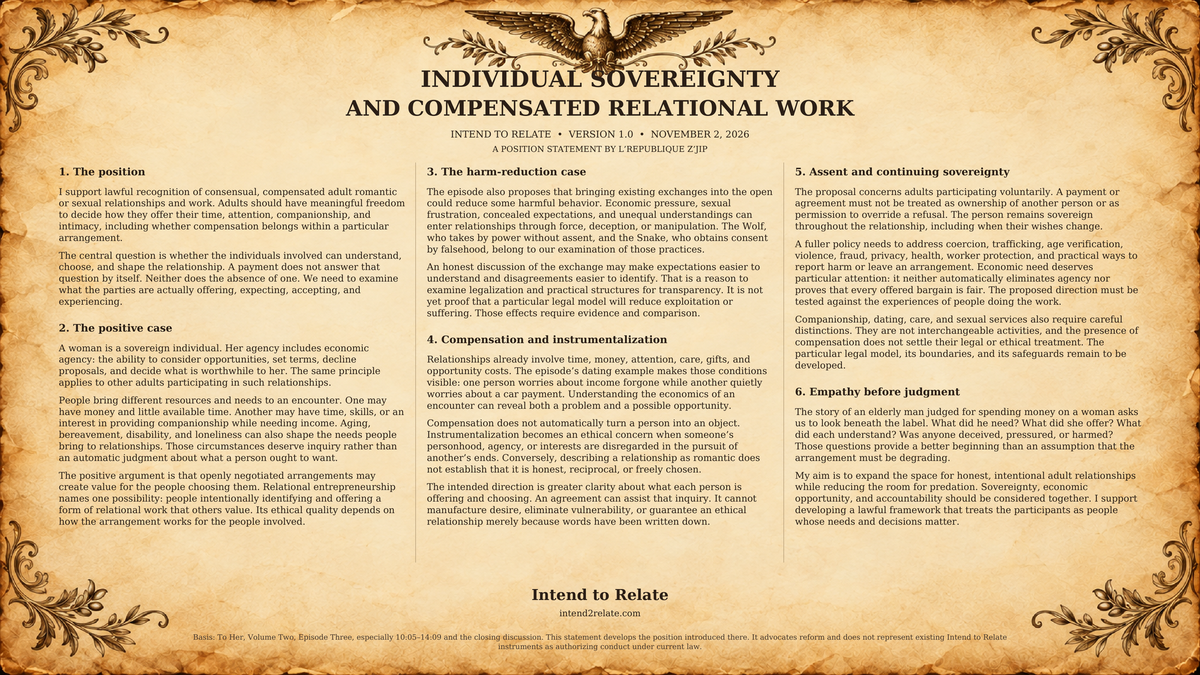
In To Her, Volume Two, Episode Three: A Magical School Bus Detour Over the Hills and Far Away…, we jumped ahead into this territory. I have now put the position introduced there into a short written statement.
I support lawful recognition of consensual, compensated adult romantic or sexual relationships and work.
Version 1.0 establishes that direction. The particular legal framework, its boundaries, and its safeguards remain to be developed.
The person within the exchange
A woman is a sovereign individual. Her economic agency belongs within that recognition: she can consider what she offers, what she needs, and what an opportunity is worth to her. The same principle applies to other adults participating in these relationships.
People arrive with different resources and needs. One may have money and little time. Another may have time, skills, or an interest in providing companionship while needing income. Aging, bereavement, disability, and loneliness can shape what people seek from an encounter.
The episode’s story of an elderly man judged for spending money on a woman asks us to begin with inquiry. What did he need? What did she offer? What did each understand? Was anyone deceived, pressured, or harmed?
The label alone cannot answer those questions.
Compensation, value, and instrumentalization
Relationships already involve time, money, attention, care, gifts, and opportunity costs. In the episode’s dating example, one person worries about income forgone while another quietly worries about a car payment. Those concerns are part of the encounter, whether anyone says them aloud or not.
Making the economics visible can help people understand what is happening between them. Openly negotiated arrangements may create value for the people choosing them. Relational entrepreneurship names one possibility: intentionally identifying and offering a form of relational work that others value.
Compensation does not, by itself, establish that someone has been reduced to an object. The ethical concern arises when a person’s agency, interests, or personhood are disregarded in pursuit of another’s ends. We should examine that concern in every relationship, including those described as romantic.
An agreement can help clarify an exchange. It cannot manufacture desire or guarantee that the relationship is ethical simply because its terms have been written down.
The person remains sovereign
A payment does not confer ownership. An agreement does not authorize overriding a refusal. The person remains sovereign throughout the relationship, including when their wishes change.
That continuing agency is essential to the proposal. It also connects this discussion to our examination of the Wolf, who takes by power without assent, and the Snake, who obtains consent by falsehood. Force and deception undermine the very conditions that make an intentional exchange possible.
The statement also raises a harm-reduction argument: greater openness may make expectations easier to understand and abuses easier to identify. That possibility deserves investigation. Whether a particular legal model actually reduces exploitation requires evidence, comparison, and attention to the experiences of people doing the work.
The work ahead
A fuller policy must address coercion, trafficking, age verification, violence, fraud, privacy, health, worker protection, and practical ways to report harm or leave an arrangement. Economic need deserves close attention: it neither automatically eliminates agency nor establishes that an offered bargain is fair.
Companionship, dating, care, and sexual services also require careful distinctions. Compensation alone does not settle their legal or ethical treatment.
My aim is to expand the space for honest, intentional adult relationships while reducing the room for predation. Sovereignty, economic opportunity, and accountability belong in that conversation together.
Read the position statement
Individual Sovereignty and Compensated Relational Work — Version 1.0
November 2, 2026