Dealing
The Myth of the Idealized Model Marriage and Truth of Sisyphus
Before we climb the hill, have we chosen where we are going?
The Intend to Relate Podcast | Season Two: The Primer | Episode Two
Written by L’republique Z’jip. Published by Intend2Relate, LLC.
Spotify / YouTube / Apple Podcasts
A relationship can become everything the picture promised and still contain pain. A child can grow up well and leave a space behind. A marriage can last a lifetime and leave one person grieving the other. The arrangement can succeed on its own terms while life continues doing what life does.
That is where this episode begins: with an apparently perfect relationship and a little movement of time.
From there, the question changes. We begin asking what we actually value in the picture, what it would take to build and maintain it, and whether the life it offers is one we want to inhabit. Then the ground rises beneath the house. The ideal becomes a destination at the top of a hill, and we find ourselves preparing to climb.
Before we take on the weight, we pause.
Is this a hill we even want to climb?
Let time into the perfect picture
We return to the idealized married couple introduced in the story: a house, a family, shared meaning, and a remarkable alignment between the people involved. For the moment, we give the model everything it asks for. We do not introduce betrayal, incompatibility, or some hidden defect that conveniently ruins the arrangement.
We simply allow time to pass.
The child grows up and leaves. That may be precisely what the parents hoped to make possible. It can also leave them facing an unfamiliar life together. Eventually, unless both spouses die at the same time, one experiences the loss of the other.
As the episode puts it:
“We gave the model everything it asked for, and there was still pain.”
The presence of pain does not, by itself, establish that the relationship failed. Nor does a relationship’s success establish that its participants will be protected from change, absence, or grief.
This matters when we compare possible lives. If one option receives the benefit of an imagined exemption from suffering while every alternative must answer for its actual difficulties, the comparison is already distorted. We have placed an impossible promise on one side of the scale.
Once we remove that promise, a successful marriage can remain deeply desirable. We can choose it with a more accurate understanding of what we are choosing. We can also examine other possibilities without pretending that a painless alternative was available all along.
The dance is part of what we may want
The picture also raises a question about movement itself. Would we want a relationship from which all friction, fluctuation, negotiation, seduction, and play had been removed?
Some of what makes a relationship alive is its capacity to surprise us. A person responds in a way we did not anticipate. We discover an interest together. An invitation changes the evening. Something we make exceeds what either of us could have planned alone.
In this episode, the “chaos element” includes that openness to creativity. The amount we want can differ considerably. Someone may want a very stable home with considerable play inside it. Someone else may value more independence, more varied experiences, or a different balance between shared responsibilities and personal exploration.
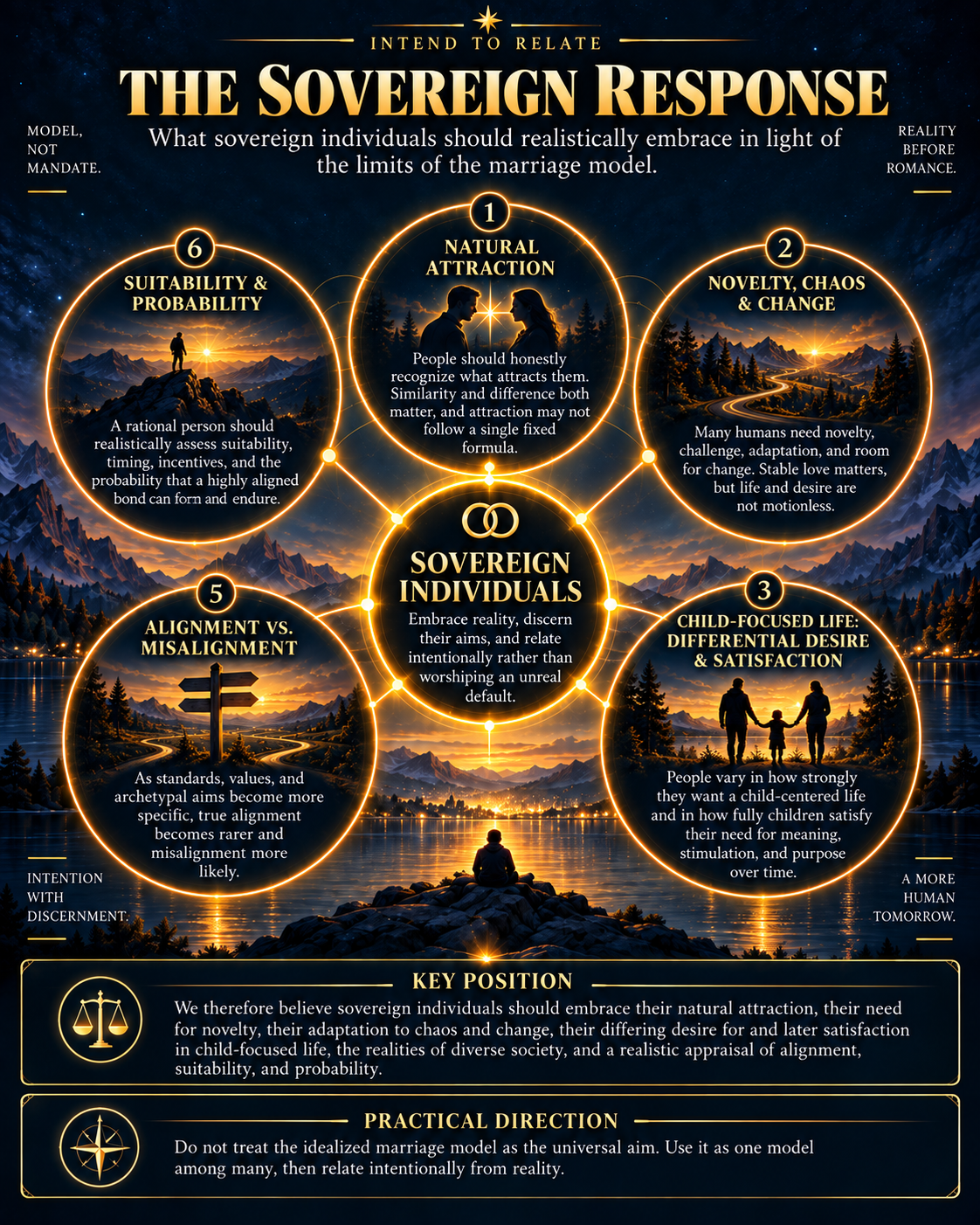
Those preferences deserve to become questions we can actually discuss. How much stability do we want? What kinds of novelty are welcome? How central do we want children to be? What do we hope to experience together, and what space do we need for ourselves?
“Plato is not God,” the episode remarks. Within this story, the line challenges the authority we give an idealized picture. Calling an arrangement ideal does not establish that its particular combination of features is ideal for everyone.
A useful next step is to separate the elements we value from the package in which we first encountered them. We may value loyalty, affection, domestic life, parenting, spiritual connection, or adventure. Which of those matter to us? Which belong together in the relationship we intend? Which have we accepted without much examination?
The economics of the hill
As we see more clearly, the house rises. A hill forms beneath it, and the climb begins to look demanding.
Here we borrow the image of Sisyphus. In Albert Camus’s The Myth of Sisyphus, Sisyphus repeatedly pushes his stone uphill, only to see it fall. Camus closes by asking us to imagine him happy. faculty.uca.edu
The episode expressly takes that image into a different inquiry: have we chosen the aim toward which we are exerting ourselves? That question belongs to our relational application of the story.
The economics of this hill includes what we invest, what we give up, what we expect to experience, and how attainable the desired alignment may be. It also includes the quality of the climb itself.
For someone who wants to build a family, care for children, or sustain a long partnership, much of the work may express what makes life valuable. The effort can be part of the wanted experience. A demanding commitment does not become misguided simply because it requires something from us.
Someone else may discover that the imagined destination contains things they admire but do not want to organize their own life around. They may have been training for a climb whose purpose they never settled.
We therefore need to consider both the destination and the life involved in pursuing it. Can I participate in this honestly? What would maintaining this arrangement ask of the other person? Are we expecting the same things from the work we propose to share?
The episode leaves room for people to choose the hill. It also leaves room to question the route, change the destination, or decline a prospective climb. Exertion alone cannot make that choice for us.
The Old King above the house
The story then turns our attention to the figure above the house. We had placed ultimate meaning there. Now we ask whether what we installed was the Old King: an inherited command telling us what our life must look like.
The Old King is a symbol within this story. It helps us examine what happens when a particular arrangement acquires authority beyond question. A familiar expectation can begin to sound like an obligation simply because it has always been presented that way.
Tradition may contain things we deeply value. A person may examine an inherited form and freely affirm it. The question is whether we have room to make that judgment, including the possibility of choosing differently.
For a moment, our imagined situation seems cramped. The old dangers remain behind us; an increasingly difficult ascent stands ahead. We appear to have two directions available, neither of which we can wholeheartedly choose.
Then the storyteller pauses.
That pause matters. It creates space to examine the alternatives we have been treating as exhaustive. What else might we intend? What capacities would help us begin?
The camel, the lion, and the child
In Thus Spoke Zarathustra, Nietzsche describes three metamorphoses of the spirit: the camel, the lion, and the child. The camel takes on weight. The lion confronts the inherited command of “thou shalt” and makes space for freedom. The child represents a new beginning and the affirmative activity of creation. The lion’s refusal opens a possibility that the child can begin to inhabit. Project Gutenberg
Intend to Relate borrows those images for its own purposes. In our adaptation, we want all three capacities available as we move through life.
| Image | Capacity we want available | A relational question |
|---|---|---|
| Camel | Carrying responsibilities we value | What am I willing to sustain because it matters to me? |
| Lion | Examining and refusing demands | Does this expectation have a rightful claim on me? |
| Child | Playing, beginning, and creating | What could we make or enjoy together? |
Sometimes the camel is exactly what a relationship needs. We have chosen something that takes patience, attention, and work. We want the strength to participate in it well.
Sometimes we need the lion. An expectation has been treated as binding without being examined. We need the courage to ask what supports it and whether we accept it.
And sometimes we have carried enough and fought enough for the moment. We need to be able to begin an experience that is wanted in its own right. Play gives us a way to explore what a relationship could become.
The episode wants to accelerate that movement toward creation without pretending that change happens instantly. There is a danger in making enjoyment permanently conditional on completing every burden and winning every argument with the Old King. A life spent entirely in opposition can remain organized around the thing it opposes.
So we ask whether some room for living can open now. Perhaps it begins with a different conversation, a shared experiment, or permission to enjoy something together without requiring it to justify an entire life plan.
We can retain the capacity for responsibility while making more room for play. We can question an expectation without turning rebellion into our whole identity.
All three capacities across all three worlds
The episode carries these capacities into the three worlds of the Intend to Relate framework: the natural world; the business and transactional world; and the divine world of meaning, ethics, and intention.
There is no assignment of one creature to each world. We may need to carry, question, and create within any of them.
Consider a couple deciding how to organize their life together. They have desires, habits, and limits. They also have practical arrangements involving time, effort, money, and expectations. They attach meanings to those arrangements: what care looks like, what fidelity means to them, and what kind of shared life they hope to make.
In developing this application, all three capacities can help. The camel sustains a commitment they value. The lion examines a role that has been taken for granted. The child helps them imagine a different way to spend time together or create a shared practice.
The same person may need each capacity in the course of one conversation. These images give us ways to notice what a situation asks of us without assigning ourselves permanent animal identities.
From an admired picture to a relationship agreement
This is where the episode’s inquiry becomes useful to the broader work of relationship agreements. Before deciding how to organize a relationship, we need some understanding of what the participants intend to make possible.
Imagine two people who both say they want a stable relationship. One means a shared home, frequent time together, and a life substantially organized around parenting. The other means dependable affection and clear commitments alongside considerable independence. They may sincerely endorse the same word while anticipating different lives.
For this illustrative pair, a label has left several questions unanswered. What time together do they actually want? What responsibilities are they offering to share? How much independence matters to each? Which expectations can they affirm, and which require further discussion?
The work begins to move from admiring a picture toward describing participation. An agreement can make an intention more explicit. It also gives the participants something they can revisit as experience develops.
That becomes especially important when a relationship already exists. The episode includes a clear qualification:
“Where we’ve already made commitments to other people, we deal with those honestly.”
Discovering a different preference does not make another person’s understanding disappear. It gives us something to address. Applying the episode’s approach may involve acknowledging what was promised, explaining what has changed, listening to the other person’s position, and considering what can be renewed or revised.
The other person has judgment and intentions of their own. They may welcome the proposed change, negotiate something different, or conclude that the new arrangement is not one they want. The freedom we seek has to leave room for that encounter.
The listening relationship makes the same offer
The episode’s opening and closing give a small example of the method.
At the beginning, we ask for a limited relationship: consider some ideas while retaining judgment and critical thinking. The listener’s assent concerns participation in an inquiry. It does not require agreement with the conclusions.
At the end, we expressly acknowledge that this particular relationship is complete. The listener remains free to accept, reject, revise, or carry an idea forward.
The form matters because a project questioning inherited authority must also leave its own ideas open to examination. The invitation is to think with us. As the episode says, we do not seek a deed to your mind.
That brings us back to the hill. Perhaps, after considering it, you want to climb. Perhaps you want to carry substantial responsibilities because they express something you cherish. Perhaps you want a different balance, or you are only beginning to ask what the alternatives might be.
The next part of the season returns to valuation, rosters, archetypal aims, and the tools through which those possibilities can become more explicit. For now, the question is available:
What do we intend to do with the life and relationships we are preparing to build?
Key ideas to carry forward
- A relationship’s success does not remove change, absence, or pain.
- An idealized arrangement still needs to be evaluated against the participants’ values.
- The work of a relationship can be part of what makes it worthwhile; its cost still deserves honest consideration.
- Carrying, questioning, and creating are capacities we can keep available together.
- Choosing differently requires honest engagement with commitments already made.
Show Notes and Chapters
| Time | Chapter |
|---|---|
| 00:00 | Introduction |
| 01:15 | The Ideal Model |
| 03:30 | The Unwanted Climb |
| 06:08 | Spirit Transformations |
| 07:20 | Embracing All Capacities |
| 09:15 | Freedom to Choose |
Full Transcript
Formatted into paragraphs from the supplied episode transcript, with spoken wording preserved. Chapter headings and timestamps are included for navigation.
00:00 — Introduction
You're listening to The Intend2Relate Podcast, published by Intend2Relate, LLC. Intend2Relate is interested in expanding human freedom and creativity in relationships.
We would like to enter into a podcast listener relationship involving a short term, limited power exchange dynamic, where you consent to considering some ideas as we present them, while retaining your judgment and critical thinking.
We do not seek a deed to your mind in this relationship. We ask for your assent to go on a journey with us into some ideas and tools regarding relationships. If you assent, let's Intend2Relate.
We're back with the Intend2Relate Podcast, Season 2, Episode 2, and suddenly we're in a different world from the one we were in earlier today. Earlier, I changed the way we were going to go about things. Now I'm in the story, telling it without a script, with just a general outline and the conceptual framework for the season. And I'm encountering it as I go.
Right now I'm outside, it's dark, crickets are chirping. I'm alone, speaking into a recorder. The moon is shining. I'm in Austin, Texas. I'm not afraid. I know this area. I have a relationship with the natural environment I'm in right now.
01:15 — The Ideal Model
But suddenly we're back in our story where we left off earlier today, looking at that idealized cognitive model of the perfectly aligned married couple. I don't know what you apprehended when you heard that and had some time to think, but there's a lot there.
Imagine that model is real right in front of you, their house, their family, everything aligned. You can even see the godhead above them, whatever ultimate meaning they share. Now imagine time moving very fast. I see two things that even this perfect picture cannot avoid.
That little boy grows up and leaves the house. That's what they wanted for him, right? But there's an absence now. For parents whose lives have been organized around their children, there's a new life to figure out.
And eventually, unless the couple dies at the same time, one will be there to lose the other.
Now remember, nothing went wrong with that marriage. They remained husband and wife. Their child grew up. We gave the model everything it asked for, and there was still pain.
I'm not making this a story about endings. I'm peeling back the picture. Even when it's perfect, even when the arrangement succeeds on its own terms, it doesn't remove change, absence or pain.
So we're not choosing between a perfect, painless life and all the imperfect alternatives. That painless option was never there.
And there's something else. I don't know that I would even want a life with no movement in it. No friction, no fluctuation, no negotiation, no seduction, no play. The dance is wanted, right? There's a chaos element. Not necessarily destruction, but the unpredictability of creativity. There's novelty, there's diversity of experience. Different people want different amounts.
So now we can start asking what we actually value. How much stability? How much novelty? How much room for chaos, creativity, and different experiences? How much of our life do we want organized around children? What else do we want from life?
That perfectly fixed picture is useful as a model, but it's not necessarily what each of us wants to live inside. Plato is not God. Calling something an ideal doesn't establish that its particular arrangement is perfect for you.
03:30 — The Unwanted Climb
Now in our story, I want you to imagine something happening as that picture begins to break apart. We're gaining some wisdom. We're seeing what the model leaves out, even when everything lines up.
And as we see that, a hill starts rising beneath the house. The house gets higher. The hill gets steeper. We would have to do so much to climb it.
Now we have the image of Sisyphus, the figure Albert Camus wrote about, pushing the stone up the mountain, only for it to roll back down again.
Camus asks us to imagine Sisyphus happy, but I'm borrowing the image here to ask a different question.
Is this a hill we even want to climb? Because I might be preparing to do all that work for an aim I never actually chose. I might value parts of it, but not the whole arrangement.
And even if I want it, how attainable is it? What would it take to find that alignment and then maintain it?
What am I investing? What am I giving up along the way? What do I expect to receive and experience?
That's the economics of this hill. Not just whether I can climb it, but whether I value what I'm climbing toward and what the climb itself is going to be like.
Some people would choose it. They would find meaning in the work, the family, the responsibility. That's part of what they value.
Someone else might want a different balance, more novelty, different forms of connection, a different relationship between responsibility and play.
What's breaking apart isn't the possibility of love or a good marriage. It's the assumption that this one picture has already settled what each of us should want and what we should be willing to invest in it.
And now in this story, look again at what's above the house. I would posit that what we put there wasn't God. It was the Old King, an inherited command telling us what our life must look like.
So here we are, in front of us a steep hill toward a fallen idol, the Old King staring down at us, behind us the snakes and wolves we left.
We can't go forward like this. Do we have to go back? Well, luckily, I'm the one telling the story, and I get to pause. So we're going to have a little story time.
Before we go further into the shadow, I want to introduce another way of approaching it. There's work to do, yes, but I don't want us to assume that the whole journey has to be grim.
Hold that image of the hill, all that effort, the risk of rolling back down, a goal you may not even want. Now imagine you've been getting ready for the climb, training yourself, taking on more weight, becoming stronger.
Then you stop and ask, wait, why am I carrying this? Where am I actually going?
06:08 — Spirit Transformations
That brings us to Nietzsche. In Thus Spoke Zarathustra, he describes three transformations of the spirit, the camel, the lion, and the child.
The camel is the load bearing spirit. It takes on heavy things and tests its strength.
Then comes the lion. The lion confronts the command thou shalt and asserts, I will. It creates freedom from imposed demands, making room for something new.
But winning that freedom is not yet the same as creating new values. That's where the child comes in. The child represents a new beginning, play, creation, and a yes to life. Not just rejecting what came before, but being able to begin.
Now, we're going to borrow that image for our own framework.
And for our purposes, I want to accelerate that movement toward the child. Not pretend there's no work to do. Not pretend we can transform everything in an evening.
But I don't want us spending the rest of our lives carrying burdens or fighting the old king before we finally give ourselves permission to live.
We want to get to the play, to the creativity, to the possibility of choosing something because we actually want it. And we don't need to throw away everything that came before.
07:20 — Embracing All Capacities
In our use of this model, we want all three available within us. The capacity to carry what we choose to carry. The courage to question and refuse. The freedom to play and create.
Sometimes I need the camel. There's something I care about and it takes work. I want to be strong enough to do it.
Sometimes I need the lion. Something is demanding my obedience and I need to ask whether it has any rightful claim on me.
And sometimes I need the child. I've carried enough and fought enough for the moment. Now, what could we make? What could we enjoy?
That's how I want us to approach this as we move through our three worlds. The natural world, the business and transactional world, and the divine world of meaning, ethics, and intention.
Not one creature assigned to each world. All three capacities available as we move among them.
Each of us gets to decide how we want to be weighted. Maybe you choose a life with substantial responsibilities.
You find meaning in carrying them. There's nothing wrong with that. Maybe as you grow, you want to become a little more playful. A playful little devil even. You can be responsible without making burden your entire identity.
You can be free without making rebellion your entire identity. And you can play without forgetting the other people you're relating to.
The aim is to live, to enjoy, to create something that aligns with what we value.
Some hills are worth climbing, some burdens are worth carrying, but suffering through a climb does not by itself make the destination yours.
And when that climb doesn't align with our values, we can question it, choose another path, or decline to begin it.
Where we've already made commitments to other people, we deal with those honestly.
So we're not trapped between the old king in front of us and the snakes and wolves behind us. We can pause, look around, and begin choosing differently.
09:15 — Freedom to Choose
Now we're back to valuation, back to our rosters, back to the different archetypal aims and dynamics we might actually choose. That's where we're going next.
On our next call, we'll get a little more playful. We'll talk about some more archetypal aims, different things we might actually want, and begin working with our tools and models. Not just to understand the hill, to decide what we intend to do.
For now, I'm still outside, the crickets are still chirping, and that's enough for tonight.
09:45 — Closing
You've been listening to The Intend2Relate Podcast, published by Intend2Relate, LLC. Our short-term podcast listener relationship is now complete.
You retain your judgment, your critical thinking, and your freedom to accept, reject, revise, or carry forward any idea we have explored together.
We do not ask you to surrender your mind to us. We hope only that something here has helped you see yourself, another person, or a relationship with greater clarity and possibility.
Thank you for going on this journey with us. Until next time, be free and be good to each other intentionally.
Continue the Conversation
Which parts of your picture of a good relationship have you consciously chosen? Which responsibilities would you gladly carry? Where could you make room for a little more play?
Questions, disagreements, and experiences are welcome. We are interested in what you make of the ideas and what happens when you try to put them into practice.
If you are new to Intend to Relate, begin with Season One and the accompanying Ghost articles for the conceptual foundations, then continue through Season Two’s explorations. Visit the project website, explore the Primer and other writings, or join the YouTube community.
Intend to Relate is interested in expanding human freedom and creativity in relationships through clearer understanding, deliberate participation, and relationship agreements.
Be free, and be good to each other—intentionally.
Written by L’republique Z’jip. Published by Intend2Relate, LLC. Philosophical and educational discussion; not individualized professional advice.