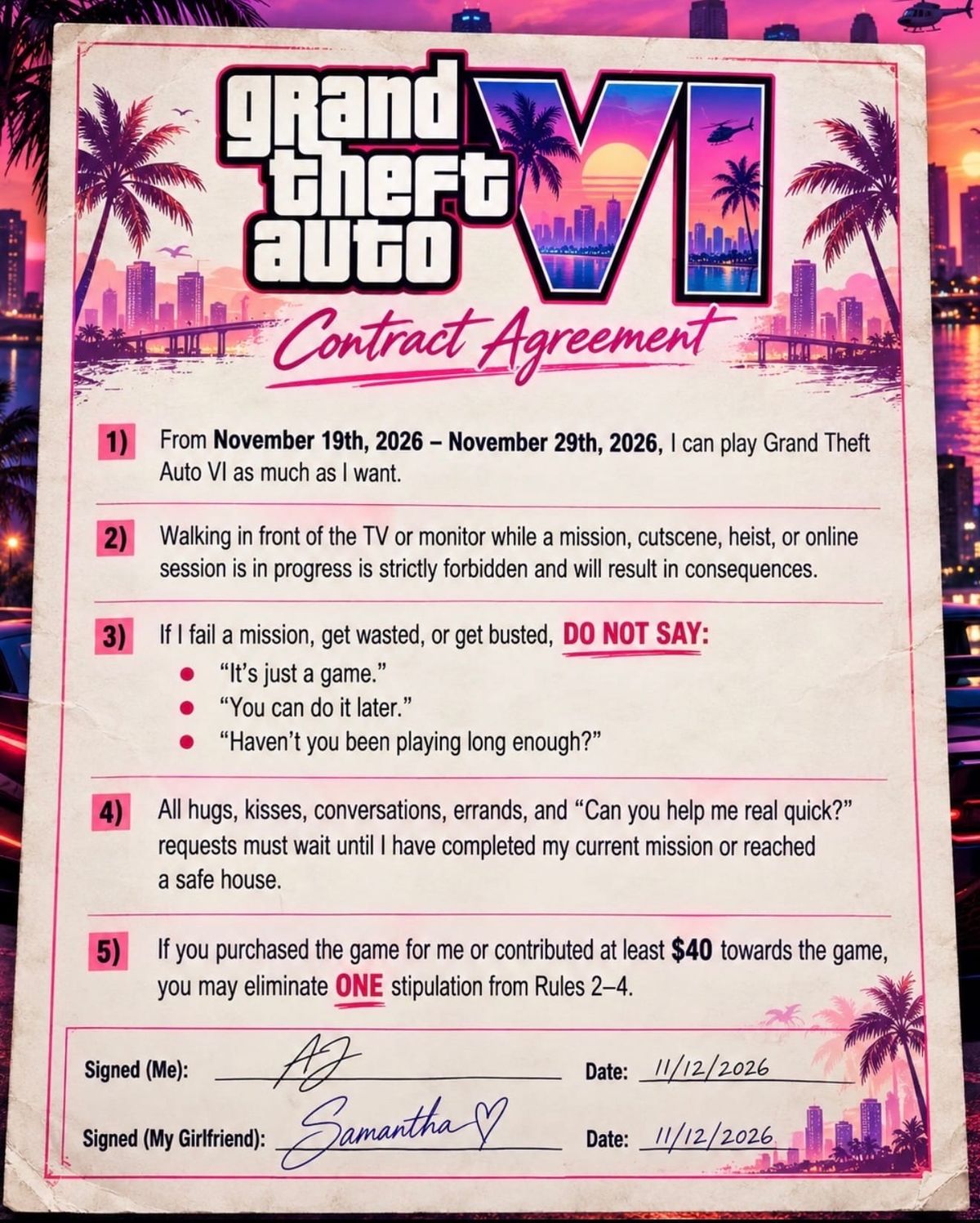
When a ten-day gaming marathon becomes an exercise in intentionality, negotiation, and relational governance.
At Intend to Relate, we are interested in expanding human freedom and creativity in relationships.
Sometimes that means exploring philosophical questions about love, identity, and the nature of shared existence.
And sometimes it means examining a contract designed to protect a man's right to play Grand Theft Auto VI without interruption.
We recently encountered an amusing example circulating on social media: a colorful, signed "Grand Theft Auto VI Contract Agreement," establishing ten days of unrestricted gaming and several rather ambitious restrictions on the other participant.
Our initial reaction?
We applaud the initiative.
Our second reaction?
We have some drafting comments.
And beneath the humor, there is a surprisingly useful example of what relationship agreements are intended to accomplish.
I. The instrument: Five rules for domestic peace
The agreement establishes a ten-day period, November 19–29, 2026, during which one participant may play GTA VI as much as desired.
It then establishes several conditions:
- The gaming participant enjoys broad freedom to play during the designated period.
- Interrupting the television or monitor during specified gaming activities is prohibited.
- Certain remarks—including "It's just a game"—are forbidden following an unsuccessful mission.
- Affection, conversations, errands, and requests for assistance must wait until a mission is completed or a safe house is reached.
- A contribution of at least $40 toward the game entitles the other participant to eliminate one restriction from Rules 2–4.
The document includes signatures and dates.
It is a wonderfully playful example of something we regularly discuss: people attempting to articulate the terms of their participation in a relationship.
But the interesting questions begin when we look beyond the signatures.
II. The problem the agreement is trying to solve
Imagine the familiar situation.
One person is deeply engaged in an activity. The other wants attention, assistance, affection, or companionship.
Neither necessarily intends to harm the other.
But their expectations conflict.
One thinks, "I'm in the middle of something important to me."
The other thinks, "Surely you can stop playing for a minute."
What follows?
Irritation. Interruption. Resentment. Perhaps an argument about whether gaming is a legitimate use of time.
The GTA agreement attempts to address this conflict prospectively.
Rather than wait until the disagreement occurs, the participants can discuss what they expect from one another.
This is one of the central ideas behind Intend to Relate.
We can make our intentions intelligible before conflicting understandings become recurring injuries.
The activity itself need not be universally important. It matters that the participants understand its importance to the person undertaking it.
III. The natural world: Gaming, affection, and competing desires
Our framework begins by considering the people involved—their experiences, desires, needs, and intentions.
One participant wants an immersive gaming experience.
The other may want companionship, affection, shared time, or ordinary household cooperation.
Neither desire automatically defeats the other.
A useful agreement begins by recognizing both.
Perhaps ten days of unusually extensive gaming is perfectly acceptable to both participants.
Perhaps one partner enjoys watching.
Perhaps the other has a project of their own and welcomes the independence.
Or perhaps the agreement would produce a very different experience from what one participant imagined.
We cannot determine those things from the document alone.
That is why an agreement should emerge from actual communication rather than merely presumed assent.
And why a signature, although potentially useful evidence of agreement, does not tell us everything about the circumstances of participation.
IV. The business world: Forty dollars and a market in concessions
Now we arrive at our favorite provision.
Rule Five.
For $40, the other participant may eliminate one of the restrictions.
This is magnificent.
The drafter has effectively created a mechanism for purchasing a contractual concession.
There is a proposed exchange. There are alternative terms. There is a price.
But let's distinguish several things.
A contribution toward the game is not automatically legal consideration for every promise in the document. Nor does the presence of signatures establish that this is a legally enforceable contract.
Indeed, the indefinite consequences provision and other questions about the instrument would complicate any serious legal analysis.
But we do not need an enforceable legal contract to appreciate the underlying relational idea.
People can negotiate the conditions of their participation.
Time has value.
Attention has value.
An uninterrupted experience may have value.
So may the other person's willingness to accommodate it.
We should not confuse recognizing these values with assigning a monetary price to the worth of either person.
The question is what each participant is offering, receiving, or foregoing—and whether the arrangement is understood and acceptable.
Rule Five introduces something else: optionality.
The parties do not have to accept every original term. They can negotiate.
We would simply suggest that a particularly thoughtful drafter might allow the other participant to propose amendments without first paying forty dollars.
V. The divine world: What kind of relationship are we creating?
Now we move beyond the mechanics.
Suppose the agreement works exactly as written.
The gamer plays for ten days.
The other participant avoids interruptions.
Nobody violates a rule.
Has the relationship succeeded?
Perhaps.
But compliance alone does not tell us everything about the quality of the shared undertaking.
Our divine-world inquiry concerns the values, meaning, and identity expressed through what the participants create together.
Does this agreement express playfulness?
Mutual generosity?
A shared appreciation for each other's interests?
Or does it express unilateral entitlement dressed up as a contract?
The document itself cannot answer that question.
Context matters.
The same provision might be an affectionate inside joke in one relationship and a source of genuine resentment in another.
We are not merely asking whether someone followed the rules.
We are asking what kind of "we" the rules are helping to create.
VI. Our drafting comments
As an exercise in relational drafting, the document offers several opportunities for improvement.
First: Define the consequences.
Rule Two threatens unspecified consequences for interrupting the screen.
That is an invitation to conflicting understandings.
Consequences should be intelligible, proportionate, and consistent with the participants' freedom and safety.
Second: Include reasonable exceptions.
Rule Four postpones affection, conversation, errands, and requests for help.
But what about emergencies? Urgent responsibilities? Situations that cannot reasonably wait?
A clear agreement can protect uninterrupted leisure without pretending that ordinary responsibilities disappear.
Third: Consider reciprocity.
If one person receives a designated period for an important personal interest, what arrangements would support the other's interests?
Reciprocity does not necessarily require identical benefits.
It requires understanding what each participant considers acceptable.
Fourth: Establish a review process.
The parties might agree to check in after three days.
Is the arrangement working?
Were the expectations realistic?
Has something changed?
An agreement need not be frozen merely because someone signed it.
Fifth: Clarify the scope.
"As much as I want" is entertaining language.
But does it include every waking hour? Does it supersede previously undertaken obligations?
An agreement becomes more useful when its scope is understood.
VII. The feedback loop: What happens after the game begins?
At Intend to Relate, we emphasize that agreements are not simply documents.
They can be instruments for learning.
We articulate our intentions.
We participate.
We encounter the consequences of our arrangements.
We receive feedback.
And we use what we learn to revise our understanding and, where appropriate, our rules.
Perhaps the gamer discovers that ten days of unrestricted gaming is more than they actually enjoy.
Perhaps the other participant discovers that protected independent time is a wonderful arrangement.
Perhaps both discover that a shared gaming session is more enjoyable than the original plan.
Or perhaps the agreement exposes an unresolved difference about how the participants value time together.
All of those outcomes provide information.
The question is whether the participants are willing to learn from it.
VIII. Our verdict
We appreciate this agreement for what it appears to be: a humorous, creative attempt to organize expectations around an anticipated experience.
We would not treat it as a model legal contract.
Nor would we assume that every restriction reflects a serious demand.
But it illustrates an important possibility.
People can talk about their desires, negotiate arrangements, and create rules for their shared participation without waiting for a conflict to force the conversation.
That can apply to gaming.
It can apply to vacations, hobbies, household responsibilities, creative work, social activities, and personal independence.
And yes, it can apply to intimacy and romantic relationships.
The goal is not to turn every human interaction into a contractual obligation.
It is to make more of our relationships intentional, intelligible, and responsive to the people actually participating in them.
So we offer our congratulations to the drafter for the initiative.
And perhaps a few friendly amendments.
Your turn
Would you sign this GTA VI agreement?
Would you negotiate the $40 provision, the interruptions clause, or the postponement of affection?
And what activity in your own life might benefit from a playful, mutually understood agreement?
We would love to hear your thoughts.
Until next time, be free, and be good to each other—intentionally.
Source: Original Instagram post, shared for commentary and discussion.
This article offers relational and educational commentary, not legal advice. Intend to Relate does not claim authorship of the original GTA VI agreement or affiliation with its creators or the game publisher.