Part One — A metaphor, an artistic experiment, and the beginning of a much larger story.
On October 21, 2026, Intend to Relate shared a little football with the world.
Not a game. Not a prediction. Not a commentary on the NFL.
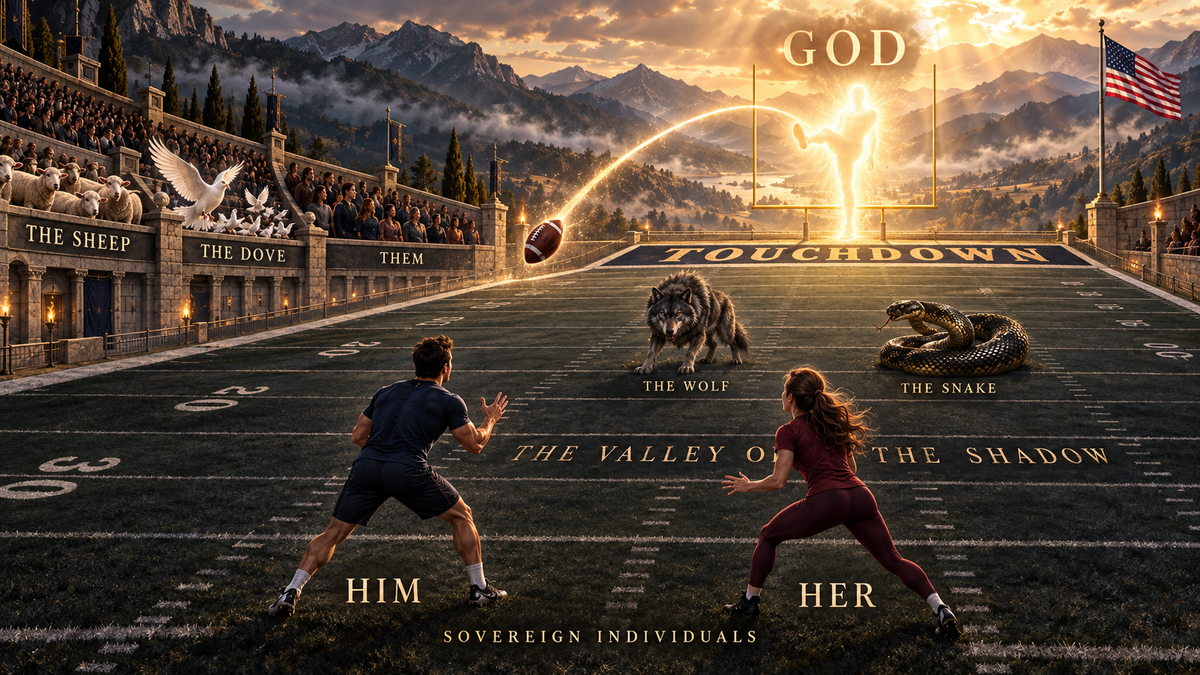
A football field populated by sovereign individuals, wolves, snakes, sheep, doves, crowds, America, and God.
And a football flying across the Valley of the Shadow.
We also brought a little Sandstorm into the picture. Because sometimes, when you're trying to develop a philosophical framework about the entirety of human relationships, a football stadium and some good electronic music seem like perfectly reasonable places to begin.
Original Instagram post available here.
There's a serious idea underneath the playfulness.
Actually, there are quite a few serious ideas. Some of them are already developed in the Intend to Relate podcasts and journal. Others belong to forthcoming volumes of the canon, works still being written, and discussions we expect to have over the years ahead.
Today, however, we're not going to explain everything.
We want to introduce this particular piece of our social-media artwork, explain a little about what we were thinking, and preserve some of the circumstances surrounding its original publication.
This is also the beginning of a larger story—one that will unfold across additional journal entries, explanations, and reflections.
1. First, the football field
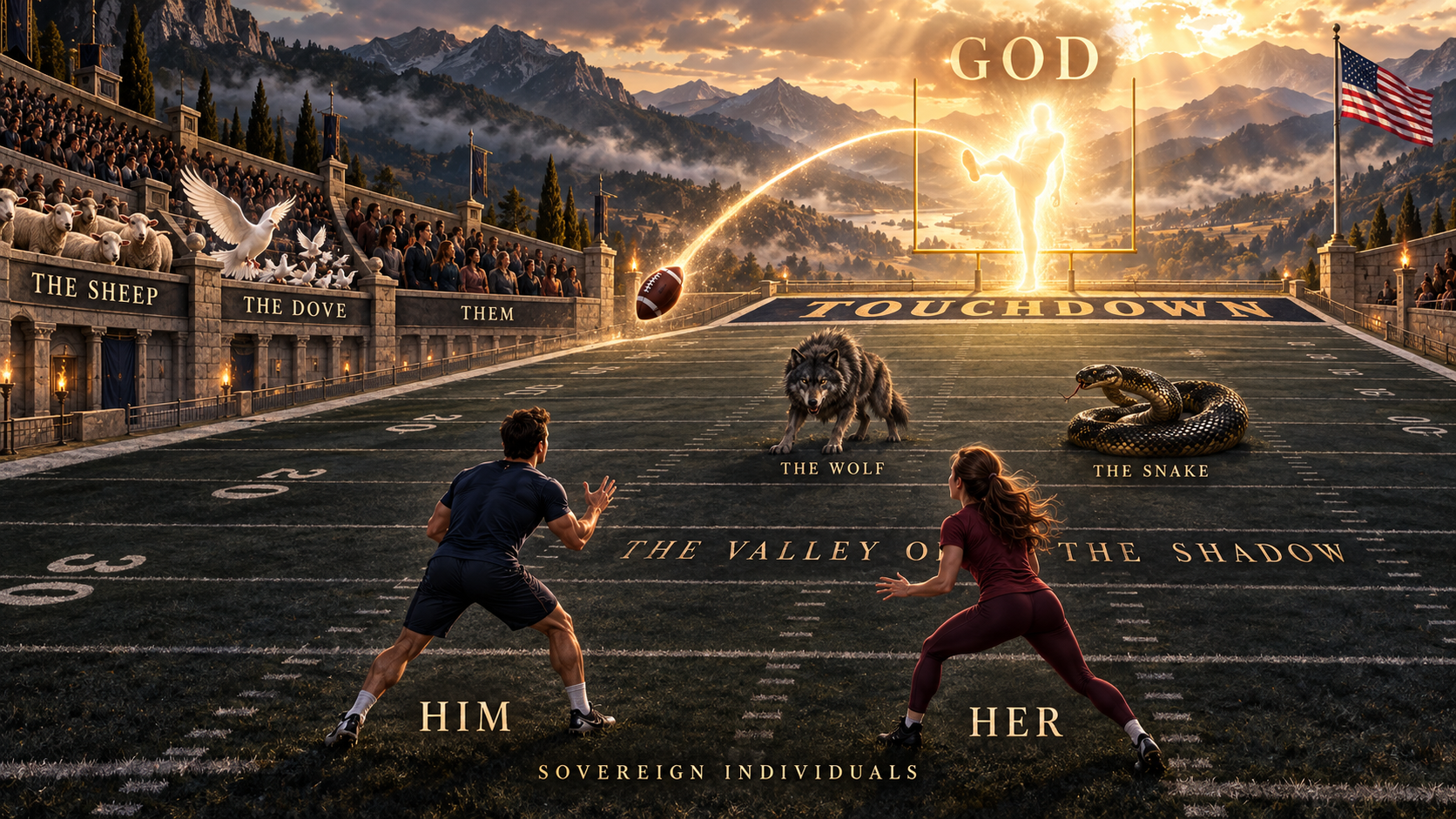
Take a look at the field.
At the near end stand Him and Her, identified as sovereign individuals.
Across from them, in the Valley of the Shadow, stand the Wolf and the Snake.
Beyond them is the end zone, with the word Touchdown beneath a brilliant figure representing God.
Along the sidelines sit the Sheep, the Dove, and Them—the crowd.
An American flag flies above the stadium.
And overhead, a football arcs toward the far end of the field.
The elements are drawn from the nine-volume canon of Intend to Relate:
- Volume One: To Him
- Volume Two: To Her
- Volume Three: To Them
- Volume Four: To the Wolf
- Volume Five: To the Snake
- Volume Six: To the Sheep
- Volume Seven: To the Dove
- Volume Eight: To America
- Volume Nine: To God
There are many possible relationships among these elements, and we're going to explore them in different ways as the work develops.
For now, notice something simple.
The individuals are on the field.
They're not merely spectators. They're participants.
They have their own experiences, intentions, judgments, capacities, and limitations. They encounter one another and the world around them.
What happens next is not entirely up to either of them.
That is an important starting point for our philosophy of relationships.
We can intend. We can choose. We can propose. We can act.
But we do not get to decide the whole world, and we do not get to decide what another sovereign individual intends or chooses.
The game, so to speak, is bigger than either participant.
2. Why the Wolf and the Snake?
If you've been following our podcasts, you've already encountered the Wolf and the Snake.
We have used these figures to investigate different aspects of human conduct, including aggression, coercion, deception, falsehood, and the difficulties of understanding what we actually encounter in another person.
The Wolf and Snake are not intended as permanent biological classifications of people.
Nor are they a suggestion that everyone we encounter belongs neatly inside one of nine boxes.
They're archetypal tools.
And tools are useful only when we understand what they're for, what they can tell us, and what they cannot.
Consider someone who approaches you aggressively, threatens you, or attempts to impose an unwanted undertaking.
We may find the Wolf useful for examining that encounter.
Or consider someone who misleads you, conceals material information, or constructs an understanding that serves their interests through falsehood.
The Snake gives us another perspective.
But a person's conduct on one occasion does not necessarily explain the totality of that person, every other relationship they maintain, or what they might become.
And we should be examining ourselves, too.
There are circumstances in which the Wolf or Snake may be found in our own behavior, our own thinking, or the explanations we give ourselves.
We are interested in understanding conduct and relationships—not simply naming villains.
Likewise, the Sheep and the Dove invite different inquiries, including questions about vulnerability, care, peace, and the ways people participate in the world.
The crowd introduces still another dimension: the relationship between individuals and the many people, institutions, audiences, and imagined others we encounter.
Then there is America.
And God.
Those are rather large subjects.
We have entire forthcoming volumes devoted to them.
So perhaps you can see why we're not going to attempt the complete explanation inside one football meme.
3. The Valley of the Shadow
There is another detail worth noticing.
The field itself is marked as the Valley of the Shadow, with the football traveling toward the light.
The imagery naturally calls to mind Psalm 23 and its valley of the shadow of death, although our illustration is not intended as a literal interpretation of the biblical passage.
We've borrowed a familiar image and placed it into another inquiry.
What happens as we make our way through human life?
What do we encounter?
What threatens us? What deceives us? What comforts us? What helps us create something meaningful?
What do we do when the relationships through which we understood our lives change, disintegrate, or end?
And what are we actually aiming toward?
We have already explored some of these questions in Season Two of the original Intend to Relate podcast, including our discussions of relational ascent, disintegration, the void, and the constellations of care that may help us find our footing again.
The football illustration places some of those concerns into a single imaginative scene.
But it also raises a problem.
Where exactly are we trying to go?
And whose idea of a touchdown are we pursuing?
We could make the mistake of deciding that every successful relationship must resemble one particular destination: marriage, family, wealth, sex, recognition, salvation, or any number of other things people might value.
That's not our position.
In fact, one of the central themes of Intend to Relate is that people should examine the aims they have inherited, the purposes they actually value, and the arrangements they intend to create.
The touchdown is therefore part of the image—not a universal prescription for everyone's life.
And perhaps the most interesting thing about this football is that it has already left someone's hands.
The ball is in motion.
Where it lands, what happens next, and what meaning the participants make of the encounter are all still open.
4. A little Sandstorm, and a reminder about our methods
The original short-form video paired the football illustration with a representation of the forthcoming nine-volume canon.
It also carried a little warning:
“Metaphors, archetypes, idealized cognitive models, and maps are not the territory ... But simmer on ’em.”
We meant that.
A football field is not a human relationship.
A wolf is not an exhaustive account of an aggressive person.
A snake is not an exhaustive account of someone who deceives.
And no diagram of a marriage, a crowd, a household, or an entire social order can fully reproduce the experience of the people participating in it.
Still, metaphors can help us think.
They can make relationships visible, offer comparisons, expose assumptions, and invite questions we might otherwise never ask.
Sometimes they are serious. Sometimes they're playful. Sometimes they're a little absurd.
We're quite comfortable with all three.
And yes, that brings us to Darude's Sandstorm.
For those who remember the electronic music and sporting-event culture of earlier decades, it carries a particular kind of energy. It also fits the slightly ridiculous spectacle of putting our developing philosophical canon into a football stadium.
Not every creative decision needs to become a solemn proposition in a philosophical treatise.
Sometimes the music is part of the fun.
Sometimes the fun helps make a complicated idea accessible.
And sometimes we discover, after creating something playful, that it has rather more conceptual possibilities than we initially expected.
That's one of the reasons we are documenting this piece.
5. What else was happening on October 21?
The football illustration did not emerge in isolation.
At the time, Intend to Relate was developing the early materials for Volume Eight: To America, including an inquiry into racism and the use of some of our existing conceptual tools in that context.
We had begun examining how ideas about ancestry, identity, power, confidence, and collective belonging might be used responsibly—or distorted into claims of superiority and exclusion.
Those inquiries were already leading us into uncomfortable territory.
On October 21, the same day associated with the football publication, we also encountered disturbing communications on Instagram.
Those communications, as documented in our contemporaneous records, included racist language, threats, and references to child abuse.
We reported the relevant conduct through Instagram's reporting mechanisms.
We also discussed the encounter in our project group chat, where we had already begun experimenting with applying the Wolf and Snake archetypes to situations we encountered.
(article continued below / member log-in required / for adult readers only)