A guided path through the framework’s early work—from the experience of relating to feedback loops, sovereignty, practical tools, and the relationship with our future selves.
Someone encountering Intend to Relate through a short video, a particular agreement, or one of our more playful posts could reasonably ask: where does all of this fit together?
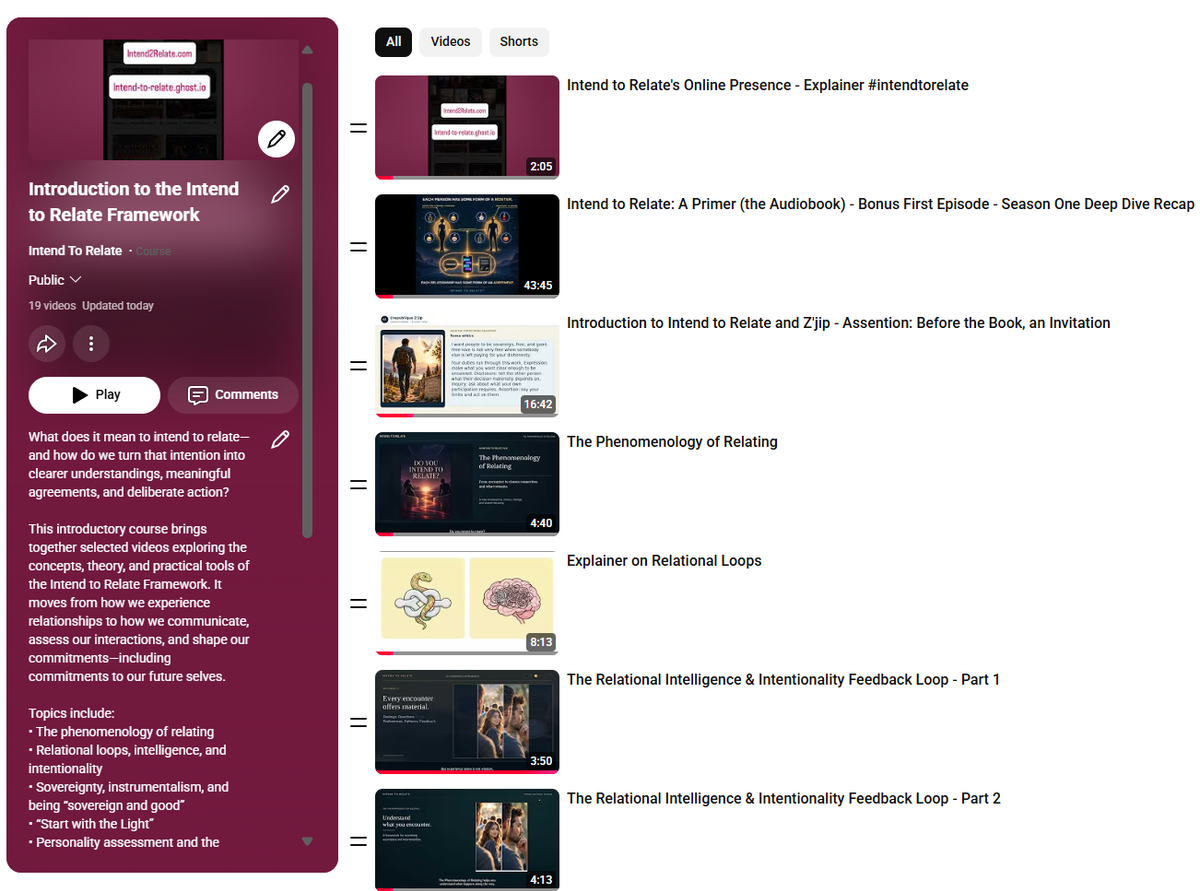
We have updated our YouTube course, Introduction to the Intend to Relate Framework, to provide a place to begin. It brings selected videos into a sequence that moves through the project’s foundational questions and toward practical applications. The collection draws from our early work, and a newly structured course is in development. In the meantime, this is an accessible route into the ideas already available.
Watch the updated introductory course on YouTube.
The course was updated on November 9, 2026. This article offers a reading guide to its progression and some questions to carry into the lessons.
Why the sequence matters
A relationship agreement becomes more useful when we understand the experiences, expectations, and purposes it is meant to address. Before deciding what to write down, we need to consider what is happening between the participants, what each understands, and what they are trying to do together.
That is the broad movement of this course: experience, recurring interaction, deliberate participation, and practical application. Each stage gives the next one more context. A tool introduced near the end can be approached with the earlier questions in mind: what are we noticing, what are we assuming, and what would we like to make more explicit?
First, an orientation to the project
The playlist opens with Intend to Relate’s Online Presence — Explainer, followed by Introduction to Intend to Relate and Z’jip — Assention: Before the Book, an Invitation.
These opening entries help locate the work. Intend to Relate has several points of entry: the website, this journal, podcasts, videos, and social media. A person may arrive through any of them. The opening orientation provides a way to move from that first encounter toward a more sustained exploration.
Our website and Ghost journal serve as primary places to explore the project directly. YouTube and the podcasts make longer presentations available in other formats. For someone beginning here, the course offers a viewing sequence, while the journal provides room to slow down, examine a distinction, and return to an idea in writing.
From experience to recurring patterns
The Phenomenology of Relating introduces the experiential side of the inquiry. A useful question to bring to it is: how is this relationship being experienced by each participant?
Consider a simple illustration. One person experiences frequent messages as interest and care. Another experiences the same frequency as pressure. The messages are observable; the meaning attached to them may differ. Before the participants can make a useful agreement about communication, those different understandings need room to become visible.
The sequence then moves to Explainer on Relational Loops and the three-part Relational Intelligence and Intentionality Feedback Loop. Here the focus shifts toward interaction over time. What one person does becomes part of the situation to which the other responds. That response, in turn, affects the next encounter.
For example, uncertainty might lead one person to send more messages. Feeling pressured, the other might become less responsive. The reduced response may increase the first person’s uncertainty. Looking at the pattern gives the participants something more specific to discuss than whether either person is simply “too much” or “too distant.”
As you move through these entries, consider where observation and intention meet. What information are you receiving? How are you interpreting it? What happens when you act on that interpretation? What might you ask or express before repeating the same response?
Sovereignty, purposes, and being “sovereign and good”
The next part of the course includes Instrumentalism Sovereign and Good Among Wolves and Snakes and Start with the Light.
These titles bring the inquiry toward questions of agency and orientation. What are we trying to accomplish in a relationship? How do our purposes affect the way we approach another person? How do we preserve our capacity to choose while participating in something that involves someone else’s choices too?
“Sovereign and good” is a useful phrase to sit with because its two terms belong in the same inquiry. The capacity to make a choice leaves open the question of what choice to make, how to communicate it, and what responsibilities accompany it. Independence alone does not supply the whole answer to how we wish to relate.
For Start with the Light, a productive viewing question is: what positive possibility are we trying to make room for? An agreement can address concerns and limits while also giving expression to what the participants value and hope to build. That constructive purpose deserves attention before drafting the details.
Bringing the ideas into use
Example Problems and Sample Tools brings practical applications into view, followed by Do You Intend to Relate? Season One Recap. This is a useful point to pause and connect the earlier concepts.
A practical exercise is to choose one small, recurring misunderstanding and ask:
- What actually happens, and what meaning does each person attach to it?
- Which expectations have been expressed, and which have been assumed?
- What would each participant like to happen?
- What specific understanding could they reach and revisit?
For the messaging example, the discussion might lead to an understanding about availability, acknowledgment, or when to expect a fuller response. The point is to give the participants a concrete subject for agreement and a way to assess whether their understanding is working.
The recap provides a natural place to consolidate that movement before continuing into the more specific tools.
Assessment as an opening for conversation
The playlist then introduces the Three-Axis Power Designation and the Personality Assessment Play and Exchange.
These named tools deserve their own explanation, and the introductory video is the place to begin with their structure. As a general approach to this part of the course, consider what an assessment makes available for discussion. What does a participant say about themselves? What does the other person understand from it? Where might further inquiry be useful?
The exchange matters. A designation or answer becomes more informative when the participants can explore its meaning, its context, and whether they are using the same words in the same way. Readers interested in this area can use the introductory entry as a bridge toward the fuller materials as they explore the project.
The future self and the relational void
The course then turns toward a distinctive area of the framework: the relationship between the present self and the future self. The sequence includes The Future Self and the Relational Void, The Future Self Creditor Score, and Explainer on Keeping the Future out of the Void.
This creates another setting in which to consider intention, commitment, and follow-through. Present choices create conditions that a future self will inherit. A promise to begin, prepare, save, rest, or complete something has consequences beyond the moment in which it is made.
One way into these lessons is to examine an ordinary commitment to yourself. What exactly did you undertake? What would fulfillment look like? What resources or circumstances does it require? If the commitment needs to change, how will you recognize and address that change?
The named concepts and the Creditor Score tool provide a more specific avenue for exploring this territory. The lessons should be approached together so that the tool sits within the surrounding discussion of the future self and the relational void.
Returning to the larger picture
The closing portion revisits Sovereign and Good and Start with the Light, then ends with Deep Dive and Speculation on the Big Picture of Intend to Relate.
By this point, a returning theme may land differently. After considering patterns, practical tools, assessment, and future commitments, the earlier questions about agency and constructive purpose have more applications to work through.
The final entry offers a broader perspective. Its framing as a deep dive and speculation is worth keeping in view: exploratory commentary can prompt useful questions while the project’s own explanations and materials remain the place to examine its specific concepts.
How to use this course
If you are new to the framework, begin with the opening entries and work through the sequence at your own pace. There is no need to absorb every term in one sitting. Choose a question that matters to you and notice how the different lessons change or sharpen it.
If you already know some of the work, the playlist can serve as a route back to a particular subject. You might revisit the feedback-loop entries alongside a recurring interaction, or return to the future-self lessons when considering a personal commitment.
This remains a developing collection. Some themes appear in more than one presentation, and the videos come from different stages of our early work. The forthcoming course will provide an opportunity to revisit the structure. For now, the updated playlist makes the existing material easier to approach as a connected body of work.
The invitation is to watch, consider, question, and apply with care. Bring your own examples. Notice where an idea clarifies something and where you need a fuller explanation. Those are useful places to continue the inquiry.
Begin the introductory course on YouTube →
Continue exploring at intend2relate.com and in the Intend to Relate journal.
Member discussion: